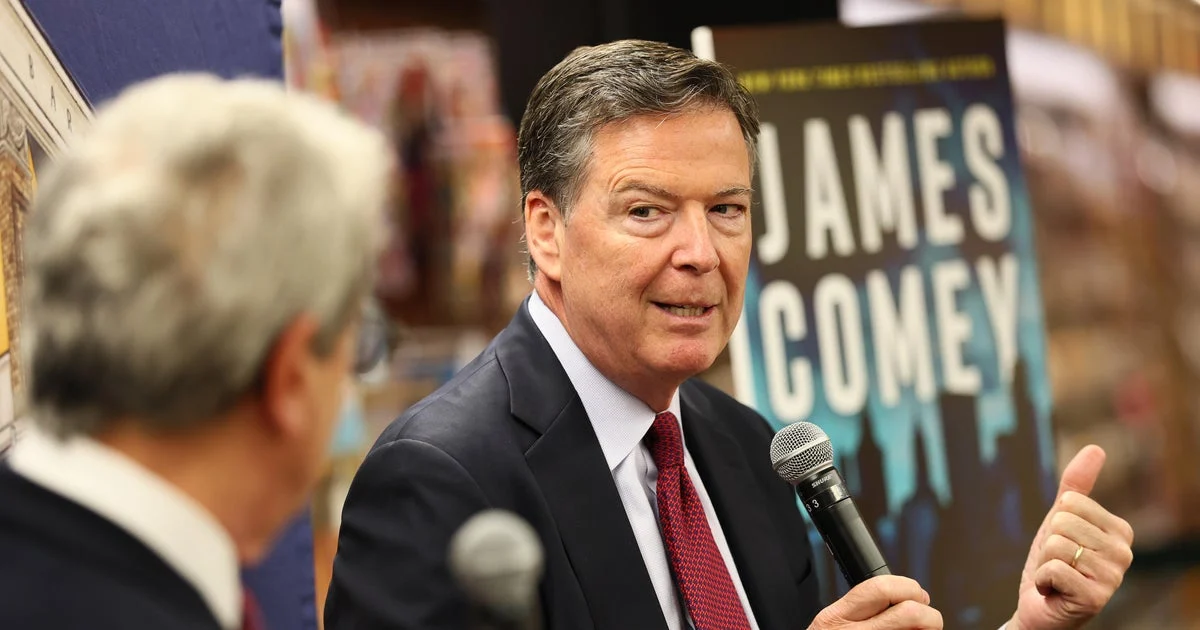
The United States Department of Justice has initiated legal proceedings to charge former Federal Bureau of Investigation Director James Comey with two counts of violating the Espionage Act, marking the third major attempt by federal prosecutors to bring criminal charges against the prominent critic of President Donald Trump. Court records unsealed on Monday reveal that prosecutors utilized a criminal information filing rather than seeking a traditional grand jury indictment. This unusual procedural maneuver was reportedly executed to preserve the statute of limitations before it expired in October.
The latest legal salvo centers on allegations that Comey transmitted national defense information to an unauthorized individual for disclosure to a newspaper in October 2016. According to court filings, prosecutors allege that Comey directed staff to communicate with a reporter at The New York Times to correct perceived misinformation concerning U.S. email surveillance published by Reuters a day earlier. The specific article in question, published on October 5, 2016, was titled "Yahoo Said to Have Aided U.S. Email Surveillance By Adapting Spam Filter" and relied on anonymous government sources.
Legal representatives for Comey have forcefully pushed back against the charges, maintaining his absolute innocence and characterizing the Department of Justice’s actions as a profound abuse of federal power. The unfolding legal battle highlights deep institutional friction and raises questions about the application of federal statutes in politically sensitive cases.
Procedural Precedent and Legal Controversy
The decision by federal prosecutors to file a criminal information rather than securing a grand jury indictment has generated considerable debate among legal scholars, former prosecutors, and defense attorneys. A criminal information is a charging document signed solely by prosecutors and does not require a grand jury’s approval or a magistrate judge’s finding of probable cause.
While federal prosecutors defended the filing as a recognized practice to toll the statute of limitations—citing approval by multiple Circuit Courts of Appeals—legal experts expressed astonishment at its application in a felony case of this nature. Michael Bromwich, a former Justice Department inspector general turned defense attorney, remarked that he had never encountered a criminal information used solely to pause the statute of limitations outside of instances where a defendant intends to waive grand jury rights and plead guilty. Comey’s defense team, led by attorney Patrick Fitzgerald, argued in court that the statutory deadline applies strictly to indictments and cannot be legally extended through an information filing.
The documents were initially filed under seal in early October. U.S. District Judge Trevor McFadden ordered the docket unsealed following a request from Comey’s legal team, noting that criminal charges against a former FBI director regarding conduct while in office carry immense public interest and that Comey had expressed a willingness to self-surrender.
A Chronology of Prior Investigations and Legal Battles
The scrutiny surrounding the 2016 New York Times article is not a novel development within the Department of Justice. The matter has been subjected to multiple exhaustive reviews over the past decade:
- 2017: Former U.S. Attorney John Durham, later appointed as special counsel by then-Attorney General William Barr, investigated the 2016 media leak. Durham’s probe identified former FBI General Counsel James Baker as a source who acted under the instructions of the bureau’s chief of staff, which Baker understood to originate from Comey. Ultimately, Durham declined to recommend prosecution for Baker or any other official.
- February 2020: The U.S. Attorney’s Office for the District of Columbia conducted a secondary investigation into the matter, code-named Tropic Vortex. This inquiry was closed without the issuance of any criminal charges.
- September 2025: The Justice Department secured an indictment against Comey accusing him of lying to Congress during a 2020 hearing regarding anonymous sourcing. That case was subsequently dismissed after a federal judge ruled that the interim U.S. attorney who signed the indictment had been improperly appointed.
- April 2026: Comey faced a separate indictment in North Carolina alleging that a social media post featuring seashells arranged to spell "86 47" constituted a threat against President Trump. Comey’s defense team has sought dismissal of this pending matter, arguing selective and vindictive prosecution.
- October 2026: Prosecutors filed the current criminal information under the Espionage Act just prior to the expiration of the ten-year statute of limitations tied to the 2016 events.
Statements and Institutional Reactions
The escalating friction between Comey and the federal government has elicited strong reactions from all involved parties. In a video statement addressing the latest legal action, Comey criticized the department’s trajectory. "It would almost be funny if it weren’t such an appalling abuse of the Department of Justice, one that we cannot become numb to," Comey stated. "Nothing’s changed with me. I’m still innocent, I’m still not afraid of these people and I still believe in the independent federal judiciary."
Patrick Fitzgerald emphasized that investigators had thoroughly examined the same leak allegations twice during the first Trump administration and concluded that no charges were warranted. He reiterated that the new filing attempts to penalize Comey for actions that do not constitute criminal offenses.
Conversely, the Justice Department defended its administrative actions through a public statement on social media, asserting that utilizing a criminal information to preserve legal timelines remains a valid and established federal procedure. Attorney General Todd Blanche has consistently maintained that department investigations and prosecutions involving political figures are driven by standard prosecutorial principles rather than external political influence.
Broader Implications and Institutional Norms
The pursuit of criminal charges against a former director of the FBI—particularly one who served as a central figure in investigations involving the sitting president—places renewed focus on the boundaries of prosecutorial discretion and the preservation of long-standing Department of Justice norms. Historically, the department has maintained strict internal policies designed to insulate investigative and charging decisions from political interference or the appearance thereof.
The convergence of multiple legal challenges against Comey, alongside parallel scrutiny directed at other prominent political figures such as New York Attorney General Letitia James, has intensified debates over the independence of federal law enforcement. Legal analysts suggest that the novel use of a criminal information to toll the statute of limitations will likely prompt extensive judicial review, establishing significant legal precedents regarding the procedural limits of federal prosecutorial power. As the case proceeds toward jurisdictional hearings, the federal judiciary will be tasked with determining the validity of the government’s charging strategy and evaluating the substantive merits of the Espionage Act allegations.