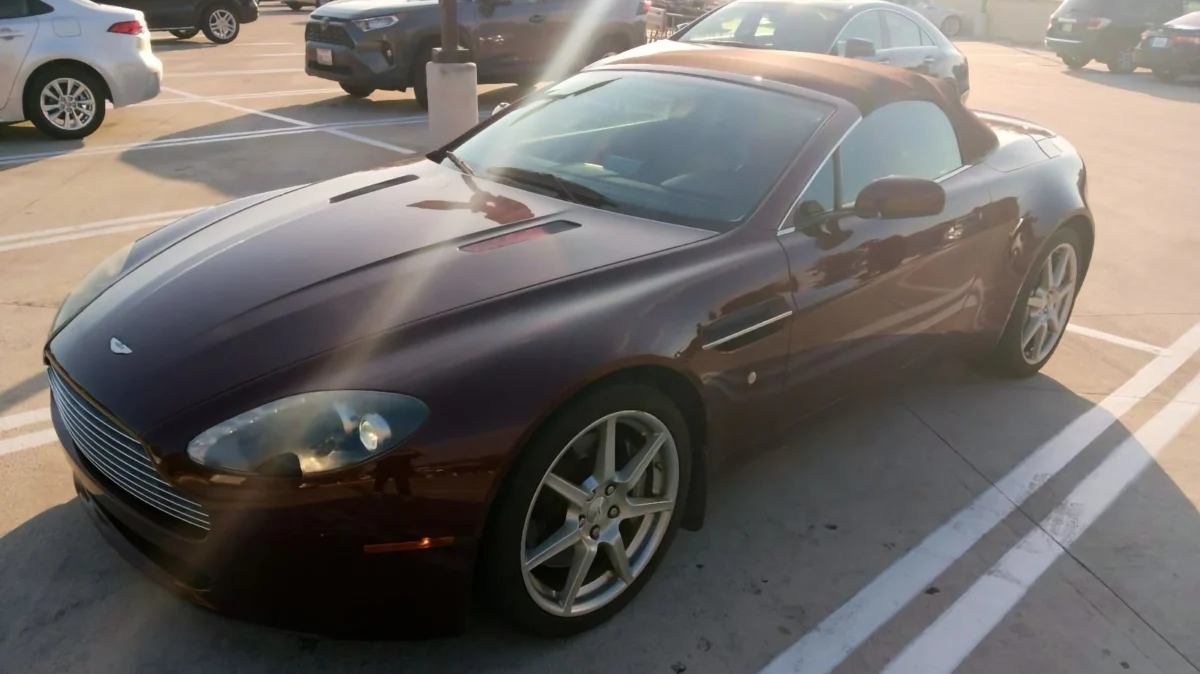
The secondary market for high-performance grand tourers has reached a notable inflection point with the recent listing of a 2009 Aston Martin V8 Vantage Roadster for $26,900. This valuation represents a significant departure from the vehicle’s original MSRP, which often exceeded $120,000 depending on optional equipment. Located in the San Francisco Bay Area, the vehicle highlights a growing trend in the automotive sector where "attainable exotics" from the late 2000s are beginning to compete in price with modern mid-range sedans and crossovers. This specific model year is of particular interest to collectors and enthusiasts, as 2009 marked a pivotal mid-cycle refresh for the V8 Vantage line, introducing a more powerful engine and a revised interior architecture.
Historical Context and Development of the VH Platform
To understand the significance of the 2009 V8 Vantage, one must look back at the corporate evolution of Aston Martin during its tenure under Ford Motor Company’s Premier Automotive Group (PAG). Throughout the 1970s and 1980s, Aston Martin was a boutique manufacturer with extremely limited production volumes, often struggling to maintain financial solvency. The company’s fortunes shifted in the early 2000s with the development of the Vertical/Horizontal (VH) architecture. This bonded aluminum platform was designed to be modular, providing the structural foundation for the DB9, the DBS, and the V8 Vantage.
The V8 Vantage, colloquially known as the "Baby Aston," was first introduced in 2005 as a direct competitor to the Porsche 911. While the Porsche was celebrated for its clinical precision and rear-engine layout, the Aston Martin sought to capture the market through aesthetic elegance and a front-mid-engine configuration that emphasized balance and grand touring comfort. Between 2005 and 2017, the V8 and V12 Vantage variants saw a total production of approximately 25,000 units, making it the most successful model in the company’s history at that time.
Mechanical Specifications and the 2009 Refresh
The 2009 model year represented the most significant mechanical overhaul in the Vantage’s twelve-year production run. The original 4.3-liter engine was replaced by a 4.7-liter 32-valve V8. This was not merely a bored-out version of the previous power plant; it featured new cylinder liners, a forged steel crankshaft, and revised cylinder heads. These improvements increased power output from 380 horsepower to 420 horsepower, while torque rose to 347 pound-feet.
This power is delivered to the rear wheels via a rear-mounted transaxle, a design choice that facilitates a near-perfect 49/51 weight distribution. The specific vehicle currently on the market features the "Sportshift" six-speed automated manual transmission. Unlike modern dual-clutch systems, the Sportshift utilizes an electro-hydraulically actuated single clutch. While this system was praised in its era for its weight savings compared to a traditional torque-converter automatic, it requires a specific driving technique to ensure clutch longevity, a factor that prospective buyers often scrutinize.
The inclusion of a dry-sump oiling system further underscores the car’s racing pedigree. By removing the traditional oil pan, engineers were able to mount the engine lower in the chassis, thereby reducing the center of gravity and improving lateral stability during high-speed cornering.
Component Synergy and the Ford-Volvo Connection
A defining characteristic of the 2009 V8 Vantage is the visible evidence of Aston Martin’s former partnership with Ford and Volvo. During the development phase, Aston Martin utilized the "parts bin" of the Premier Automotive Group to reduce development costs and ensure reliability for secondary systems.
For example, the pop-up navigation system in the 2009 Vantage is a derivative of the unit found in contemporary Volvo models. Similarly, various interior switches, window motors, and electrical components share DNA with Ford and Volvo products. While some purists criticized this at the time of launch, it has become a strategic advantage for second- and third-hand owners. The shared architecture means that many "wear-and-tear" items are significantly less expensive and more accessible than parts for bespoke competitors like Ferrari or Lamborghini.
Aesthetic Condition and Interior Preservation
The vehicle currently listed is finished in a custom burgundy or merlot exterior, a departure from the more common "Silver Birch" or "Tungsten Silver" palettes associated with the marque. The roadster configuration features an electrically operated fabric top and a glass rear window, designed to maintain the car’s silhouette whether the roof is raised or lowered.
Inside, the cabin is upholstered in two-tone leather. Historically, the leather-wrapped dashboards of British luxury cars have been susceptible to "shrinkage" when exposed to high heat and UV radiation, a process where the hide pulls away from the defrost vents and instrument binnacle. However, reports on this specific 63,000-mile unit suggest the interior has remained remarkably intact, indicating either consistent garage storage or meticulous leather conditioning by the previous two owners.
Comparative Market Analysis
The asking price of $26,900 places this Aston Martin in an unusual market position. For comparison, a 2009 Porsche 911 (997.2 generation) with similar mileage typically commands a price between $50,000 and $70,000. The divergence in value highlights the "maintenance premium" often associated with British exotics. While the Porsche is viewed as a daily-driver-capable sports car with a vast independent service network, the Aston Martin is often perceived as a more temperamental machine requiring specialized care.
However, from a value-per-horsepower perspective, the Vantage currently represents a significant bargain. The $26,900 price point is roughly equivalent to the cost of a new, base-model Toyota Corolla or a three-year-old Honda CR-V. For the enthusiast buyer, the trade-off involves accepting higher potential repair costs in exchange for a hand-assembled vehicle with a bespoke aluminum chassis and one of the most celebrated exhaust notes in automotive history.
Chronology of the V8 Vantage Production Cycle
The lifecycle of the V8 Vantage can be categorized into four distinct phases:
- Launch Phase (2005–2008): Introduction of the 4.3L engine and the VH platform. The car gained international fame through appearances in media and its reputation for design excellence.
- The Performance Update (2009–2011): Introduction of the 4.7L engine, updated Bilstein dampers, and the revised center console (the "Glass Key" era).
- The S and V12 Era (2012–2016): Introduction of the Vantage S with a seven-speed Sportshift II transmission and the shoehorning of the 6.0L V12 engine into the compact chassis.
- The Final Editions (2017): Limited runs like the GT8 and the AMR editions marked the end of the naturally aspirated era before the transition to AMG-sourced turbocharged engines.
Ownership Implications and Maintenance Forecast
Potential buyers of a 63,000-mile Vantage must account for the "Major Service" intervals. At this mileage, specific attention is typically required for the twin-plate clutch (on Sportshift models), the timing cover gaskets (which can develop minor oil seeps), and the suspension bushings. The listing notes that this specific car has recently received new brake pads and tires, which addresses two of the most immediate "consumable" expenses.
Furthermore, the requirement for a recent emissions test certificate in California suggests the vehicle’s catalytic converters and oxygen sensors are in functioning order—a critical detail, as replacing the primary catalysts on an Aston Martin V8 can cost several thousand dollars.
Broader Impact on the Exotic Car Market
The availability of a well-maintained V8 Vantage at this price point reflects a broader stabilization in the "modern classic" market. As the automotive industry pivots toward electrification and turbocharged power plants, naturally aspirated, high-displacement engines like the 4.7L V8 are increasingly viewed as historical artifacts.
While the depreciation curve for the V8 Vantage has been steep, market analysts suggest that values for the 4.7L models may be nearing their floor. As supply diminishes due to accidents or neglect, survivors with documented service histories are expected to eventually see a modest appreciation, or at the very least, a cessation of the rapid depreciation seen over the last decade.
In conclusion, the $26,900 2009 Aston Martin V8 Vantage Roadster serves as a case study in the accessibility of high-tier luxury. It offers a blend of hand-crafted British prestige and Ford-era reliability, packaged in a design that remains contemporary fifteen years after its debut. For the third owner, the vehicle represents an opportunity to experience the pinnacle of 2000s grand touring at a fraction of the original entry cost, provided they are prepared for the specialized stewardship such a machine demands.