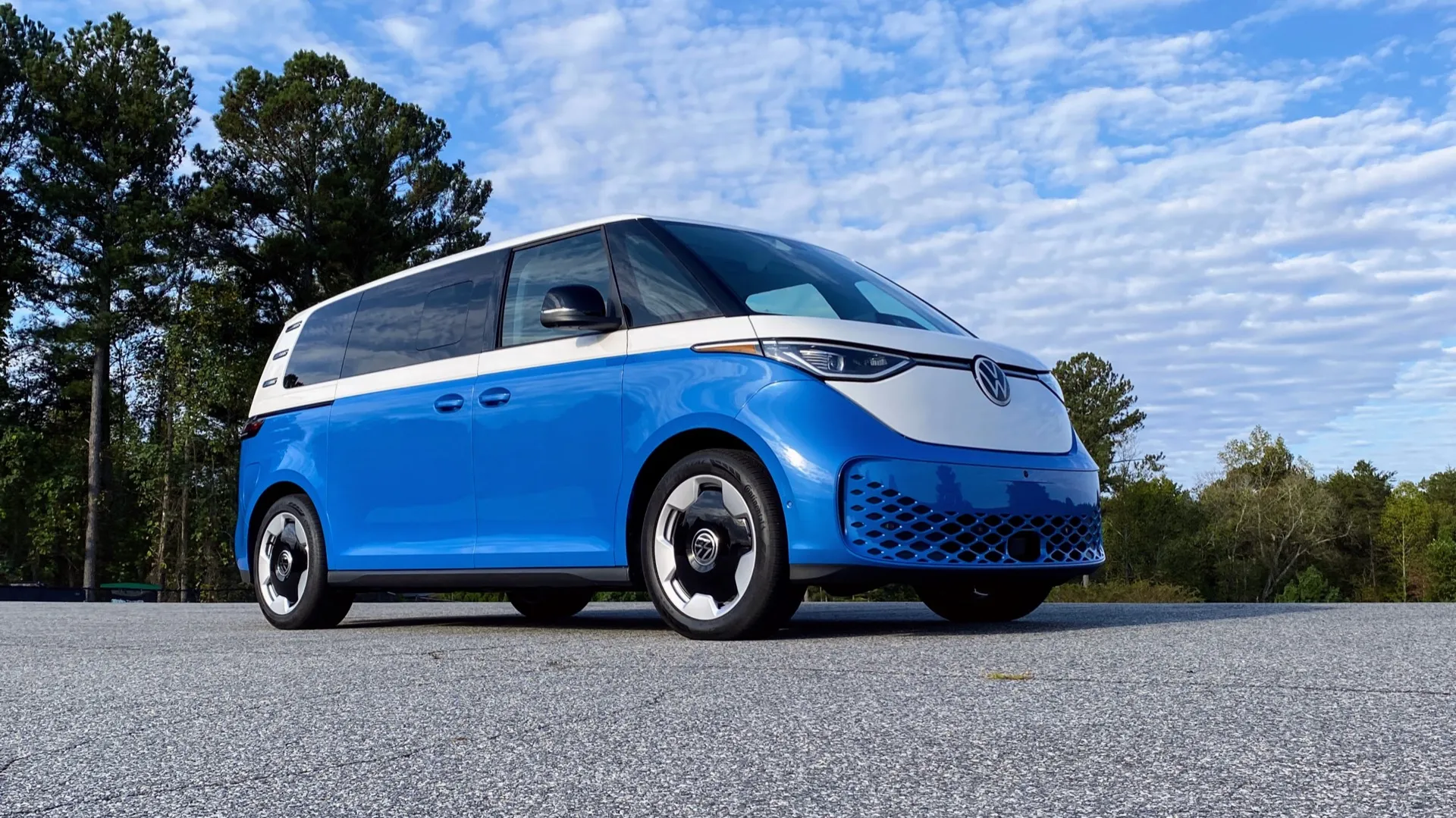
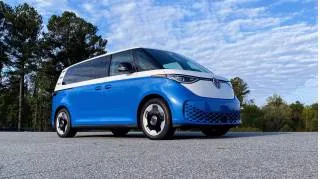
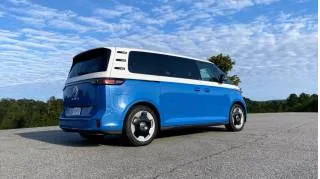
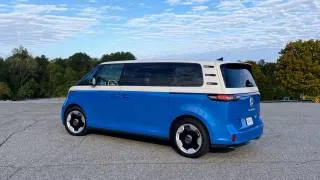
The long-awaited return of the Volkswagen Microbus to the United States has officially transitioned from a decades-long exercise in nostalgia and concept car teases to a tangible, electrified reality. Arriving as the 2025 ID.Buzz, this battery-electric van represents a high-stakes gamble for Volkswagen of America, blending the counterculture iconography of the 1960s with the sophisticated requirements of the modern family vehicle market. While the vehicle successfully captures the visual DNA of the original Type 2, it enters a significantly different automotive landscape than its air-cooled predecessor, carrying a premium price tag and a sophisticated electric drivetrain that positions it as a niche lifestyle vehicle rather than the utilitarian "people’s mover" of the past.

The Long Road to Modernity: A Chronology of the Microbus Revival
The arrival of the ID.Buzz in U.S. showrooms is the culmination of nearly a quarter-century of false starts and design studies. For Volkswagen, the challenge was never a lack of interest, but rather the difficulty of translating the "forward-control" (cab-over) proportions of the original bus into a package that could meet modern global safety standards.
The journey began in earnest at the 2001 North American International Auto Show with the unveiling of the "Microbus Concept." Despite massive public acclaim, the project was shelved in 2004 due to cost concerns and a shifting focus toward SUVs. Volkswagen revisited the idea in 2011 with the smaller, retro-styled Bulli concept, and again in 2016 with the BUDD-e, a technology-focused van meant to showcase the brand’s post-Dieselgate commitment to electrification.
It was not until the 2017 North American International Auto Show that the ID.Buzz concept debuted, built upon the then-new Modular Electric Drive Matrix (MEB) platform. Unlike previous attempts, the MEB’s flat-floor battery architecture finally allowed designers to push the wheels to the corners and reclaim the boxy, voluminous interior that defined the original. After a launch in Europe with a short-wheelbase variant, Volkswagen spent an additional two years developing the long-wheelbase version specifically for the North American market, featuring a larger battery, more horsepower, and a standard three-row configuration.

Technical Specifications and Performance Dynamics
The U.S.-specification ID.Buzz is a substantial vehicle, both in its physical dimensions and its curb weight. Riding on a 127.5-inch wheelbase—nearly 10 inches longer than the European model—the van measures 195.4 inches in total length. This puts it in direct competition with mid-size and large three-row SUVs like the Kia EV9 and Volkswagen’s own Atlas.
Underpinning the vehicle is a 91-kWh (gross) lithium-ion battery pack. In its standard rear-wheel-drive configuration, the ID.Buzz utilizes Volkswagen’s latest AP550 electric motor, which produces 282 horsepower and 413 lb-ft of torque. For those requiring all-weather capability, an 4Motion all-wheel-drive version adds an inductive motor to the front axle, bringing total system output to 335 horsepower.
On the road, the ID.Buzz prioritizes comfort over cornering. Weighing in at approximately 5,968 pounds for the rear-wheel-drive model and exceeding 6,100 pounds for the AWD variant, the vehicle’s mass is ever-present. However, the low-slung placement of the battery pack ensures a stable center of gravity. The suspension is softly tuned to absorb road imperfections, making it an ideal long-distance cruiser. One of the most notable performance metrics is the turning radius; at 37.4 feet for the RWD model, the ID.Buzz is remarkably maneuverable in tight urban environments, outclassing many smaller crossovers.
Acceleration is more than adequate for a vehicle of this size. The RWD version reaches 60 mph in approximately 7.5 seconds, while the AWD model drops that figure to about 6.0 seconds. For utility-minded buyers, the ID.Buzz offers a maximum towing capacity of 2,600 pounds for braked trailers, sufficient for small campers or utility trailers.
Range, Efficiency, and Charging Infrastructure
Efficiency is a critical metric for any electric vehicle, particularly one with the aerodynamic profile of a van. The ID.Buzz achieves a coefficient of drag of 0.29, a respectable figure for its "box on wheels" silhouette. The EPA has rated the RWD model at 234 miles of range, with the AWD version following closely at 231 miles. In real-world testing across varied terrains—including highway speeds and suburban stop-and-go traffic—the vehicle consistently delivers between 2.2 and 2.6 miles per kWh.
Charging capabilities have been modernized to keep pace with industry leaders. The ID.Buzz supports DC fast charging at rates of up to 200 kW, allowing the battery to replenish from 10% to 80% in approximately 26 minutes under ideal conditions. For home charging, the 11-kW onboard charger can fully recharge the 91-kWh pack in about nine hours using a Level 2 station.
Volkswagen has also integrated "Plug & Charge" functionality, which simplifies the charging process at compatible Electrify America stations by automating the payment and authentication process. Furthermore, the infotainment system includes a sophisticated route planner that automatically suggests charging stops and can precondition the battery to ensure maximum charging speeds upon arrival.
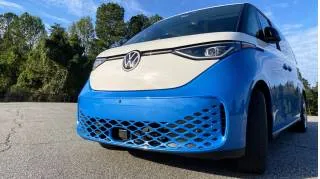
Interior Versatility and Technological Integration
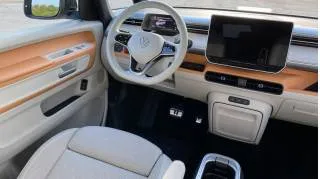
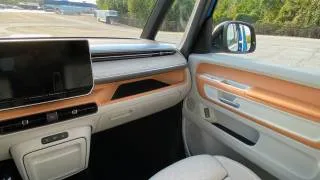
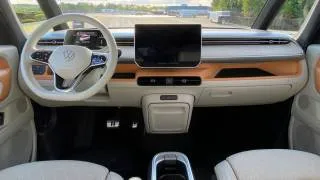
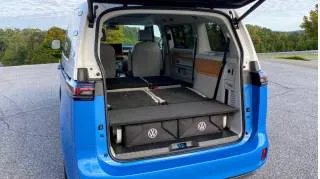
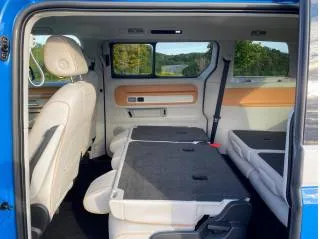
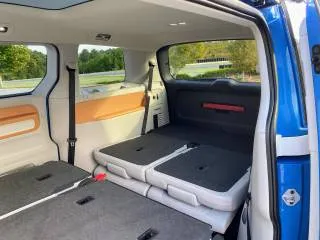
The interior of the ID.Buzz is where the benefits of the EV platform are most evident. The absence of a traditional engine bay and transmission tunnel allows for a completely flat floor and a cavernous cabin. Volkswagen has maximized this space with a variety of clever storage solutions and modular components.
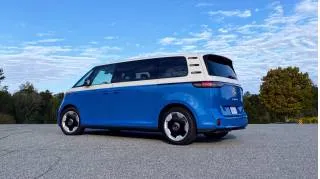
The "Buzz Box" center console is a standout feature; it is fully removable and contains adjustable partitions that can double as ice scrapers or bottle openers. The second row of seating can slide fore and aft by up to 7.9 inches, allowing users to prioritize either legroom or cargo space. In the third row, the seats can be removed entirely, though their weight makes this a labor-intensive task.
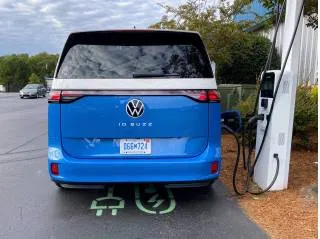
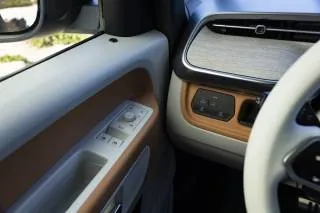
Technologically, the ID.Buzz features a 12.9-inch central infotainment display running Volkswagen’s latest software. This system addresses many of the criticisms leveled at earlier ID.4 models, offering faster response times and illuminated sliders for volume and temperature control. The vehicle also features "ID. Light," an intuitive LED strip below the windshield that uses color pulses to communicate navigation cues, incoming calls, and charging status to the driver.

Standard equipment for the U.S. market is generous, including:

- Twelve-way power-adjustable front seats with massage functions.
- A "climatized" seating system that offers both heating and ventilation.
- Eight USB-C ports distributed throughout all three rows.
- A 110-volt outlet under the passenger seat and a 12-volt outlet in the cargo area.
The Economic Reality: Pricing and Market Positioning
Perhaps the most debated aspect of the 2025 ID.Buzz is its pricing structure. The base Pro S trim starts at $61,545, while the Pro S Plus begins at $65,045. The flagship 1st Edition, which includes unique wheels and standard two-tone paint, reaches $71,545.
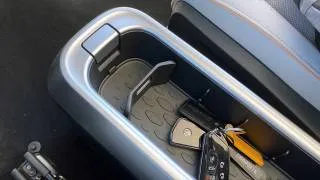
This pricing places the ID.Buzz in the premium segment, a significant departure from the original Microbus’s legacy as affordable transportation. When the Microbus gained popularity in the mid-1960s, it retailed for roughly $2,550—equivalent to approximately $25,400 in today’s currency. At more than double that inflation-adjusted figure, the ID.Buzz is being marketed as a lifestyle flagship rather than a high-volume commodity.

Compounding the pricing issue is the vehicle’s manufacturing origin. Because the ID.Buzz is currently produced in Hannover, Germany, it does not qualify for the $7,500 federal EV tax credit for outright purchases under the Inflation Reduction Act. However, Volkswagen is expected to utilize the "leasing loophole" (Section 45W), which allows the $7,500 credit to be passed on to consumers who choose to lease the vehicle, potentially lowering the monthly cost to a more competitive level.
Broader Impact and Industry Implications
The release of the ID.Buzz comes at a pivotal moment for the electric vehicle market. After a period of rapid growth, EV adoption in the U.S. has entered a more complex phase characterized by price sensitivity and a demand for more diverse body styles beyond the ubiquitous crossover.
The ID.Buzz occupies a unique "market of one." It is currently the only electric minivan available in the United States, as competitors like the Chrysler Pacifica remain stuck in the plug-in hybrid phase and others have abandoned the segment entirely. By reviving a beloved icon, Volkswagen is attempting to bypass the "EV discord" that has politicized electric car ownership in recent years. The van’s design is so universally recognized and positively received that it often transcends the debate over its powertrain.
Industry analysts suggest that the ID.Buzz will serve as a "halo" vehicle for Volkswagen, drawing foot traffic into showrooms even if many customers eventually opt for the more affordable ID.4 or the gasoline-powered Atlas. The success of the ID.Buzz will likely be measured not just in raw sales volume, but in its ability to rehabilitate Volkswagen’s brand image and prove that electric vehicles can be emotionally resonant and culturally significant.
As deliveries begin in late 2024 and early 2025, the automotive world will be watching closely. If Volkswagen can manage dealer markups and capitalize on the immense pre-order interest, the ID.Buzz could signal a renaissance for the van segment, proving that utility and style are not mutually exclusive in the electric age. For now, the "Electric Bus" stands as a bold, expensive, and visually stunning bridge between Volkswagen’s storied past and its electrified future.