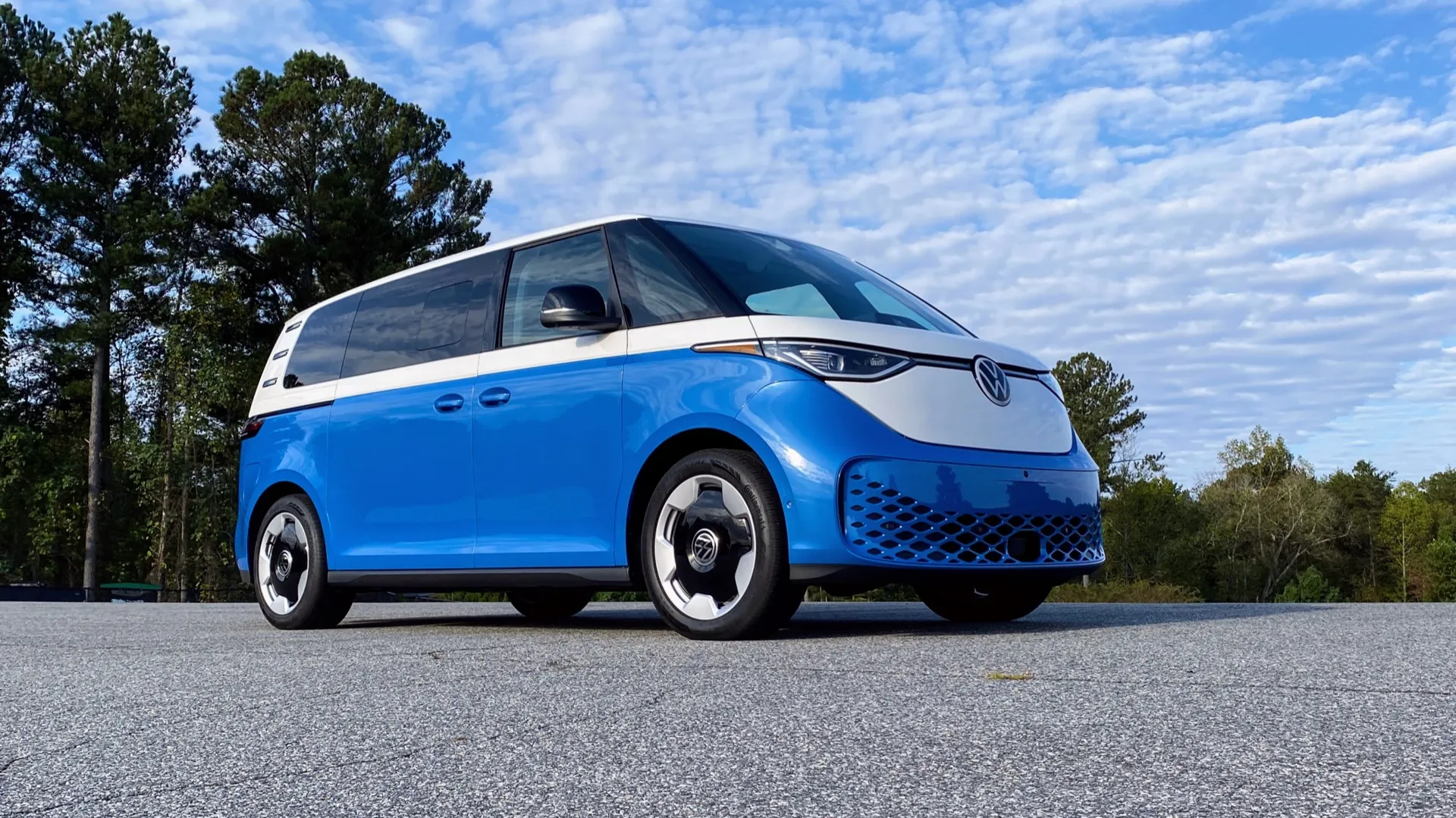
The 2025 Volkswagen ID.Buzz has officially commenced its journey into the United States market, marking the culmination of a multi-decade effort to resurrect one of the most iconic silhouettes in automotive history. For Volkswagen, the stakes are exceptionally high; the ID.Buzz is not merely a new entry into the burgeoning electric vehicle (EV) sector, but a "halo" product designed to bridge the emotional gap between the brand’s counterculture past and its carbon-neutral future. By design and execution, the ID.Buzz attempts to capture the essence of the original Type 2 Microbus while leveraging the modular efficiency of the Volkswagen Group’s MEB (Modularer E-Antriebs-Baukasten) platform.
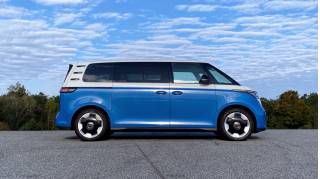
The arrival of the ID.Buzz in North America follows years of anticipation and a series of developmental hurdles. While the European market received a short-wheelbase version earlier, Volkswagen leadership determined that the American consumer required a larger, more versatile three-row configuration. This decision necessitated a nearly two-year delay to accommodate a 10-inch stretch in the wheelbase, a larger battery pack, and a more powerful drivetrain. As the vehicle begins to populate American roads—from the rural stretches of north Georgia to the coastal highways of California—it faces a complex landscape defined by high interest rates, a cooling EV market, and a competitive field of three-row electric SUVs.
A Chronology of the Microbus Resurrection
The path to the 2025 ID.Buzz was paved with a long string of concept vehicles and "false starts" that tested the patience of enthusiasts. The original Type 2, introduced in 1950, became a global symbol of freedom and utility, eventually becoming the unofficial vehicle of the 1960s counterculture. However, as safety regulations and consumer preferences evolved, the air-cooled "bus" was phased out in favor of the more utilitarian Vanagon and eventually the front-engine Eurovan, which exited the U.S. market in 2003.
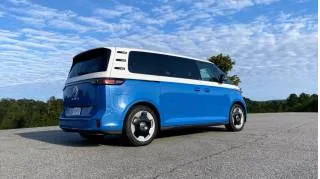
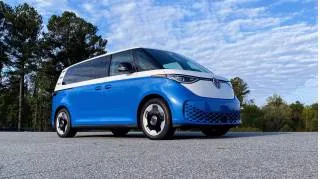
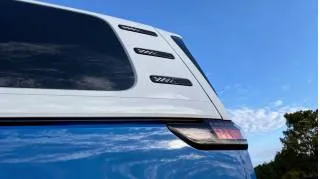
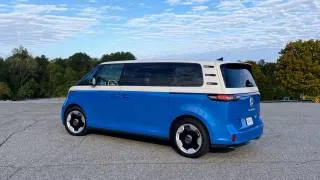
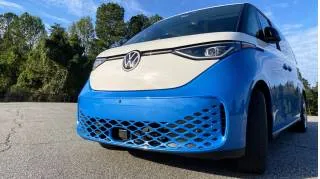
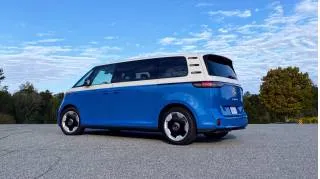
Volkswagen first teased a modern revival in 2001 with the "Microbus Concept" at the North American International Auto Show. Despite overwhelming public acclaim, the project was shelved due to financial constraints and shifting corporate priorities. Subsequent attempts included the 2011 Bulli concept and the 2016 Budd-e concept. It was not until the 2017 Detroit Auto Show that the ID.Buzz concept was unveiled, promising a fully electric powertrain and autonomous driving capabilities. The production version arriving today remains remarkably faithful to that 2017 design, preserving the short overhangs, V-shaped hood, and available two-tone paint schemes that define the Microbus identity.

Technical Specifications and Performance Dynamics
The North American iteration of the ID.Buzz is significantly upgraded compared to its European predecessor. It rides on a 127.5-inch wheelbase with an overall length of 195.4 inches. To provide context, this makes it approximately the same length as a mid-size crossover like the Volkswagen Atlas Cross Sport, though its boxy architecture allows for vastly superior interior volume.
Powertrain and Battery
Under the floor lies a 91-kWh (gross) lithium-ion battery, providing a significant step up from the 82-kWh pack found in the European short-wheelbase model. The rear-wheel-drive (RWD) variant features Volkswagen’s latest AP550 permanent magnet synchronous motor, which produces 282 horsepower and 413 lb-ft of torque. For those requiring more traction and power, the 4Motion all-wheel-drive (AWD) version adds an induction motor to the front axle, bringing total system output to 335 horsepower.
Performance figures are respectable for a vehicle of this stature. The AWD version can sprint from 0 to 60 mph in approximately 6.0 seconds, while the RWD version completes the task in 7.5 seconds. The top speed is electronically governed at 99 mph, an increase over the 90 mph limit set for earlier international versions.
Driving Impressions: The Weight of Innovation
On the road, the ID.Buzz carries its weight with a sense of deliberate stability. Weighing in at nearly 6,000 pounds (5,968 lbs for RWD and 6,197 lbs for AWD), the vehicle is undeniably heavy. This mass is felt primarily in its soft-sprung suspension, which is tuned for ride comfort over cornering prowess. However, the low center of gravity afforded by the floor-mounted battery prevents excessive body roll.

The steering is precise, and the turning circle for the RWD model is a remarkably tight 37.4 feet—a feat made possible by the lack of front drive shafts. Visibility is a standout feature; the vast glasshouse and upright pillars provide the driver with a commanding view of the surroundings, a trait that traditional SUVs have largely lost in the pursuit of aerodynamic efficiency.
Efficiency, Range, and Charging Infrastructure
For many potential buyers, the viability of the ID.Buzz as a road-trip vehicle depends on its efficiency and charging speed. The EPA has rated the RWD ID.Buzz at a combined 83 MPGe, with a range of 234 miles. The AWD version sees a slight decrease to 231 miles. In real-world testing across varied terrain, drivers have reported averages between 2.4 and 2.6 miles per kWh, suggesting that the EPA estimates are achievable under moderate conditions.
Charging Metrics
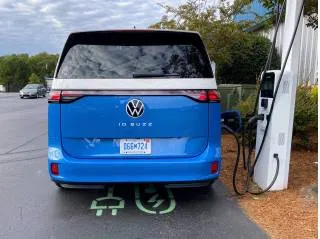
The ID.Buzz supports DC fast charging at rates of up to 200 kW. According to Volkswagen, this allows the battery to charge from 10% to 80% in approximately 26 minutes. For home charging, the 11-kW onboard charger can fully replenish the battery in about 9 hours using a Level 2 station. A critical feature for the North American market is the inclusion of battery preconditioning, which can be triggered automatically through the navigation system or manually via the infotainment screen, ensuring the battery is at the optimal temperature for rapid charging upon arrival at a station.
Interior Versatility and Technological Integration
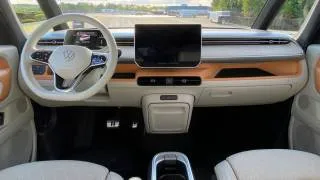
The interior of the ID.Buzz is a masterclass in modern "van-life" ergonomics. Unlike the original Microbus, which was famously sparse, the 2025 model is packed with premium amenities and flexible storage solutions.
Seating and Cargo
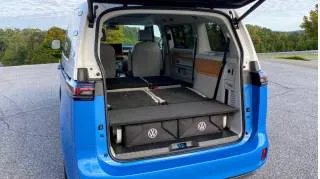
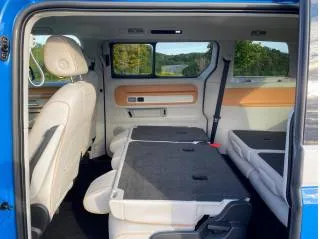
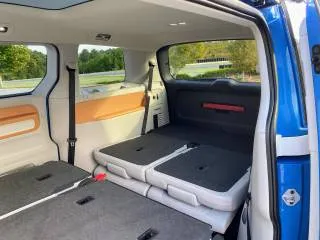
The U.S. model is offered exclusively as a three-row vehicle. The Pro S trim features a second-row bench seat for seven-passenger capacity, while the Pro S Plus and 1st Edition models offer optional second-row captain’s chairs, reducing capacity to six. The third row provides what Volkswagen claims is best-in-class legroom, comfortably accommodating adult passengers.
The cargo area features a "Flexboard" system, which creates a flat load floor when the rear seats are folded. While the second and third rows do not fold completely into the floor (like Chrysler’s Stow ‘n Go system), they can be removed entirely, though their significant weight makes this a labor-intensive task.

Technology and Controls
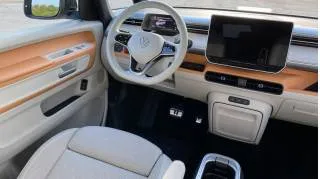
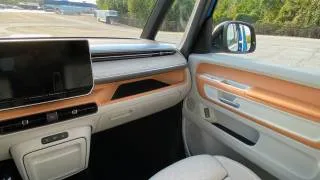
The ID.Buzz introduces a revamped 12.9-inch infotainment system, which addresses many of the criticisms leveled at earlier ID.4 models. The interface is faster, and the climate control sliders are now backlit for easier nighttime operation. Standard features include a head-up display (on higher trims), eight USB-C ports, and a "Buzz Box"—a removable center console with adjustable compartments and a built-in bottle opener and ice scraper.

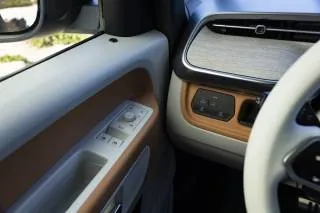
One polarizing carryover from the ID.4 is the simplified power window switchgear on the driver’s door. Rather than four separate switches for the four windows, there are only two, with a capacitive "Rear" button to toggle between the front and back panes. This has been a point of contention for some critics who find the system unnecessarily complex.

Market Positioning and Economic Analysis
Perhaps the most debated aspect of the ID.Buzz is its pricing strategy. With a starting MSRP of $61,545 (including destination fees), the vehicle enters the market at a premium price point. Fully loaded AWD models can exceed $71,000.

The Inflation Factor
To understand the ID.Buzz’s positioning, one can look at the 1965 Microbus. In its heyday, a top-tier Microbus cost approximately $2,550. When adjusted for inflation using the Consumer Price Index, that figure equates to roughly $25,400 in 2024 dollars. Today’s average new vehicle price in the U.S. is approximately $48,000. By pricing the ID.Buzz at 25% to 45% above the market average, Volkswagen is clearly positioning it as a lifestyle luxury vehicle rather than a mass-market utility tool.
Production and Tax Credits
A significant factor in this pricing is the vehicle’s production location. The ID.Buzz is currently manufactured in Hanover, Germany. Because it is not assembled in North America, it does not qualify for the $7,500 federal EV tax credit for purchases. However, consumers may be able to take advantage of this credit through leasing programs via the "EV leasing loophole," which allows the credit to be passed from the manufacturer to the lessee regardless of where the vehicle is built.
Broader Impact and Industry Implications
The launch of the ID.Buzz comes at a pivotal moment for Volkswagen. The brand is navigating a global transition to electrification while facing stiff competition from both traditional automakers and new EV entrants.
Competitive Landscape
The ID.Buzz occupies a unique niche. While it competes for the same customers as the Kia EV9 and the Rivian R1S, it is the only fully electric vehicle that leans so heavily into the "minivan" form factor. Its primary competition may not be other EVs, but high-end gasoline-powered minivans like the Toyota Sienna and Honda Odyssey, or premium three-row SUVs like the Chevrolet Tahoe.
Brand Sentiment
Initial reactions from the public suggest that the ID.Buzz possesses a "smile factor" that is rare in the modern automotive industry. During field tests in diverse regions, the vehicle has drawn positive attention from a wide demographic, cutting through the often-polarized discourse surrounding electric vehicles. For Volkswagen, this emotional resonance is a powerful asset that could drive showroom traffic and improve brand perception across its entire lineup.
Conclusion
The 2025 Volkswagen ID.Buzz is a sophisticated, albeit expensive, reimagining of a cultural icon. It successfully translates the spirit of the 1960s into a package that meets 21st-century standards for safety, performance, and technology. While its price and 234-mile range may limit its appeal to a specific "niche" of enthusiasts and early adopters, its role as a symbol of Volkswagen’s future cannot be overstated. As it begins to reach dealerships across the United States, the ID.Buzz stands as a testament to the enduring power of design and the complex realities of the electric transition. Whether it becomes a mass-market success or remains a high-end curiosity will depend on Volkswagen’s ability to navigate the logistical and economic challenges of the current automotive era.