The impending release of Rockstar Games’ Grand Theft Auto VI continues to generate unprecedented levels of analytical scrutiny from the gaming community, with automotive and transportation enthusiasts turning their attention away from high-speed supercars and toward the civic infrastructure of the fictional state of Leonida. In a recent viral experiment conducted by gaming content creator Sonny Evans, the public transit systems featured within the upcoming open-world title were subjected to rigorous operational testing, revealing an unexpected depth in Rockstar Games’ environmental design and simulation capabilities.
The investigation, which has captured the attention of both urban planners and virtual explorers alike, sought to answer a fundamental question: whether the buses, metro lines, and regional transit networks of Leonida are fully functional or merely decorative backdrop elements. The results of the experiment offer profound insights into the sheer scale of the game map, the fidelity of its simulated society, and the lengths to which developers go to construct believable, living urban ecosystems.
Main Facts of the Public Transit Experiment
Sonny Evans, renowned within the gaming community for undertaking absurdly methodical and marathon-length challenges—such as walking a bowl of stew across the entire map of Red Dead Redemption 2—turned his focus to the transit networks of Vice City and the broader Leonida region. Utilizing the in-game mapping tools, transit schedules, and physical station infrastructure, Evans charted a multi-stage commute from a remote starting location to the bustling urban core of Vice City.
The transit test relied on two primary vectors of movement: the Interstate Loop bus network and the elevated or subterranean metropolitan rail lines. By observing posted schedule boards, waiting at designated stops, and boarding the vehicles alongside non-player characters (NPCs), Evans documented the operational viability of these systems.
Key findings from the transit audit include:
- Route Functionality: Both the Interstate Loop buses and the metropolitan trains are fully operational, moving along fixed geographic corridors and stopping at designated stations without requiring player intervention to trigger movement.
- Travel Time Realism: A single bus commute along the Interstate Loop into Vice City consumed approximately five hours of in-game time, underscoring the massive geographical scale of the Leonida map, which heavily mirrors the sprawling nature of the state of Florida.
- Scheduling Anomalies: Unlike real-world public transportation networks, which are frequently plagued by delays, mechanical failures, and logistical bottlenecks, the Vice City transit system operated with uncanny, unbroken punctuality—a feature Evans jokingly noted as the most unrealistic aspect of the simulation.
- Architectural and Signage Oversight: A minor design discrepancy was discovered at a metro platform, where the navigational signage for both northbound and southbound routes was identical, mirroring real-world subway layout confusions but presenting a momentary navigation hurdle for the traveler.
Chronology of the Virtual Commute
The chronological progression of the experiment highlights the meticulous pacing required to navigate Leonida strictly by public transit, avoiding the franchise’s signature vehicle theft mechanics.
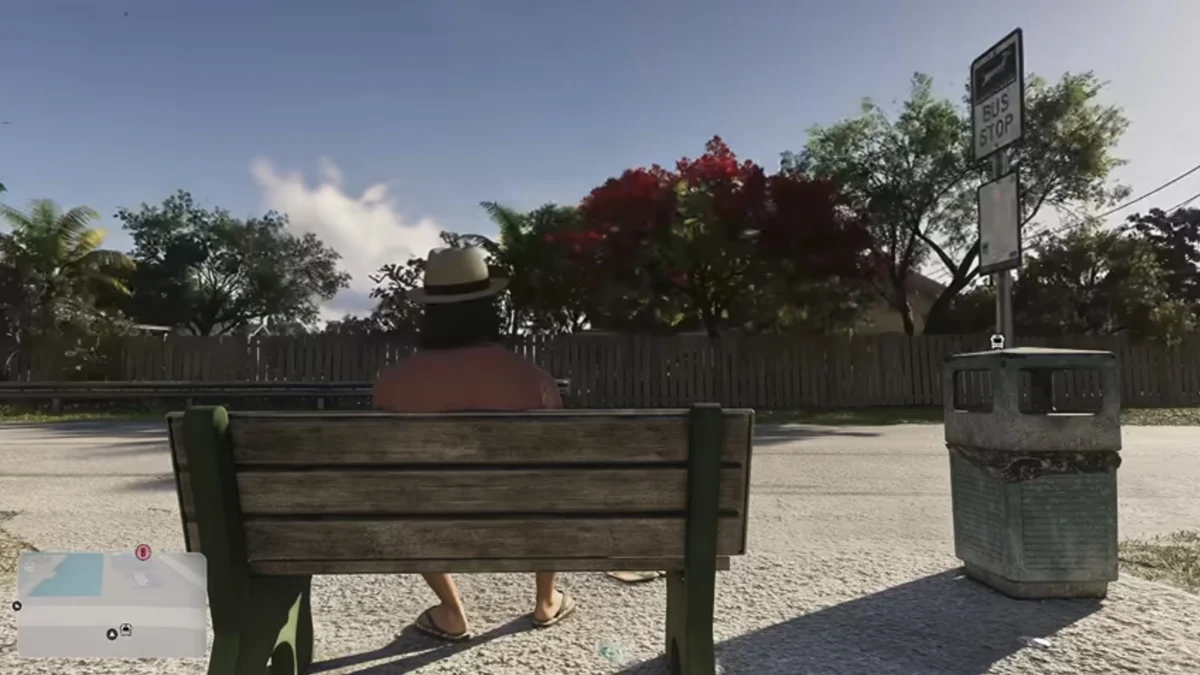
The journey began at a suburban starting point within the Leonida mainland. Recognizing the absence of a personal automobile, Evans located the nearest physical bus stop, where route maps and arrival timetables were prominently displayed. Upon the arrival of the Interstate Loop bus, Evans boarded and settled in for a long-haul journey.
As the vehicle traversed regional highways and secondary roads, the passage of time was recorded via the game’s internal clock. The five-hour in-game transit window allowed for extensive observation of AI behavior, traffic flow, and environmental transition zones, moving from rural outskirts into denser suburban environments and finally culminating in the high-density urban core of Vice City.
Upon arriving at the metropolitan transit hub, Evans transitioned from the bus network to the local rail system. Consulting platform arrival boards, he boarded a scheduled train. Despite the identical labeling on the directional signage, the train successfully navigated the rail network, depositing the commuter at the Vice City International Airport complex.
What began as a disciplined civic infrastructure audit quickly devolved into open-world sandbox chaos upon arrival at the airport terminal. After exploring hidden subterranean architecture beneath the luggage carousels, the experiment concluded with a simulated breach of airport security checkpoints and the unauthorized commandeering of a commercial airliner by the game’s protagonist, Jason—illustrating the friction between structured civilian simulation and chaotic gameplay freedom.
Background Context of Open-World Simulation and Rockstar’s Design Philosophy
To understand the significance of this transit test, one must examine the evolutionary history of Rockstar Games’ open-world design. Since the inception of the 3D era with Grand Theft Auto III in 2001, the studio has steadily increased the systemic complexity of its virtual environments.
In Grand Theft Auto V, the city of Los Santos featured a functional subway system (the Mass Transit Transit or LCT) and a working international airport, though these systems were largely utilized by players as shortcuts or shooting galleries rather than authentic commuting options. Similarly, Red Dead Redemption 2 introduced functioning passenger trains across the American frontier, which players could board, rob, or use for fast travel.
With Grand Theft Auto VI, the return to Leonida—a satirical yet painstakingly researched pastiche of modern Florida—represents a generational leap in hardware utilization. Modern gaming hardware allows for complex background simulations where thousands of NPCs maintain daily routines, employment schedules, and transit habits. The inclusion of working buses and trains is not merely a gameplay mechanic; it is a testament to the pursuit of ecological immersion. Industry analysts note that contemporary players increasingly judge open-world games not just by map size, but by the density and interactivity of the simulated world when the player chooses not to directly interact with it.
Supporting Data and Scale Analysis
The five-hour in-game commute measured by Evans provides valuable metric indicators regarding the physical dimensions of the Leonida map. While Rockstar Games has not officially published precise square-mile measurements for Grand Theft Auto VI, comparative analysis with previous titles offers a baseline.
Grand Theft Auto V featured a map measuring roughly 49 square miles (including land and surrounding ocean). Industry insiders and community cartographers analyzing leaked development footage and official promotional material have estimated that Leonida could be significantly larger, potentially doubling or tripling the landmass of Los Santos to encompass expansive rural wetlands, keys, sprawling suburban developments, and the multi-tiered urban sprawl of Vice City.
The transit duration data collected during the bus journey strongly supports these estimates. In a game simulation where time compression ratios dictate a rapid cycle of day and night, a five-hour transit block across a single regional loop indicates that traveling from one end of the state to the other will require substantial logistical planning or reliance on fast-travel and high-speed transit infrastructure.
Broader Impact and Implications for Virtual Tourism
The viral reception of Sonny Evans’ transit experiment underscores a broader cultural shift within gaming: the rise of "virtual tourism" and passive open-world engagement. Millions of players no longer engage with sandbox titles strictly through the lens of violent progression or narrative completion. Instead, communities form around simulated habitation—roleplaying as ordinary citizens, obeying traffic laws, working virtual jobs, and testing the infrastructural integrity of digital cities.
From a development perspective, the discovery that NPCs utilize these transit networks and that the infrastructure functions independently of the player character highlights the immense resource allocation dedicated to background systems. While most players will likely hijack a sports car within seconds of spawning rather than waiting for an Interstate Loop bus, the existence of a functioning transit system enriches the overall atmosphere of the world. It creates a subconscious layer of realism: a city feels genuinely alive when its buses run on schedule and its trains carry invisible commuters to unseen destinations.
As the gaming community eagerly awaits further official disclosures from Rockstar Games ahead of the title’s release window, experiments of this nature demonstrate that the anticipation for Grand Theft Auto VI extends far beyond traditional combat and narrative metrics. The desire to inhabit, explore, and test the very civic mechanics of Leonida proves that the ultimate appeal of modern open-world gaming lies in the depth and believability of the living worlds developers construct.