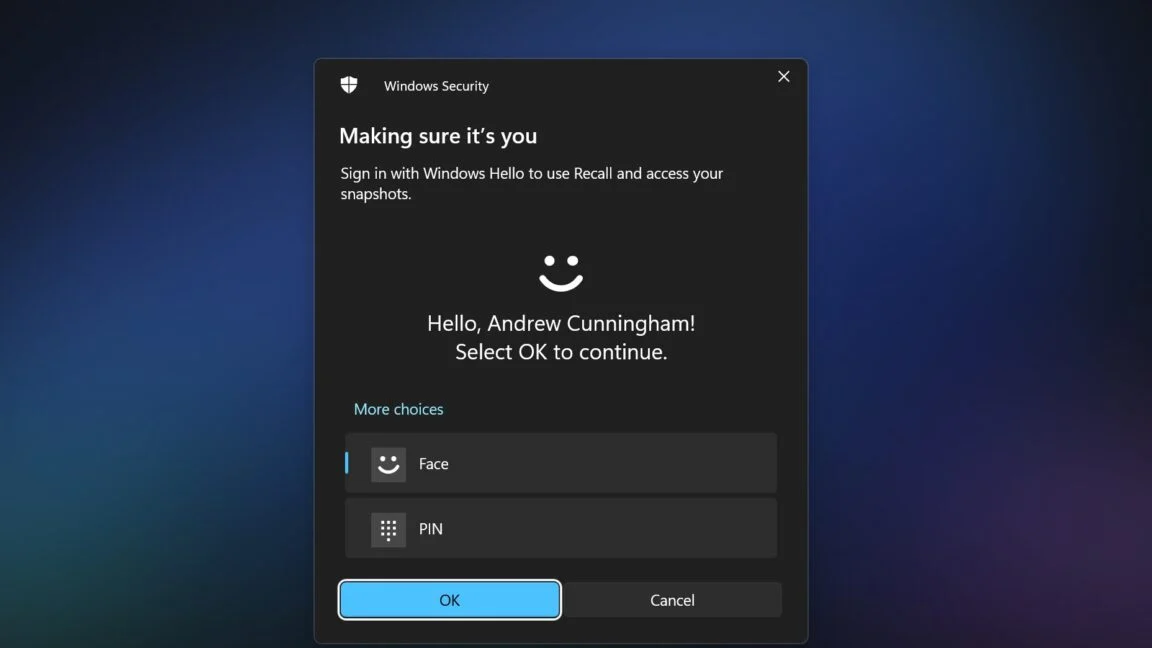
A significant security concern has emerged regarding Microsoft’s controversial Recall feature, with independent security researcher Alex Hagenah detailing a method to extract sensitive user data despite Microsoft’s assertion that the flaw does not constitute a vulnerability. The core of the problem, as elucidated by Hagenah on the TotalRecall GitHub page, lies not with the robust security protecting the Recall database itself, which he describes as "rock solid," but with the process by which this data is subsequently handled. Once a user has successfully authenticated, the system transfers Recall data to a separate process, AIXHost.exe, which critically lacks the same stringent security protections afforded to the primary Recall data store. Hagenah succinctly analogizes the situation: "The vault is solid. The delivery truck is not."
This architectural weakness allows for the potential unauthorized access and exfiltration of highly sensitive user information. The tool developed by Hagenah, dubbed TotalRecall Reloaded, leverages an executable file to inject a Dynamic Link Library (DLL) into the AIXHost.exe process. Crucially, this injection can be performed without requiring administrator privileges, significantly lowering the bar for potential attackers. Once injected, the tool operates in the background, patiently awaiting the user to initiate and authenticate a Recall session, typically via Windows Hello. Upon successful authentication, TotalRecall Reloaded gains the capability to intercept a wide array of data flowing to AIXHost.exe, including screenshots, Optical Character Recognition (OCR) extracted text, and various other metadata. This interception can persist even after the user concludes their active Recall session, allowing for continuous data capture.
Hagenah clarifies that his tool does not bypass the fundamental security provided by the Virtualization-Based Security (VBS) enclave, which houses the encrypted Recall data and requires Windows Hello for decryption. Instead, he notes, "The VBS enclave won’t decrypt anything without Windows Hello. The tool doesn’t bypass that. It makes the user do it, silently rides along when the user does it, or waits for the user to do it." This distinction is critical: the vulnerability exploits the legitimate data transfer post-authentication, rather than circumventing the initial authentication mechanism. However, certain operations, such as acquiring the most recent Recall screenshot, capturing specific metadata about the Recall database, and even deleting the entirety of a user’s Recall database, can be executed without any Windows Hello authentication whatsoever, presenting an even more immediate risk. Once authenticated, Hagenah further stated on LinkedIn that TotalRecall Reloaded can access both newly recorded information and historical data previously captured by Recall, providing a comprehensive window into a user’s digital activity.
Background and Initial Controversies of Microsoft Recall
Microsoft Recall was first unveiled at the company’s Build 2024 developer conference in May, positioned as a groundbreaking AI-powered feature for Copilot+ PCs. Designed to provide users with a "photographic memory" of their digital activities, Recall continuously captures screenshots of everything displayed on the user’s screen, analyzes the content, and stores it locally. Users can then search through their past interactions, documents, and web pages using natural language queries, effectively allowing them to "rewind" their computing experience.
From its very announcement, Recall was steeped in controversy, primarily due to profound privacy and security concerns. Critics quickly labeled it as "spyware," raising alarms about the sheer volume and sensitive nature of the data being collected. The idea of a system constantly recording and indexing every screen interaction, from confidential emails and financial transactions to personal conversations and medical information, ignited a firestorm among privacy advocates, cybersecurity experts, and the general public. Initial fears revolved around how this data would be stored, who could access it, and the potential for misuse, either by malicious actors or even by Microsoft itself.
Microsoft attempted to assuage these fears by emphasizing several key security measures. The company stated that all Recall data would be stored locally on the user’s device, not in the cloud. Furthermore, it would be encrypted using BitLocker and protected by the VBS enclave, ensuring that the data was isolated from the operating system and required Windows Hello authentication for access. Users were also promised granular control over the feature, including the ability to pause recording, filter specific applications, and delete their entire Recall history. Despite these assurances, the skepticism persisted, leading to significant backlash. This intense public and expert scrutiny ultimately compelled Microsoft to alter its deployment strategy. Initially slated for a broad rollout with the first wave of Copilot+ PCs in June, Microsoft later announced that Recall would first be made available through the Windows Insider Program, allowing for further testing and feedback before a wider release. This delay underscored the company’s struggle to balance innovative AI functionality with fundamental user privacy and security expectations.
Chronology of Discovery and Official Responses
The timeline of Alex Hagenah’s discovery and Microsoft’s official response highlights a fundamental disagreement regarding what constitutes a security vulnerability. Hagenah, demonstrating responsible disclosure, initially reported his findings to Microsoft’s Security Response Center (MSRC) on March 6. This early reporting provided Microsoft with ample opportunity to investigate and address the potential issue before the feature’s public release. However, on April 3, Microsoft officially classified Hagenah’s discovery as "not a vulnerability." This classification suggests that, from Microsoft’s perspective, the described method of data exfiltration does not cross a defined security boundary or exploit a flaw that the company deems critical enough for a patch.
Microsoft’s stance is typically predicated on the idea that if an attack requires physical access to the device and/or user authentication, it falls outside the scope of what they classify as a "security vulnerability" requiring a fix, particularly when discussing local privilege escalation. They argue that if a user has already authenticated, the system assumes a certain level of trust, and subsequent actions are within the user’s authenticated context. However, this definition often clashes with the broader understanding of security risks held by independent researchers and the wider cybersecurity community.
Alex Hagenah, for his part, has consistently maintained that the issue is significant. His detailed explanations on GitHub and LinkedIn, accompanied by the TotalRecall Reloaded tool, serve as a stark counterpoint to Microsoft’s official position. He clearly articulates that while the "vault" (the VBS-protected database) is indeed secure, the "delivery truck" (AIXHost.exe) that transports the data post-authentication is not, creating an avenue for unauthorized access to highly sensitive information. This divergence in classification underscores a recurring tension between vendor definitions of security boundaries and the practical realities of threat models in the wild.
Statements and Reactions from Related Parties
The contrasting viewpoints between Alex Hagenah and Microsoft have sparked wider reactions across the cybersecurity and privacy communities. Hagenah’s technical analysis is precise and direct. He emphasizes that the tool doesn’t break the encryption or bypass Windows Hello; rather, it intercepts data after the legitimate decryption and authentication process, making it a critical local privilege escalation and data exfiltration vector. His analogy of the "vault" and the "delivery truck" effectively communicates the nature of the vulnerability to both technical and non-technical audiences, highlighting that a secure storage mechanism is insufficient if the data transfer process is exposed.
Microsoft’s official response, reiterating that the issue is "not a vulnerability," is consistent with their established security boundary policies for certain types of local attacks. Their argument typically posits that attacks requiring an authenticated user session or physical access fall outside the scope of exploitable vulnerabilities that warrant a patch, particularly when the data is locally stored and protected by BitLocker and VBS. This perspective, however, has been met with considerable skepticism by many in the cybersecurity community.
Numerous security experts have publicly or privately expressed disagreement with Microsoft’s classification. Many argue that any mechanism allowing non-administrative users or malware to access sensitive data intended for the user, especially without explicit, real-time user consent, represents a significant security flaw. The ability to inject a DLL into a system process without elevated privileges and then harvest deeply personal information is widely considered a serious risk, particularly in corporate environments where insider threats or compromised user accounts are a concern. The fact that the data includes screenshots of potentially anything a user has viewed—passwords, financial details, medical records, confidential documents, private communications—amplifies these concerns.
Privacy advocates, already wary of Recall’s implications, have viewed this development as further validation of their initial fears. Organizations like the UK Information Commissioner’s Office (ICO) had previously initiated inquiries into Recall, citing concerns about its data collection practices and potential privacy impacts. This latest disclosure from Hagenah adds another layer of complexity to their investigations, reinforcing the argument that even with local storage and VBS protection, the inherent design of Recall introduces significant privacy risks that may not be adequately mitigated. The debate extends beyond a mere technical classification; it delves into fundamental questions about user control, data ownership, and the acceptable level of risk introduced by advanced AI features.
Analysis of Implications
The implications of Hagenah’s findings, irrespective of Microsoft’s official classification, are multifaceted and significant, particularly for user trust, data security, and the broader enterprise landscape.
User Trust and Microsoft’s Reputation: The most immediate casualty of this ongoing controversy is user trust. Recall was already struggling to gain acceptance due to its perceived "spyware" characteristics. This new revelation, demonstrating a practical method for data exfiltration, further erodes confidence in Microsoft’s ability to secure highly sensitive AI-driven features. Users may become increasingly hesitant to adopt new Windows functionalities, especially those that interact deeply with their personal data, if they perceive a disconnect between Microsoft’s security assurances and the reality of potential exploits. For a company that relies heavily on its ecosystem and the adoption of its new technologies, this erosion of trust can have long-term repercussions.
Data Security Risks: While Microsoft may not classify it as a "bug," the risk to user data is undeniable. The ability to intercept screenshots, OCR’d text, and metadata means that virtually any information displayed on a user’s screen—including passwords entered into forms, sensitive documents, private messages, banking details, or intellectual property—could be captured and potentially exfiltrated. This makes the Recall feature a prime target for sophisticated malware or malicious insiders. Even if an attacker needs to wait for a user to authenticate with Windows Hello, the ease of DLL injection without admin privileges significantly expands the attack surface. For ordinary users, this means that a seemingly benign application or a local network compromise could lead to a complete compromise of their digital history, without them ever being aware.
Enterprise and Regulatory Challenges: For businesses, the implications are even more severe. Deploying Copilot+ PCs with Recall enabled in a corporate environment could introduce substantial insider threat risks and compliance challenges. Employees handling sensitive client data, proprietary information, or regulated data (e.g., healthcare, financial) could inadvertently expose this information if their machines are compromised by malware exploiting this mechanism. Companies would face immense pressure to disable Recall entirely or implement extremely stringent security policies around its use, potentially negating the very productivity benefits Microsoft intends for the feature. Furthermore, regulatory bodies, such as the ICO, could intensify their scrutiny, potentially leading to fines or mandated changes if Recall is deemed non-compliant with data protection laws like GDPR or CCPA due to these vulnerabilities.
Microsoft’s Security Boundary Definition Debate: This incident reignites the perennial debate about Microsoft’s definition of security boundaries. While it’s common for vendors to draw lines, classifying certain local privilege escalations or post-authentication data exposures as "not a vulnerability" can appear out of step with the evolving threat landscape. Modern cybersecurity often emphasizes defense-in-depth, assuming that initial perimeters can be breached and focusing on limiting the damage thereafter. If an authenticated user’s session can be leveraged to extract deeply personal data without further explicit user consent or admin rights, many experts would argue this represents a failure in the defense-in-depth strategy, particularly for a feature designed to capture such a wide array of information. This incident may force Microsoft to re-evaluate its internal classification criteria for what constitutes an actionable security flaw, especially concerning features that handle highly sensitive user data.
Future of Recall: The ongoing security and privacy concerns, now amplified by Hagenah’s findings, could significantly impact the future trajectory of Recall. The feature has already been delayed once; further revelations of unaddressed risks could lead to additional postponements, substantial redesigns, or even its eventual shelving if public and enterprise resistance proves insurmountable. Microsoft faces a critical challenge: either to definitively address these perceived vulnerabilities to restore trust or risk Recall being seen as a liability rather than an innovation.
Supporting Data and Further Details
The sheer volume of data Recall is designed to capture makes any security weakness particularly alarming. Recall’s continuous screenshotting and OCR processing means it can index potentially millions of individual data points over time, forming an incredibly rich and detailed history of a user’s digital life. This includes not just documents and web pages, but also fleeting on-screen notifications, pop-up messages, video conference calls, and any other visual information that appears on the display. The local storage on an NPU-enabled Copilot+ PC is designed to handle this vast amount of data, reinforcing the idea of a "photographic memory."
The specific types of sensitive data at risk are broad:
- Financial Information: Bank statements, credit card details, investment portfolios, payment confirmations.
- Personal Communications: Private chats, emails, video call transcripts, social media interactions.
- Healthcare Data: Medical records, doctor’s notes, prescription information, health app data.
- Login Credentials: Usernames and passwords displayed during login processes or within password managers if the screen is captured.
- Intellectual Property: Confidential company documents, design plans, code snippets, research data.
- Legal Documents: Contracts, legal correspondence, court filings.
While Microsoft has reiterated the VBS enclave and local storage for security, Hagenah’s demonstration exposes a critical gap in the security chain after the initial data protection. The problem isn’t the vault itself, but the seemingly unprotected path that data takes from the vault to be processed by other components of the system. This architectural choice, perhaps made for performance or integration reasons, inadvertently creates a vector for compromise. The fact that TotalRecall Reloaded operates without administrator privileges is a game-changer, as it means even a standard user account, if compromised by basic malware, could be used to extract this sensitive data, bypassing more robust system-level protections.
This situation also highlights a broader industry trend where new AI capabilities, while promising enhanced user experiences, often introduce novel and complex security and privacy challenges. The integration of AI deeply into operating system functions, especially those involving continuous data collection and processing, demands an exceptionally high standard of security design and implementation.
In conclusion, the debate surrounding Microsoft Recall and Alex Hagenah’s TotalRecall Reloaded tool is more than a technical dispute over vulnerability classification. It is a critical examination of trust, data security, and the responsibilities of technology giants in an age of pervasive AI. Regardless of how Microsoft officially categorizes the issue, the practical demonstration of data exfiltration without administrator privileges poses a tangible and significant risk to user privacy and security. For Recall to gain widespread acceptance, Microsoft will likely need to go beyond its current stance and implement demonstrable, transparent changes that unequivocally address these profound concerns.