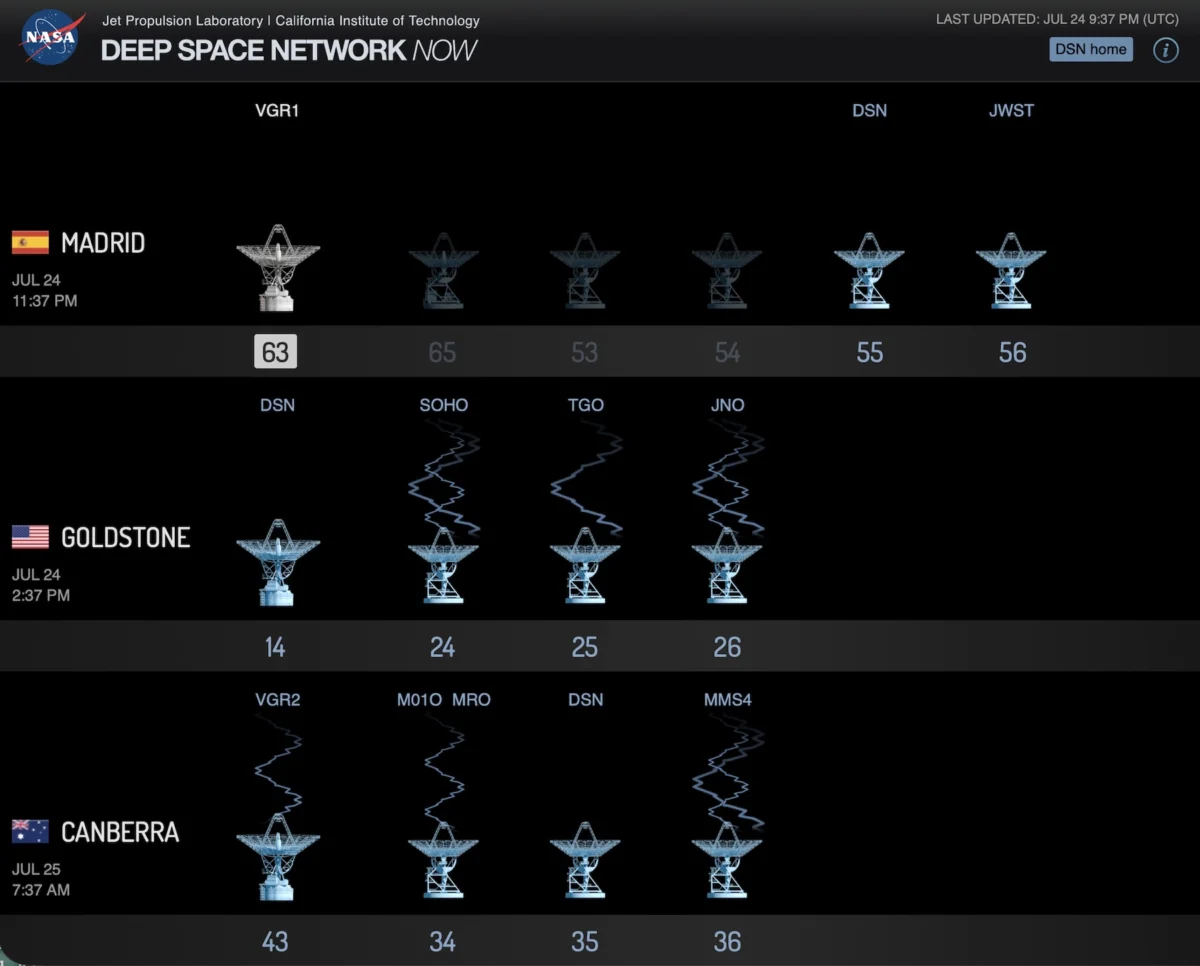
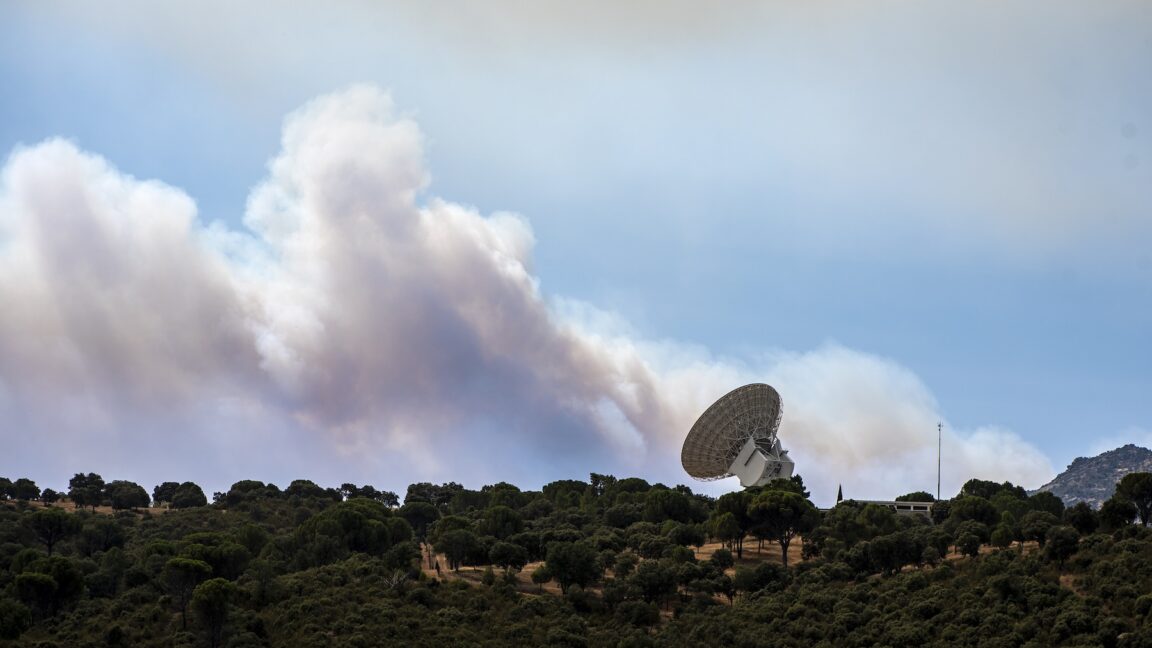
The Madrid Deep Space Communications Complex (MDSCC), a cornerstone of NASA’s global Deep Space Network (DSN), has ceased all operational activity as raging wildfires in Spain’s mountainous west of Madrid forced the evacuation of personnel and threatened critical infrastructure. This abrupt shutdown, observed Friday afternoon, July 24, 2026, through a NASA website providing real-time DSN status updates, leaves the vital network with severely diminished capacity, particularly impacting its ability to communicate with distant spacecraft exploring the solar system and beyond. While the DSN complexes in Goldstone, California, and Canberra, Australia, continued to track and communicate with various NASA missions, including the venerable Voyager 2 in interstellar space and the Jupiter orbiter Juno, the sudden incapacitation of the Madrid site presents a significant challenge to space operations.
The Deep Space Network: A Global Lifeline for Space Exploration
The Deep Space Network, managed by NASA’s Jet Propulsion Laboratory (JPL), is arguably the most sophisticated and sensitive scientific instrument on Earth. Comprising three strategically located complexes – Goldstone, California; Madrid, Spain; and Canberra, Australia – the DSN provides continuous, high-bandwidth radio communication with spacecraft navigating the vast distances of our solar system and venturing into interstellar space. Each complex is positioned approximately 120 degrees of longitude apart, ensuring that as the Earth rotates, at least one station always has a line of sight to deep space missions. This geographic distribution is crucial for maintaining uninterrupted contact, allowing for the transmission of commands, the reception of engineering telemetry, and the invaluable scientific data that forms the bedrock of planetary science and astrophysics.
Established in the late 1950s with the dawn of the Space Age, the DSN evolved from tracking early Explorer satellites to becoming the primary communication link for nearly all of NASA’s robotic interplanetary missions. Its large parabolic antennas, some reaching 70 meters (230 feet) in diameter, are capable of detecting faint radio signals from billions of miles away, signals that are often weaker than the power of a digital watch. These gargantuan dishes are not merely receivers; they are also powerful transmitters, sending commands that guide spacecraft through complex maneuvers, activate instruments, and even update onboard software. Without the DSN, missions like the Mars rovers, Cassini at Saturn, New Horizons at Pluto, and the twin Voyager probes would be impossible, effectively rendering humanity’s robotic explorers deaf and blind in the cosmos.
The Madrid Complex: A Crucial Link to the Cosmos
The Madrid Deep Space Communications Complex (MDSCC), officially designated DSS-60, is located near Robledo de Chavela, approximately 60 kilometers (37 miles) west of Madrid. It is a joint effort between NASA and Spain’s National Institute for Aerospace Technology (INTA). The complex houses several large antennas, including a 70-meter dish (DSS-63), which is among the largest and most powerful in the DSN, essential for communicating with the most distant spacecraft. It also features multiple 34-meter antennas (DSS-53, DSS-54, DSS-55, DSS-61, DSS-65, DSS-66) designed for various functions, including tracking missions closer to Earth or providing redundant support.
The Madrid site plays a particularly critical role in the network’s operations, often serving as the "first contact" station for newly launched missions heading out of Earth’s gravitational sphere, or providing crucial downlink opportunities as Earth’s rotation brings spacecraft into its view. Its location in Europe provides a unique observational window that complements the capabilities of the Goldstone and Canberra complexes. The temporary loss of this complex, especially its powerful 70-meter antenna, directly impacts the data flow and operational command capabilities for a significant portion of NASA’s deep space fleet.
Wildfires Force Evacuation: A Regional Crisis
The immediate cause of the Madrid DSN shutdown is the escalating wildfire crisis gripping regions west of the Spanish capital. Reports indicate that the intense blazes, fueled by a severe summer heatwave and prolonged drought conditions, have necessitated mass evacuations across several towns in the mountains surrounding Robledo de Chavela. Reuters reported that Spanish authorities ordered the evacuation of over 19,000 people from affected communities, deploying more than 2,000 personnel and 10 aircraft in a desperate effort to contain the fires. The proximity of the fires to the MDSCC posed an undeniable threat to both personnel and equipment, leading NASA to prioritize the safety and well-being of its staff.
"The safety and well-being of our personnel is our highest priority and our thoughts are with the families and neighbors who are also experiencing the impact of the wildfires in the surrounding communities," NASA stated, emphasizing the human dimension of the crisis. "We will provide updates as conditions evolve." This statement underscores the severity of the situation on the ground, where communities are battling a formidable natural disaster.
The wildfires are part of a broader trend across Southern Europe, where climate change is exacerbating extreme weather events. Record-breaking temperatures, extended periods of drought, and strong winds create a volatile environment, turning dry vegetation into highly flammable fuel. This year has seen an alarming increase in the frequency and intensity of wildfires across Spain, Portugal, Greece, and France, leading to widespread destruction, displacement, and significant ecological damage. The fires near Madrid are a stark reminder of how terrestrial events can directly impinge on humanity’s most ambitious endeavors in space.
Concurrent Challenges: California’s Antenna Remains Offline
Compounding the crisis in Madrid is the ongoing incapacitation of one of the DSN’s other critical 70-meter antennas, located at the Goldstone Deep Space Communications Complex (GDSCC) in California. The DSS-14 antenna, also known as "Mars," has been offline since an accident occurred last year, believed to be around June 2025. The incident involved an "over-rotation" of the massive dish, a mechanical malfunction that caused significant damage to the antenna’s delicate internal mechanisms, including cables and water lines. This catastrophic event led to an estimated 200,000 gallons of glycol-contaminated water flooding the base of the antenna, creating not only a structural repair challenge but also an environmental hazard requiring extensive cleanup.
The repairs to DSS-14 are complex and costly, projected to range between $4.1 million and $4.6 million. NASA officials have opted to combine these essential repairs with already-planned upgrades to the antenna’s systems, aiming to enhance its capabilities and extend its operational lifespan. However, this integrated approach means a prolonged period of unavailability, with the work expected to keep the antenna offline well into 2028. The Goldstone complex, situated in California’s Mojave Desert, is also home to multiple 34-meter antennas and another 70-meter dish (DSS-15, though often used for different frequency bands or as a backup), but the loss of DSS-14, a primary workhorse, has significantly reduced the network’s redundancy and capacity for critical missions.
Operational Strain: A Network Under Pressure
With the Madrid 70-meter antenna (DSS-63) offline due to the wildfires and the Goldstone 70-meter antenna (DSS-14) out of commission for repairs, the Deep Space Network is currently reliant on a single operational 70-meter radio antenna: DSS-43 at the Canberra Deep Space Communication Complex (CDSCC) in Australia. This situation represents an unprecedented operational strain on the network.
The 70-meter antennas are crucial because their immense size and sensitivity allow them to detect the extremely faint signals from the most distant spacecraft, such as the Voyager probes, which are billions of miles away. As radio signals travel across vast cosmic distances, they attenuate significantly, requiring the largest possible "ears" on Earth to hear them. While the DSN has numerous 34-meter antennas, these are primarily used for missions closer to Earth or for less demanding communication tasks. They lack the raw power and sensitivity to reliably communicate with the likes of Voyager 2.
The reliance on a single 70-meter dish means that mission planners must meticulously schedule communication windows, potentially leading to reduced data downlink opportunities, delays in receiving critical telemetry, and even limitations on sending commands. If DSS-43 in Canberra were to experience any technical issues or require maintenance, the DSN would effectively lose its ability to communicate with its most distant assets, a scenario that carries substantial risk for ongoing scientific missions.
Impact on Current Missions: Voyager 2, Juno, and Beyond
The immediate impact of the Madrid outage, exacerbated by the existing Goldstone situation, is felt across a spectrum of deep space missions.
- Voyager 2: One of the most venerable and distant spacecraft, Voyager 2 is currently exploring interstellar space, having crossed the heliopause in 2018. At over 19 billion kilometers (12 billion miles) from Earth, its signal is incredibly weak, requiring the combined sensitivity of the 70-meter antennas to reliably receive its data and send commands. With two of the three 70-meter dishes offline, the ability to maintain consistent contact with Voyager 2 becomes significantly constrained. This could lead to longer gaps between data transmissions, potentially impacting the continuity of its interstellar measurements.
- Juno: Currently orbiting Jupiter, Juno is conducting a detailed study of the gas giant’s atmosphere, magnetosphere, and internal structure. While Jupiter is closer than interstellar space, Juno’s mission generates enormous volumes of high-resolution imagery and scientific data. The 70-meter antennas are vital for efficiently downlinking this large data volume. Reduced access to these large dishes could mean longer download times, a backlog of data, or even a temporary reduction in instrument operation to conserve data until communication windows become available.
- Other Deep Space Missions: Numerous other missions, including those at Mars (e.g., Perseverance rover, Mars Reconnaissance Orbiter), Saturn (e.g., Cassini’s legacy data, if still being processed), and other planetary probes, rely on the DSN. While many of these can utilize 34-meter antennas, the 70-meter dishes provide critical redundancy and higher data rates, especially for complex operations or anomaly resolution. The loss of Madrid’s capacity forces a re-prioritization and tighter scheduling across the entire network.
Mission teams will now have to re-evaluate their communication plans, potentially shifting schedules to align with Canberra’s visibility windows and increasing reliance on the smaller 34-meter antennas where feasible. This requires meticulous planning and introduces an element of risk, as unexpected events could further disrupt the already limited communication resources.
Future Implications: The Artemis Program and Human Spaceflight
While the immediate concern is for robotic missions, the long-term implications for NASA’s ambitious Artemis program, aimed at returning humans to the Moon and eventually sending them to Mars, are significant. The good news for DSN is that the next crewed Artemis mission is still a couple of years away, providing a window for potential recovery and repair.
Artemis missions place exceptionally high demands on the DSN. Unlike robotic probes, human spaceflight requires continuous, high-bandwidth communication for a multitude of reasons:
- Real-time Telemetry: Constant monitoring of crew health, spacecraft systems, and environmental controls.
- Voice Communication: Live audio links between astronauts and mission control.
- High-Definition Video: Live imagery from the lunar surface and orbital operations, crucial for public engagement and operational awareness.
- Command and Control: Rapid transmission of critical commands for spacecraft maneuvers and emergency procedures.
- Navigation and Tracking: Precise tracking data for accurate trajectory adjustments.
The original plan for Artemis II, the first crewed test flight around the Moon, would have placed significant demands on the DSN. While Artemis II’s trajectory is now focused on low-Earth orbit to test the Orion capsule with commercial lunar landers from SpaceX and Blue Origin, subsequent missions will venture much further. Artemis III, slated for no earlier than 2028, is targeted to be the first lunar landing with astronauts in decades. Artemis IV, also targeted for 2028, will further expand lunar infrastructure. These missions will require the full, robust capabilities of the DSN, particularly its 70-meter dishes, to ensure the safety and success of human explorers operating millions of miles from Earth.
The current situation highlights the critical need for a fully operational DSN, with redundant 70-meter capabilities, before the Artemis program progresses to its most complex and risk-intensive phases. Delays in DSN repairs or unforeseen issues could potentially impact the ambitious timelines for human lunar exploration.
Contingency and Resilience: Navigating the Crisis
NASA and its partners, including the European Space Agency (ESA), operate with robust contingency plans for such scenarios. While the DSN is designed for redundancy, the simultaneous loss of two 70-meter antennas pushes these contingencies to their limits.
Notably, a separate deep space tracking station owned and operated by the Spanish government and ESA was also evacuated due to the wildfires. The Cebreros tracking station, part of ESA’s Estrack network, is located just a few miles from NASA’s DSN facility. Estrack operates a network of ground stations across the globe, similar in function to the DSN, supporting ESA’s own scientific and Earth observation missions. The evacuation of Cebreros further underscores the widespread impact of the wildfires on critical space infrastructure in the region and implies a shared challenge for both agencies. This mutual vulnerability may prompt increased collaboration and resource sharing once the immediate crisis subsides.
In the interim, NASA will be maximizing the use of the remaining 34-meter antennas at all three complexes, as well as the sole operational 70-meter antenna in Canberra. This will necessitate stringent scheduling, prioritization of data, and potentially a temporary reduction in data rates for some missions. Engineers will be working tirelessly to optimize the available resources to minimize the impact on ongoing scientific research and mission operations. Furthermore, close coordination with international partners, including ESA, may become even more critical to leverage any available alternative communication assets.
Broader Context: Climate Change and Infrastructure Vulnerability
The wildfires forcing the Madrid DSN shutdown serve as a stark reminder of the increasing vulnerability of critical global infrastructure to the impacts of climate change. As global temperatures rise, heatwaves become more frequent and intense, and drought conditions persist, the risk of natural disasters like wildfires, floods, and extreme storms grows exponentially. Facilities like the DSN, while designed to be robust, are not immune to these large-scale environmental threats.
The economic and operational costs associated with these events are substantial. The repairs at Goldstone, costing millions of dollars, combined with the operational disruption in Madrid, represent significant unplanned expenditures and potential delays in scientific returns. As societies become more reliant on complex technological infrastructure, ensuring its resilience against climate-related threats will become an increasingly urgent priority for governments and space agencies worldwide. This event may prompt a review of site selection criteria, fire suppression protocols, and contingency planning for all DSN complexes, especially those in regions prone to extreme weather.
Looking Ahead: Recovery and Adaptation
The immediate focus for the Madrid Deep Space Communications Complex will be on ensuring the safety of personnel and assessing any potential damage to the facility once the wildfire threat has receded and it is safe to return. The timeline for its full operational recovery will depend entirely on the evolution of the fires and any damage sustained. Simultaneously, the arduous repair and upgrade work at Goldstone’s DSS-14 will continue, with the expectation of its return to service by 2028.
This dual challenge highlights a critical juncture for the Deep Space Network. The network’s resilience, built over decades of operational experience, is being tested by concurrent and significant outages. As humanity pushes further into space, demanding ever more data and precise control, the foundational infrastructure that enables these endeavors must evolve to meet both the technical demands of new missions and the growing environmental challenges on Earth. The events unfolding in Spain underscore the interconnectedness of our terrestrial environment with our aspirations in the cosmos, urging a renewed focus on both technological robustness and environmental stewardship.