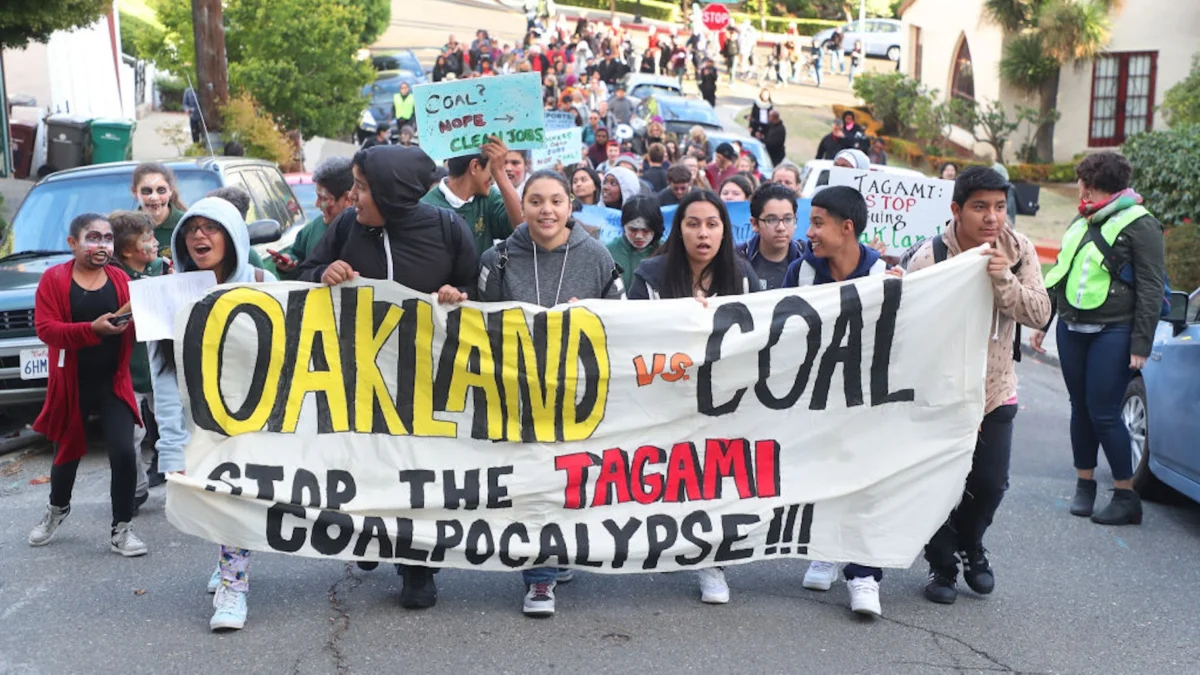
The U.S. Department of Energy has announced an allocation of up to $75 million in federal funding to support the construction of a long-stalled export terminal in Oakland, California, marking a significant intervention by the Trump administration into one of the most protracted environmental and legal conflicts in the state’s recent history. This financial injection, facilitated through the Defense Production Act, aims to revitalize a project that has been mired in litigation for over a decade, pitting local government and environmental advocates against private developers and federal energy interests. The funding is part of a broader $500 million package intended to bolster the nation’s coal infrastructure, even as the domestic market for the fossil fuel continues to face structural declines.
The proposed terminal, situated on the site of the former Oakland Army Base, was originally envisioned as a multi-commodity bulk facility. However, the discovery of plans to use the site as a primary conduit for Utah coal sparked a firestorm of local opposition. The latest federal move is viewed by proponents as a necessary step toward "energy dominance" and by critics as a taxpayer-funded "life preserver" for a project that has repeatedly failed to secure private financing or clear local regulatory hurdles. As the project moves into its second decade of controversy, the intersection of federal authority, municipal rights, and environmental justice remains at the heart of the dispute.
Historical Context: The Decommissioned Base and the Initial Vision
The saga began in 2013 when the City of Oakland entered into a development agreement with California Capital & Investment Group (CCIG), led by prominent local investor Phil Tagami. The goal was to redevelop the West Oakland waterfront, specifically the defunct Oakland Army Base which had been decommissioned in 1999. The city sought to modernize its port infrastructure to remain competitive with other West Coast hubs like Long Beach and Seattle.
At the time of the initial agreement, Tagami and his partners assured the city and the public that the facility would be a "world-class" bulk terminal capable of handling a variety of commodities. Early rumors regarding the shipment of coal were dismissed by the developers. In a December 2013 newsletter, Tagami characterized concerns about coal as "misinformed," emphasizing that the project was focused on general cargo that would bring jobs and economic revitalization to the West Oakland area—a community that has historically suffered from high rates of unemployment and industrial pollution.
However, the narrative shifted dramatically in 2015. An investigative report by the Salt Lake Tribune revealed that the developers had been in clandestine negotiations with four coal-producing counties in Utah. The plan involved a $53 million investment from Utah’s Permanent Community Impact Fund Board to secure capacity at the Oakland terminal for the export of bituminous coal to Asian markets. The revelation transformed a local development project into a national flashpoint for the "Keep It In The Ground" movement.
The Legal Tug-of-War: Contracts vs. Public Health
Following the 2015 revelation, the Oakland City Council faced immense pressure from constituents and environmental organizations, including the Sierra Club and San Francisco Baykeeper. In 2016, the city moved to block the shipment of coal by passing an ordinance and a resolution that prohibited the storage and handling of coal and coke within city limits. The city justified the move by citing significant health risks, particularly the emission of coal dust (particulate matter), which is linked to respiratory issues and cardiovascular disease.
The developers immediately filed a federal lawsuit, arguing that the city had breached the 2013 development agreement. The core of their argument rested on a "vested rights" clause, which stipulated that the project would be governed by the regulations in place at the time the contract was signed. By passing a new ordinance specifically targeting the terminal’s primary intended commodity, the developers claimed the city was moving the goalposts.
In 2018, U.S. District Judge Vince Chhabria ruled in favor of the developers. While the judge did not dispute the city’s right to protect public health, he found that the evidence presented by the city regarding the specific dangers of coal dust at the terminal was insufficient and technically flawed. The court noted that the city’s record was "riddled with inaccuracies" and failed to meet the high burden of proof required to override a pre-existing contract under the "substantial danger" exception. This ruling was later upheld by the Ninth Circuit Court of Appeals, dealing a major blow to the city’s legal strategy.
Financial Collapse and the Kentucky Bankruptcy
While the developers won in court, the project struggled to maintain financial momentum. The protracted legal battle discouraged private investors, and the primary operator slated for the terminal, Insight Terminal Solutions (ITS), eventually spiraled into financial distress. In a surprising turn, ITS filed for Chapter 11 bankruptcy in Kentucky, the heart of American coal country, rather than in California.
During the bankruptcy proceedings, ITS and its backers alleged that Oakland’s "regulatory hostility" had caused more than $650 million in damages. A bankruptcy judge initially sided with the company, suggesting the city was liable for the project’s failure. However, this ruling was vacated by a federal district court late last year, providing a temporary reprieve for Oakland’s municipal treasury, which has already spent millions on legal fees.
The project’s inability to break ground despite legal victories highlighted a fundamental weakness: without federal support or a massive shift in market dynamics, the Oakland coal terminal was a "zombie project"—legally alive but financially terminal.
Federal Intervention: The Role of the Department of Energy
The recent announcement by Energy Secretary Chris Wright marks a pivot in federal policy toward the Oakland project. By utilizing the Defense Production Act (DPA)—a Korean War-era law typically reserved for national emergencies—the Trump administration is positioning coal exports as a matter of national security and economic strategy.
"For too long, limited West Coast export capacity has constrained America’s ability to move coal and other energy resources to global markets," Secretary Wright stated. He argued that the $75 million investment is essential for "advancing American energy dominance" and ensuring that U.S. coal can compete with Russian and Australian supplies in the Indo-Pacific region.
This funding is part of a broader administrative push to deregulate the coal industry. Over the past year, the Department of Energy and the EPA have:
- Loosened Mercury and Air Toxics Standards (MATS) for coal-fired power plants.
- Delayed the closure of aging coal facilities scheduled for retirement.
- Shifted the oversight of toxic coal ash disposal from federal to state authorities.
- Allocated $400 million to upgrade existing coal infrastructure across 13 states.
For the Oakland terminal, the $75 million is intended to cover the remaining construction costs and environmental mitigation technologies that the developers claim will make the facility the "cleanest coal terminal in the world."
Environmental Justice and Community Reaction
The community of West Oakland remains the epicenter of the resistance. Residents point out that their neighborhood already experiences diesel particulate matter levels significantly higher than the California average due to its proximity to the Port of Oakland and major freeway interchanges.
"This community has been a dumping ground for industrial pollution for decades," said Ben Eichenberg, an attorney with San Francisco Baykeeper. "The idea that the federal government is using taxpayer money to force a coal terminal into a neighborhood that has fought it at every level is an affront to environmental justice."
Environmental groups argue that the "enclosed" domes and railcars promised by developers are not foolproof. They cite data from other coal export hubs showing that coal dust can escape during loading and unloading processes, contributing to PM2.5 and PM10 pollution. Furthermore, they argue that the global climate impact of exporting millions of tons of coal contradicts California’s aggressive carbon reduction goals.
Chronology of the Oakland Coal Conflict
- 2012-2013: City of Oakland approves the redevelopment of the Oakland Army Base; CCIG signs a 66-year lease.
- 2014: Developers begin secret negotiations with Utah coal interests.
- 2015: The Salt Lake Tribune exposes the plan to ship coal through the terminal.
- 2016: Oakland City Council votes unanimously to ban coal storage and handling.
- 2017: Developers sue the city in federal court for breach of contract.
- 2018: Judge Vince Chhabria strikes down the city’s coal ban; city appeals.
- 2020: Ninth Circuit Court of Appeals affirms the lower court’s ruling against the city.
- 2022-2023: Insight Terminal Solutions files for bankruptcy; legal battles move to Kentucky and then back to federal district courts.
- Late 2023: Federal court vacates the $650 million damage claim against Oakland.
- Current: Department of Energy announces $75 million in DPA funding to jumpstart construction.
Implications and Future Outlook
The infusion of federal cash does not mean the terminal will begin operations immediately. The project still faces a gauntlet of state and regional permits. The Bay Area Air Quality Management District (BAAQMD) has the authority to impose stringent air quality requirements that could make the project economically unviable despite the federal subsidy.
Furthermore, the State of California has historically used its authority under the Clean Water Act (Section 401) to block energy projects it deems harmful to the environment, a tactic previously used by Washington and Oregon to stop coal terminals in the Pacific Northwest.
The Oakland coal saga serves as a microcosm of the broader American struggle over energy transition. While the federal government attempts to provide a "lifeline" to traditional energy sectors, local and state governments are increasingly using land-use and public health authorities to pivot toward a green economy. For the residents of Oakland, the battle is no longer just about a contract; it is a fight over the future of their waterfront and the air they breathe. As litigation continues and the permitting process begins anew, the $75 million "life preserver" may yet find itself tossed into turbulent and unforgiving waters.