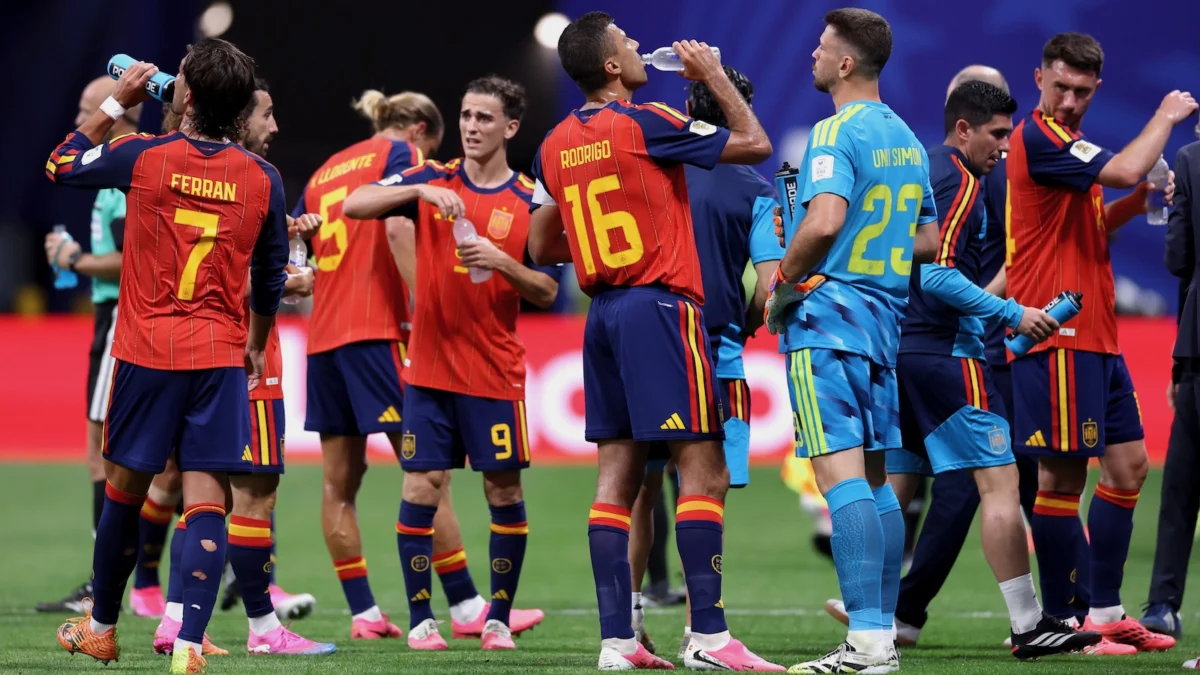
As the United States national team prepares to take the pitch against Australia this afternoon, millions of soccer fans across the globe are bracing for a viewing experience that looks fundamentally different from any previous iteration of the tournament. For the casual observer who has not tuned into a major international match since the 2022 World Cup in Qatar, the most jarring change is not found in the tactics or the technology, but in the rhythm of the clock: the implementation of mandatory three-minute hydration breaks midway through each half. While FIFA, the sport’s global governing body, defends the move as a critical intervention for player safety in an era of accelerating climate change, the policy has ignited a firestorm of criticism from fans, broadcasters, and purists who view the breaks as a thinly veiled attempt to maximize advertising revenue.
The controversy, already dubbed "Water-gate" by British tabloids, has transcended the sports pages to become a flashpoint in the broader debate over how global institutions adapt to a warming planet. To critics, the breaks represent a "momentum killer" and a "money-grabbing disgrace," as labeled by the Daily Mail’s chief sportswriter. To FIFA, they are a necessary evolution to protect the "beautiful game" from the harsh realities of 21st-century meteorology.
The Evolution of Cooling Breaks: From Exception to Mandate
To understand the current friction, one must look at the history of how soccer has handled extreme weather. Historically, FIFA’s regulations regarding cooling breaks were reactive and strictly contingent on environmental data. Prior to the 2026 World Cup, officials utilized the Wet Bulb Globe Temperature (WBGT) index—a sophisticated metric that combines air temperature, humidity, wind speed, and solar radiation—to determine if a match required a pause. Under the old protocol, cooling breaks were only sanctioned if the WBGT exceeded 32 degrees Celsius (approximately 89.6 degrees Fahrenheit).
The first official cooling break in World Cup history did not occur until 2014, during a Round of 16 match between the Netherlands and Mexico in Fortaleza, Brazil. At that time, the decision was seen as a pragmatic response to the tropical heat of the Brazilian coast. However, for the 2026 tournament, which is being hosted across 16 cities in the United States, Canada, and Mexico, FIFA has discarded the contingency-based model in favor of a universal mandate.
The new rule dictates that hydration breaks will occur in every match, regardless of the ambient temperature or the presence of climate-controlled environments. This includes matches played in covered stadiums with advanced air conditioning systems, as well as evening matches in cooler northern climates. FIFA’s official stance, articulated in a December policy announcement, emphasizes uniformity and fairness. The organization argues that because the tournament is spread across three massive nations with vastly different climates, applying the rule universally ensures that no team gains a physical advantage or disadvantage based on their group-stage geographic assignments.
The Intersection of Climate Change and Athlete Welfare
The shift toward mandatory breaks did not happen in a vacuum. It follows years of increasing pressure from FIFPRO, the global union for professional football players. Following a series of summer tournaments in North America where players reported symptoms of heat exhaustion, FIFPRO released a scientific study urging FIFA to prioritize "mitigation strategies that protect the health and wellbeing of our players."
The union argued that the physical demands of modern soccer—where elite players often cover 10 to 12 kilometers per match at high intensity—make them uniquely vulnerable to heat stress. As global temperatures continue to break records, the risk of heatstroke, dehydration, and long-term renal issues has moved from a peripheral concern to a central operational risk. "It has never been more important to give space to scientific knowledge," FIFPRO stated in a press release leading up to the tournament.
Despite this scientific backing, the application of the rule has been met with skepticism. Virgil van Dijk, the veteran captain of the Netherlands squad, expressed a sentiment shared by many players: that while heat protection is vital, a "one-size-fits-all" approach may be unnecessary. "If it’s really hot, obviously it will be good to put them in," Van Dijk noted. "But I think you have to look at it in every game separately."
The Commercial Engine: Advertising and the "Quarter" System
The primary driver of public outrage is not the water itself, but what happens on television screens while the players are drinking it. Unlike the traditional soccer format, which offers only a single 15-minute window for commercials at halftime, the new hydration breaks provide broadcasters with two additional high-value windows per match.
Financial data suggests the stakes are enormous. According to reports from The Wall Street Journal, a 30-second advertisement during early-round matches of the World Cup sells for approximately $200,000. For high-stakes matches involving the U.S. national team, that price tag can soar to $750,000 per 30-second spot. By mandating a three-minute break in each half, FIFA has effectively created over four minutes of additional "premium" ad time per game.
John Kosner, a former executive at ESPN, observed that FIFA has "essentially divided the game into quarters," mirroring the structure of American football or basketball. This structural shift is particularly lucrative because these breaks occur during peak engagement, unlike the halftime interval when many viewers step away from their screens.
The tension between commercial interests and broadcast quality reached a boiling point during the tournament’s opening match. The American broadcaster, Fox, cut to a commercial block during the first hydration break. However, the advertisements ran longer than the three-minute stoppage. When the broadcast returned to the pitch, the game had already resumed, leaving viewers confused and angry. Fox later explained that they missed the referee’s signal to restart because it occurred during a replay, and while FIFA declined to sanction the network, the incident fueled the narrative that the breaks are designed for sponsors rather than fans.
Comparative Broadcast Strategies
Interestingly, not all broadcasters have embraced the commercial potential of "Water-gate." In the United Kingdom, the BBC—which is publicly funded and does not run traditional commercials—uses the breaks to provide rapid-fire tactical analysis or player close-ups, maintaining the flow of the sporting narrative. Similarly, Telemundo, the Spanish-language broadcaster in the U.S., has opted to keep the camera on the field for many of these breaks, focusing on the coaching adjustments being made on the sidelines.
These differing approaches highlight a growing divide in how the sport is consumed. For traditionalists, the continuous 45-minute half is a sacred element of soccer’s "flow." The introduction of mandatory stoppages is seen by many as the "Americanization" of the sport, where the rhythm of the game is sacrificed for the convenience of the advertising industry.
On social media platforms like Reddit, the backlash has been visceral. Fans have lamented that FIFA has "ruined the beautiful game," with many pointing out the absurdity of holding hydration breaks during matches where the temperature is a mild 74 degrees Fahrenheit. The booing heard in stadiums during matches like England vs. Croatia serves as an audible testament to the frustration of spectators who feel the match’s momentum is being artificially throttled.
Tactical Implications and the Coach’s Perspective
Beyond the fans and the financiers, the mandatory breaks are having a profound impact on the tactical side of the game. In traditional soccer, a coach’s ability to influence the game is largely limited to the pre-match talk, halftime, and the limited instructions they can shout from the technical area. The three-minute hydration break effectively serves as a "timeout," allowing coaches to pull their players together, adjust formations, and break the momentum of an opposing team that might be dominant.
Chris Taylor, the head coach of Vermont Green FC—a club known for its focus on climate justice—acknowledges the necessity of heat protection but remains wary of FIFA’s implementation. "I don’t think the health of the players is their primary concern," Taylor said, reflecting on the 2026 tournament’s atmosphere. "This World Cup has felt that every angle has been monetized."
From a tactical standpoint, Taylor notes that every soccer game is different. A team trailing by one goal in the 30th minute might find their rhythm disrupted by a mandatory break, while a defending team under heavy pressure might welcome the respite. By making the breaks mandatory rather than discretionary based on weather, FIFA has introduced a new variable into the game’s strategic landscape that some argue rewards defensive, "stalling" tactics.
The Broader Impact: Precedent for Future Tournaments
The 2026 World Cup serves as a litmus test for the future of international sport. As FIFA looks toward the 2030 tournament, which will span three continents, and the 2034 tournament, widely expected to be held in the extreme heat of Saudi Arabia, the "hydration break" model is likely to become a permanent fixture.
The implications extend beyond soccer. As global temperatures rise, other outdoor sports—including tennis, cricket, and marathon running—are being forced to re-evaluate their structures. FIFA’s decision to prioritize a universal mandate over a data-driven approach suggests that the organization is moving toward a future where "climate-proofing" a sport also means re-engineering it for commercial stability.
However, the "Water-gate" controversy suggests that FIFA has a significant public relations challenge ahead. To regain the trust of the global fanbase, the organization may need to find a middle ground—perhaps returning to a system where breaks are triggered by objective heat data but managed with greater transparency and fewer commercial interruptions.
Conclusion: A Game in Transition
As the U.S. and Australia take the field today, the eyes of the world will be on the players, but the ears of the world will be listening for the referee’s whistle at the 25-minute mark. The mandatory hydration break has become more than just a pause for water; it is a symbol of a sport in transition, caught between the urgent demands of a changing climate and the relentless pursuit of profit.
Whether these breaks are a vital safety measure or a "money-grabbing disgrace" may depend on who you ask: a physiologist concerned with core body temperatures, a broadcast executive looking at quarterly earnings, or a fan in the stands watching their team’s momentum evaporate during a three-minute ad for a soft drink. What is certain is that the "beautiful game" is no longer immune to the pressures of the modern world, and the 2026 World Cup may be remembered as the moment the clock stopped for good.