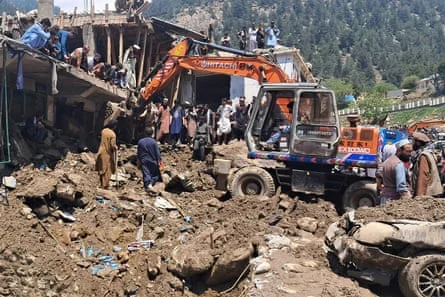
Rescue crews in Afghanistan are engaged in a desperate search for survivors and bodies amidst the extensive rubble of homes obliterated by devastating flash floods. Authorities have confirmed the deaths of nearly two dozen people, with more than 100 individuals reported missing following the torrents that swept through the eastern province of Nuristan. The catastrophe underscores Afghanistan’s extreme vulnerability to natural disasters, a challenge amplified by decades of conflict, severe infrastructural deficits, and the escalating impacts of climate change.
The Afghanistan National Disaster Management Authority (ANDMA) released an updated toll on Tuesday, confirming that 23 people had perished and 80 had sustained injuries. The agency also reported over 100 individuals unaccounted for after the floods, which commenced on Monday, caused an unspecified number of buildings to collapse, particularly in the provincial capital city of Parun and surrounding areas. Eyewitness accounts and initial assessments paint a grim picture of communities overwhelmed by sudden deluges, leaving behind scenes of widespread destruction and human tragedy.
The Unfolding Disaster in Nuristan
The mountainous and often remote province of Nuristan, known for its rugged terrain and deep valleys, bore the brunt of the initial flash flood wave. On Monday, residents experienced an abrupt and powerful surge of water, mud, and debris, which cascaded down hillsides and through riverbeds, catching many unprepared. The speed and force of the floodwaters were such that entire homes, often constructed from traditional mud-brick and timber, were either swept away or severely damaged, burying families beneath the debris. The remote nature of Nuristan, coupled with limited communication infrastructure, initially hampered the rapid assessment of the damage and the immediate coordination of rescue efforts.
Local officials, working with the scant resources available, were among the first responders, attempting to reach affected villages. The provincial capital, Parun, typically a bustling hub for the region, found its streets turned into raging rivers, with significant structural damage reported across its residential areas. The loss of life and the high number of missing persons highlight the sudden and overwhelming nature of the disaster, leaving families in agonizing suspense as search operations continue.
Rising Toll and Urgent Search Efforts
As Tuesday dawned, the scale of the tragedy became clearer. ANDMA, coordinating with local authorities, mobilized available teams to conduct search and rescue missions. The work is arduous and fraught with danger, as unstable ground, lingering mud, and the threat of further collapses make the recovery of bodies and the search for survivors a challenging endeavor. Excavators and heavy machinery, where accessible, are being used to clear vast quantities of mud and rubble, while residents and volunteers, often using only shovels and their bare hands, sift through the debris with desperate hope.
The figure of over 100 missing persons is particularly distressing, suggesting that the final death toll could rise significantly. Many of those missing are believed to have been caught inside their homes or swept away by the powerful currents. The injured, some critically, are being transported to the nearest medical facilities, which are often rudimentary and already stretched thin by the country’s ongoing humanitarian crisis. Access to remote areas, cut off by damaged roads and bridges, remains a major logistical hurdle for aid delivery and further search operations.
Foreboding Forecasts and Heightened Alert
Compounding the immediate crisis is the ominous forecast for even more extreme weather across Afghanistan. The Ministry of Transport and Civil Aviation’s meteorology department issued a stark warning on Monday evening, predicting heavy rain, thunderstorms, strong winds accompanied by dust and sand, and further flash floods in 10 of the country’s 34 provinces. This includes regions that may already be saturated from recent rainfall, increasing the risk of landslides and further flooding. The ministry specifically advised citizens to exercise extreme caution, urging them to avoid riverbanks and other areas identified as high-risk for flooding.
This persistent threat of severe weather events presents a significant challenge for rescue and relief operations, potentially hindering access to affected areas and endangering those already displaced or involved in recovery efforts. The cyclical nature of these warnings highlights the urgent need for robust early warning systems and comprehensive disaster preparedness strategies, which are largely absent or severely underdeveloped in many parts of Afghanistan. The prospect of successive natural calamities threatens to further exacerbate the already dire humanitarian situation.
Afghanistan’s Perennial Vulnerability
Afghanistan’s geographical and socio-economic landscape renders it acutely vulnerable to extreme weather phenomena. Situated in a region prone to seismic activity and characterized by rugged mountains and arid plains, the country experiences a wide array of natural hazards, including earthquakes, droughts, avalanches, and crucially, flash floods triggered by snowmelt and heavy rainfall. The country’s largely agrarian population often settles in river valleys or on mountain slopes, placing them directly in the path of such destructive forces.

Decades of protracted conflict have decimated Afghanistan’s infrastructure, leaving roads, bridges, and communication networks in a dilapidated state. This significantly impedes humanitarian access and disaster response capabilities, particularly in remote, mountainous regions like Nuristan. The struggling economy means that communities lack the resources to build resilient homes or implement effective mitigation measures. Furthermore, widespread deforestation, driven by a desperate need for fuel and building materials, has stripped hillsides of their natural protection, accelerating soil erosion and increasing the likelihood and severity of flash floods. When heavy rains fall on denuded land, the water runs off rapidly, carrying vast amounts of sediment and debris, turning streams into destructive torrents.
A History of Catastrophe: Previous Flood Events
The recent floods in Nuristan are not an isolated incident but rather a tragic continuation of a distressing pattern of natural disasters afflicting Afghanistan. The year 2024 has already seen an alarming number of fatalities due to similar events. In springtime, more than 300 people perished in a series of flash floods that swept across several provinces, inundating villages and destroying livelihoods. Earlier in the year, at least 110 individuals lost their lives to widespread flooding and landslides in other parts of the country.
Historical data from organizations such as the UN Office for the Coordination of Humanitarian Affairs (OCHA) consistently highlight Afghanistan as one of the countries most susceptible to climate-induced disasters. Over the past decade, hundreds, if not thousands, of Afghans have been killed by floods annually, with tens of thousands displaced and countless homes, farmlands, and livestock destroyed. This recurring cycle of destruction traps vulnerable communities in a continuous state of recovery, hindering long-term development and exacerbating poverty. The lack of robust national infrastructure, coupled with limited resources for disaster risk reduction, means that each event carries a disproportionately heavy toll on human life and livelihoods.
The Humanitarian Response and Appeals
In the wake of the Nuristan floods, the Afghanistan National Disaster Management Authority is spearheading the national response. Its immediate priorities include search and rescue, providing emergency medical aid to the injured, and distributing essential relief items such as food, clean water, shelter kits, and blankets to those displaced. However, the sheer scale of recurrent disasters often overwhelms domestic capacities.
Humanitarian organizations, both national and international, are typically pivotal in such crises. While specific statements regarding this particular event are pending from major international bodies, it is highly probable that groups like the United Nations Assistance Mission in Afghanistan (UNAMA), OCHA, and various non-governmental organizations (NGOs) are either already assessing the situation or preparing to launch coordinated relief efforts. Their work often involves delivering aid to remote areas, providing psychosocial support to trauma-affected populations, and assisting in the reconstruction of vital infrastructure. Appeals for international assistance are almost certainly imminent or underway, given the immense needs and the country’s ongoing economic and political challenges, which severely limit its ability to respond independently to such large-scale emergencies.
Long-Term Implications and Recovery Challenges
The flash floods in Nuristan carry profound long-term implications for the affected communities and the wider region. Beyond the immediate loss of life and injury, the destruction of homes, agricultural land, and essential infrastructure will lead to significant displacement and exacerbate food insecurity. Many families have lost their entire livelihoods, including crops and livestock, pushing them further into destitution. The psychological trauma experienced by survivors, particularly children, will require sustained support.
The challenges of recovery are immense. Rebuilding homes and infrastructure in remote, difficult-to-access areas is a daunting task, requiring substantial financial investment and logistical coordination. Efforts to implement more resilient building standards and develop early warning systems are crucial but require resources and political stability that have historically been scarce in Afghanistan. Furthermore, the broader issue of climate change, with its increasing frequency and intensity of extreme weather events, demands a long-term strategy for adaptation and mitigation. Without sustained international support and a concerted national effort to address these systemic vulnerabilities, Afghanistan will remain trapped in a cycle of disaster and recovery.
International Engagement and Support
Given Afghanistan’s complex humanitarian landscape, international engagement remains critical. Following the political changes in August 2021, direct development aid has largely been curtailed, with assistance primarily focused on humanitarian relief. However, the recurring natural disasters underscore the urgent need for a more comprehensive approach that integrates humanitarian aid with disaster risk reduction and climate change adaptation strategies. International donors and organizations play a crucial role in funding emergency responses, providing technical expertise, and supporting long-term resilience-building initiatives. The ability of these organizations to operate effectively, however, is often influenced by the prevailing political environment and security conditions.
The Nuristan floods serve as a stark reminder of the multifaceted crisis confronting Afghanistan, where human suffering is compounded by environmental fragility and socio-political instability. As search efforts continue and the full extent of the damage becomes clear, the international community’s attention and support will be vital in alleviating the immediate suffering and helping Afghanistan build a more resilient future against the relentless forces of nature.