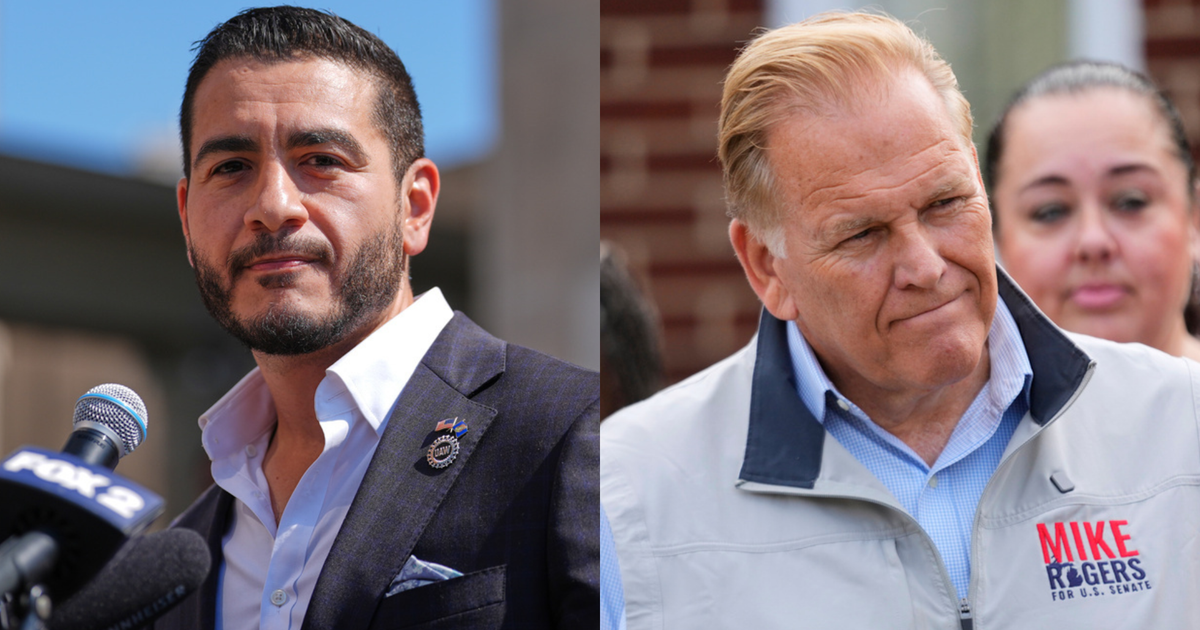
The political landscape in Michigan has entered a volatile and high-stakes phase with the United States Senate race capturing national attention. As the state marks the solemn 25th anniversary of the September 11 terrorist attacks, the contest between Democratic nominee Abdul El-Sayed and Republican nominee Mike Rogers has become deeply personal and politically polarized. The campaigns are trading sharp accusations regarding legislative records, historical statements, and political associations, highlighting how the enduring legacy of 9/11 continues to resonate in modern American electoral politics. This high-profile Senate seat is widely considered one of a handful of competitive races nationwide that could ultimately decide the balance of power in the United States Senate, raising the stakes for both candidates as they court undecided voters across the crucial Midwestern battleground.
Background Context and Campaign Dynamics
The intense friction between the two campaigns came to a head during a college town hall event in Lansing, Michigan, where Abdul El-Sayed paused to commemorate the quarter-century milestone since the 2001 tragedies. El-Sayed quickly pivoted from remembrance to a direct political assault on Mike Rogers, a former Republican congressman who represented Michigan’s 8th congressional district from 2001 to 2015 and served as the chairman of the House Intelligence Committee.
The core of the Democratic campaign’s offensive targets Rogers’s legislative record regarding the health and financial welfare of September 11 survivors and first responders. While Rogers initially supported funding for victims in the immediate aftermath of the attacks, El-Sayed and his supporters have repeatedly drawn attention to Rogers’s votes against the James Zadroga 9/11 Health and Compensation Act. Passed in 2010, the landmark legislation established a federal program to provide continuous medical treatment and financial compensation to emergency responders and survivors suffering from long-term health consequences tied to their exposure at Ground Zero. At the time, conservative lawmakers, including Rogers, raised fiscal objections, arguing that the funding mechanism should be handled through annual appropriations rather than permanent mandatory spending to safeguard the broader federal budget.
Simultaneously, the Republican campaign and aligned outside groups have sought to place El-Sayed on the defensive over his past political associations. In particular, Republicans have highlighted El-Sayed’s connections to left-wing internet personality and political streamer Hasan Piker, with whom El-Sayed campaigned during the primary season. Piker faced severe condemnation for remarks made in 2019 suggesting that United States foreign policy made the nation culpable for the terrorist attacks. Although Piker subsequently clarified his comments and expressed regret for his phrasing, and El-Sayed has publicly distanced himself from the streamer—referring to the statements as "dumb"—the association has become a central line of attack for the GOP.
Chronology of Events and Escalating Rhetoric
The controversy surrounding the candidates’ records and past statements has unfolded through a rapid sequence of campaign events, media appearances, and national convention speeches:
- August 2026: Abdul El-Sayed addresses the media regarding his primary campaign trail associations, explicitly calling Hasan Piker’s historical remarks regarding the September 11 attacks "dumb" and working to distance his platform from the streamer’s controversial commentary.
- Early September 2026: Republican political action committees, including the Senate Leadership Fund, deploy a wave of television and digital advertising in Michigan. The multi-million-dollar ad reservations heavily feature Piker’s past statements alongside images of El-Sayed, aiming to frame the Democratic nominee as out of touch with mainstream American values.
- September 8, 2026: Public scrutiny intensifies around El-Sayed’s own archived social media statements and historical commentary, specifically a 2021 remark in which he asserted that while 9/11 deeply scarred the United States, subsequent American military responses inflicted profound suffering on millions of individuals abroad.
- September 10, 2026: At the Republican midterm convention in Dallas, Texas, prominent national figures take aim at the Michigan Senate race. Vice President JD Vance criticizes Democrats broadly, while Mike Rogers delivers a national address framing the contest as a battle for the nation’s core principles, accusing his opponent of entertaining anti-American rhetoric.
- September 11, 2026: On the 25th anniversary of the attacks, El-Sayed hosts a campus town hall in Lansing and a subsequent event in Detroit. He delivers a strong defense against the attacks, honors the victims, and retaliates by attacking Rogers’s 2010 votes against the Zadroga Act.
Official Responses and Statements from Key Stakeholders
The war of words has drawn passionate reactions from the candidates, political surrogates, veterans, and advocacy organizations across the state and the country.
Mike Rogers defended his legislative record on social media and during campaign appearances, pushing back forcefully against the suggestion that he lacks compassion for victims and their families. "The insinuation that I do not support the victims or their families is patently false," Rogers wrote in a public statement on X, emphasizing that he consistently advocated for dedicated annual appropriations of $150 million to support the ongoing needs of 9/11 survivors and victims’ families during his tenure in Congress. During his speech at the Republican convention, Rogers amplified his critique of his opponent: "Together, [El-Sayed and Piker] attack America. They excuse extremism. They treat our country like it’s the villain."
Abdul El-Sayed has maintained that his opponent is weaponizing the solemn memory of the tragedy for transparent political gain while failing to support the heroes who risked their lives. "This is somebody who, you know, when he thinks it’s politically useful for him, wants to invoke the memory of 9/11, but also wants to deny the people who were the real heroes, who ran in to the attacks to take care of others, the healthcare that they need afterwards," El-Sayed told reporters. El-Sayed has also expressed frustration with the persistent media focus on internet personalities rather than kitchen-table issues. During his town hall, he addressed a student’s question on healthcare by noting, "You know what I always get asked about? Hasan Piker. All you in the press, you hear these folks are talking about healthcare. Stop asking me about some streamer in California."
Broader Impact and Political Implications
The intense focus on the September 11 anniversary within the Michigan Senate race underscores the deeply polarized nature of modern electoral politics, where national identity, foreign policy, and historical grievances are frequently leveraged to mobilize core bases. Political analysts note that outside spending in the race has surged, with the Senate Leadership Fund alone committing tens of millions of dollars toward autumn ad reservations in the state.
While Republican strategists believe that tying El-Sayed to controversial online figures and highlighting his foreign policy commentary is an effective strategy to define him as radical to moderate and independent voters, Democratic strategists and Muslim advocacy groups argue that the attacks cross a line into Islamophobia. Tyler Mitchell, an Afghanistan War veteran and Michigan voter, voiced concern over the rhetoric, suggesting that the relentless focus on El-Sayed’s faith and background is designed to stoke fear. "They look at him, because he’s a Muslim, so they target that with the rhetoric about being dangerous," Mitchell noted, reflecting the friction present within diverse communities across the state.
As the campaign enters its final weeks, both candidates face the challenge of balancing nationalized cultural and security debates with the domestic policy concerns—such as inflation, healthcare access, and economic development—that consistently rank highest among Michigan voters. With the partisan balance of the United States Senate hanging in the balance, the race remains one of the most closely watched and contentious legislative battles in the country, guaranteed to test the limits of voter tolerance for negative campaigning centered on the historic wounds of the past.