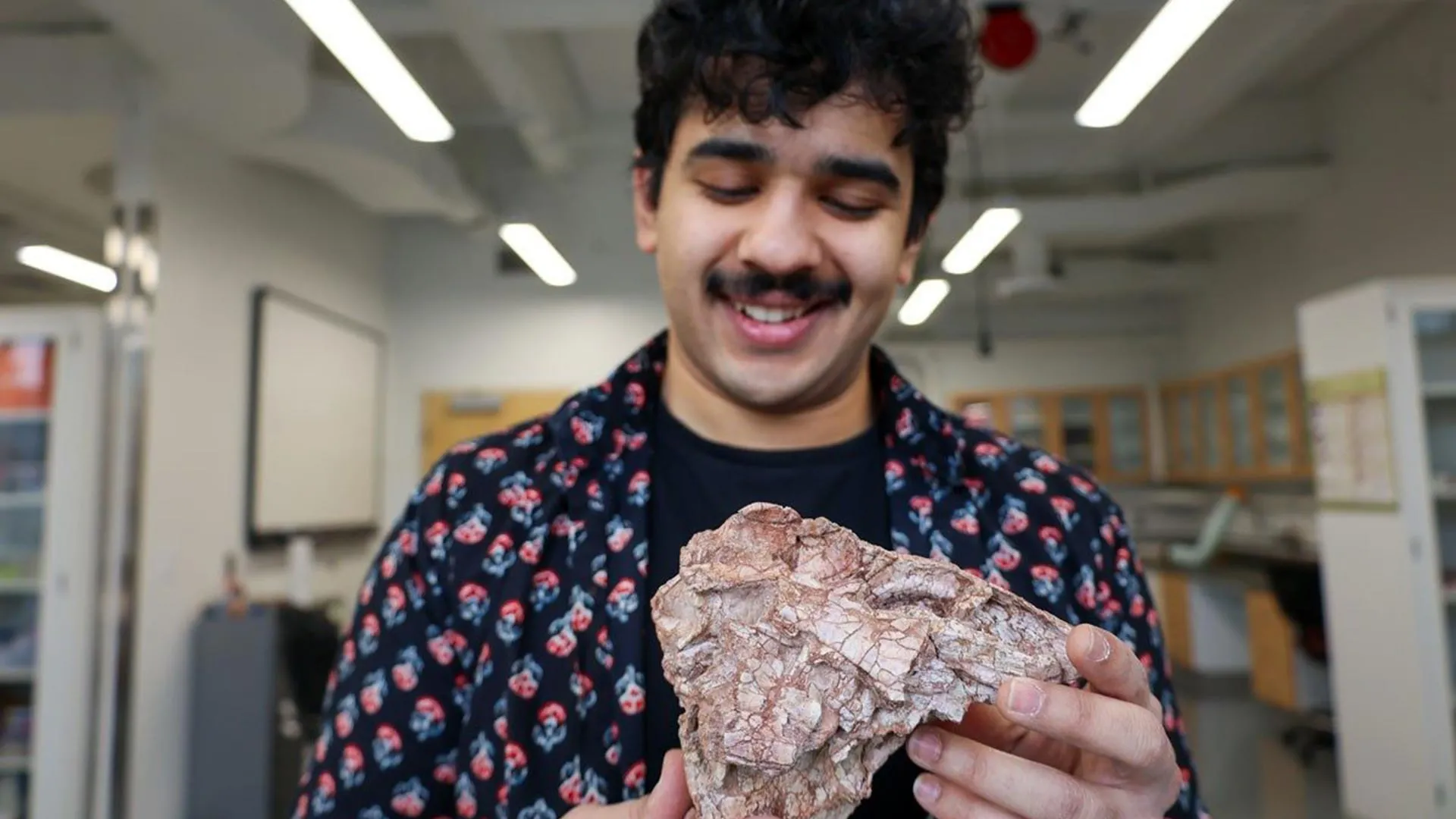
In the hallowed halls of Virginia Tech’s paleobiology laboratory, amidst cabinets brimming with the silent testaments of eons past, a senior geosciences major named Simba Srivastava grappled with a relic of prehistory. Holding a rough, pitted skull, he posed a rhetorical question, tinged with both scientific curiosity and a touch of the macabre: "You want to stick your finger in a dinosaur brain?" The specimen in his hands, though severely compromised by the ravages of time, represented a significant leap forward in understanding the evolutionary trajectory of dinosaurs, particularly their ascent to apex predator status during the Jurassic period. Srivastava’s meticulous two-year reconstruction and analysis of this uniquely challenging fossil, recently published in the esteemed journal Papers in Palaeontology, offers compelling new insights into a pivotal era in Earth’s history.
This groundbreaking research, typically the domain of seasoned paleontologists, was entrusted to Srivastava as a first-year undergraduate by geobiologists Sterling Nesbitt and Michelle Stocker. Their philosophy at Virginia Tech emphasizes immersive undergraduate research, allowing students to engage with the complete paleontological process. "We want undergraduate researchers to experience the whole paleontological research process at Virginia Tech," stated Nesbitt, commending Srivastava’s initiative. "Simba grabbed the project by the reins."
The Perilous Journey of a Prehistoric Predator
The story of this particular fossil is as convoluted as its physical state suggests. Its initial discovery dates back to 1982, unearthed by a team from the Carnegie Museum of Natural History at the famed paleontological site of Ghost Ranch in New Mexico. For over three decades, it languished, its scientific potential unrecognized, until Nesbitt rediscovered it tucked away in a drawer and brought it to Virginia Tech for a comprehensive re-examination.
The skull’s condition was, as Srivastava aptly described it, "uniquely sucky." Its intricate structure was heavily distorted, a testament to immense geological pressures and the passage of millions of years. "It’s so bad. Like, if you saw a human skull in this way, you’d throw up," he admitted, underscoring the magnitude of the challenge. However, rather than being deterred by its dilapidated state, Srivastava saw an opportunity.
Employing advanced computed tomography (CT) scanning technology, Srivastava embarked on a digital excavation. This non-invasive technique allowed him to virtually separate the fractured and compressed bones, creating a detailed digital model. From this digital blueprint, a tangible, three-dimensional printed reconstruction of the skull was meticulously produced. This process not only allowed for a precise anatomical study but also provided a physical representation of a creature unseen for over 200 million years.
The reconstructed skull belongs to a carnivorous dinosaur species that predates the iconic Tyrannosaurus Rex by more than three times. These formidable predators roamed the Earth during the latter part of the Triassic period, a geological epoch that spanned from approximately 252 to 201 million years ago. During this era, dinosaurs were not yet the undisputed rulers of the terrestrial realm. Instead, they navigated a complex ecological landscape, vying for survival and resources with a diverse array of creatures, including the early ancestors of modern crocodiles and mammals.
The Great Dying and the Dawn of Dinosaur Supremacy
The ecological balance of the Late Triassic was dramatically and irrevocably altered by a catastrophic mass extinction event. This cataclysmic period, known as the End-Triassic Extinction, wiped out a significant portion of the planet’s biodiversity, including many of the dominant reptilian groups that had previously held sway. This mass extinction event created ecological vacuums, paving the way for the dramatic rise of the dinosaurian lineage. As the Triassic drew to a close, dinosaurs, once one of many successful groups, rapidly transitioned to become the dominant land animals, a position they would largely maintain for the next 140 million years.
"Dinosaurs go from being co-stars to the headliner," Srivastava explained, vividly illustrating this pivotal shift in the planet’s biosphere. The period immediately following this extinction event marked a critical transition in vertebrate evolution. Fossils from this transitional phase are inherently rare, and well-preserved specimens from the very end of the Triassic are exceptionally scarce. This scarcity makes the damaged yet informative skull discovered by Srivastava and his team all the more scientifically valuable.
Remarkably, no other fossil specimen of this particular species has ever been found, rendering it unique in the paleontological record. Even in its severely distorted state, the fossil yielded crucial anatomical details that challenged previous understandings of early dinosaur evolution. The analysis revealed that this dinosaur possessed unusually large cheekbones, a broad braincase, and a prognathic, or forward-jutting, snout that was likely short and deep. These distinctive cranial features had not been observed in earlier dinosaur species, strongly suggesting that these animals were undergoing more rapid and complex evolutionary adaptations than previously hypothesized.
A "Murder Muppet" Emerges: Unveiling Ptychotherates bucculentus
Based on its distinctive and somewhat peculiar appearance, Srivastava bestowed upon this newly identified species a name that reflects its unique morphology: Ptychotherates bucculentus. The Latinate designation translates to "folded hunter with full cheeks," a descriptor that captures the prominent cheekbones and predatory nature of the creature. Srivastava humorously recounted a paleo-artist’s observation that the dinosaur resembled a "murder muppet," a testament to its somewhat unsettling yet intriguing visage.
Following years of rigorous analysis and comparative anatomy, the research team placed Ptychotherates bucculentus within Herrerasauria, a group recognized as one of the earliest lineages of carnivorous theropod dinosaurs. The fossil evidence suggests that this species may have represented one of the last surviving members of this ancient evolutionary branch.
Rethinking the End-Triassic Extinction: A Broader Impact
The discovery of Ptychotherates bucculentus also led to a profound revision of the prevailing understanding of the End-Triassic extinction event. The rock layers in which the fossil was found are believed to date to the very brink of the mass extinction, a period of immense environmental upheaval. The fact that no other members of the Herrerasauria lineage have been found in strata dating after this extinction event strongly suggests that this entire dinosaur group may have been among its casualties.
"This forces us to reconsider the impact of the end-Triassic extinction as something that wiped out not just the competitors to dinosaurs, but some long-standing dinosaur lineages themselves," Srivastava emphasized. This finding implies that the extinction event was not solely a catalyst for dinosaur diversification but also a force that extinguished established dinosaur groups, reshaping the evolutionary landscape in a more complex manner than previously understood.
The geographical distribution of Late Triassic fossils further contributes to this re-evaluation. The absence of herrerasaurians in other regions from such a late point in the Triassic suggests that the area now comprising the American Southwest might have served as a final, isolated refuge for this lineage.
A Lone Fossil, A Lost Lineage
Simba Srivastava’s "folded hunter," confined within the confines of his cupped hands, represents far more than just a collection of fossilized bone. It stands as the sole surviving testament to the final chapter of a once-thriving dinosaur group. "This specimen, it fits in my hands, but it is the only proof that any of these dinosaurs lived this long, lived in these latitudes, the only proof that they evolved to have this skull shape," Srivastava poignantly observed. "All these billions of individuals that existed through time are spoken for by this one specimen."
This singular fossil, painstakingly reconstructed from fragmented remains, has rewritten a critical passage in the grand narrative of life on Earth. It highlights the crucial role of meticulous scientific investigation, even of seemingly unpromising specimens, in unlocking profound evolutionary secrets. The story of Ptychotherates bucculentus serves as a powerful reminder that the Earth’s ancient past continues to yield remarkable discoveries, challenging our assumptions and enriching our understanding of the long and complex journey of life.
The broader implications of this discovery extend to the ongoing study of extinction events and their role in shaping biodiversity. By demonstrating that even established dinosaur lineages could succumb to mass extinctions, the research underscores the fragility of evolutionary success and the unpredictable nature of planetary change. Future paleontological expeditions and further analysis of existing collections may yet reveal more about the final moments of Ptychotherates bucculentus and its kin, but for now, this singular fossil stands as a monumental piece of evidence, bridging the vast temporal chasm between a lost world and our present understanding. The work by Srivastava and his mentors at Virginia Tech provides a compelling case study in how dedicated research, innovative techniques, and the willingness to tackle challenging problems can illuminate the deepest mysteries of prehistoric life.