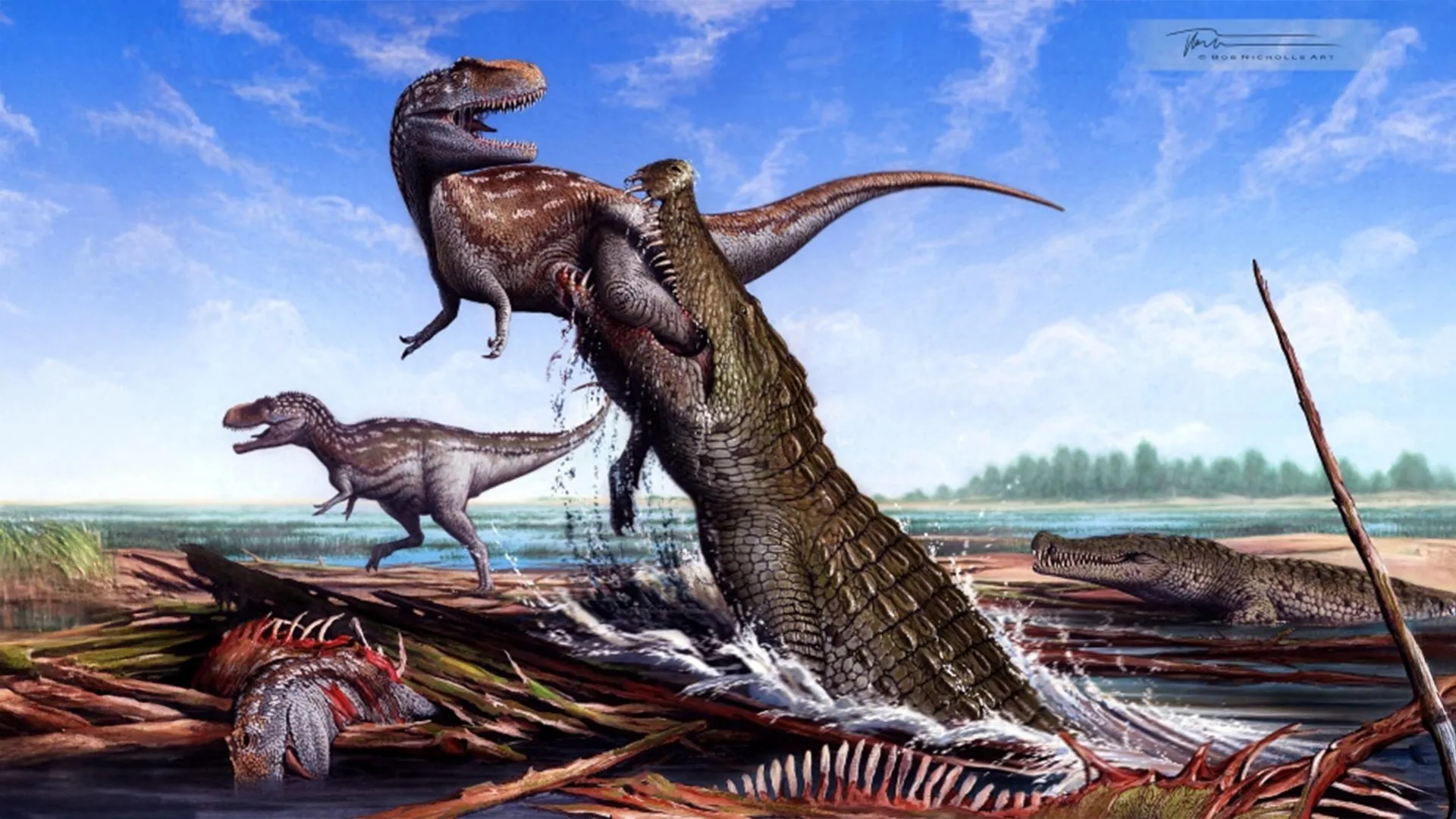
Dr. David Schwimmer, a preeminent authority on the colossal North American crocodilian genus Deinosuchus, has been instrumental in resurrecting a prehistoric titan from the depths of time. A geology professor at Columbus State University, Dr. Schwimmer’s decades of dedicated research have culminated in the creation of the first scientifically accurate, fully mounted skeleton replica of Deinosuchus schwimmeri. Once feared as a "dinosaur-killer," this immense predator likely reigned supreme at the apex of its ancient food chain.
The unveiling of this life-size replica at the Tellus Science Museum in Cartersville, Georgia, marks a significant achievement in paleontology and public education. Spanning an impressive 31 feet (9.45 meters) in length, Deinosuchus schwimmeri roamed the eastern United States between 83 and 76 million years ago during the Late Cretaceous Period. This gargantuan relative of modern alligators was a formidable hunter, capable of preying on dinosaurs that shared its watery domain. The museum exhibit, the result of a two-year collaboration between Dr. Schwimmer and Triebold Paleontology Inc., a renowned firm specializing in the creation of detailed fossil skeleton models, offers a tangible glimpse into a lost world.
Bringing the Cretaceous Ecosystem to Life for a New Generation
The Tellus Science Museum anticipates that the Deinosuchus schwimmeri exhibit will significantly enhance the learning experience for its thousands of student visitors annually. Hannah Eisla, the museum’s director of education, highlighted the exhibit’s potential to deepen understanding of the region’s natural history. "Many of these students come on school field trips specifically to learn more about the region they call home and how it has changed over time," Eisla stated. "The addition of Deinosuchus schwimmeri allows us to provide a more detailed picture of this area’s ecosystem in the Cretaceous Period."
The unique nature of this exhibit was further emphasized by Rebecca Melsheimer, the museum’s curatorial coordinator. "Tellus is currently the only museum to have a cast of Deinosuchus schwimmeri, so this is an experience our visitors can’t get anywhere else," Melsheimer remarked. She added, "The scale of the dinosaurs and other creatures that lived during [the Late Cretaceous epoch] is hard to capture in words or pictures. We can tell you that Deinosuchus is 30 feet long, but seeing it is far more impactful." This visual encounter is crucial for grasping the sheer magnitude of these prehistoric behemoths.
A Name Earned Through Decades of Unwavering Dedication
The scientific community formally recognized Dr. Schwimmer’s profound contributions to the study of Deinosuchus in 2020 when a team of paleontologists officially identified and named a new species, Deinosuchus schwimmeri, in his honor. This prestigious designation, published in the esteemed Journal of Vertebrate Paleontology, acknowledged "his tireless work on the Late Cretaceous paleontology of the Southeast and Eastern Seaboard, USA." This recognition was the culmination of years of meticulous fossil analysis, extensive scientific publications, impactful conference presentations, and Dr. Schwimmer’s seminal 2002 book, "King of the Crocodylians: The Paleobiology of Deinosuchus."
For over four decades, Dr. Schwimmer has dedicated himself to unearthing the secrets of Deinosuchus, meticulously exploring fossil sites across Alabama, Georgia, and Texas. His pioneering research, supported in part by grants from the National Geographic Society, has yielded significant specimens now housed in world-renowned institutions such as the Smithsonian Institution in Washington, D.C., the American Museum of Natural History in New York, and the Tellus Science Museum itself.
Harnessing Modern Technology to Reconstruct an Ancient Predator
The meticulous process of constructing a scientifically accurate, full-scale replica of Deinosuchus schwimmeri demands an exceptional level of detail. Dr. Schwimmer explained that the Triebold Paleontology team employed cutting-edge high-resolution 3D scanning technology. This advanced technique allowed for the precise reconstruction of the animal’s skeletal structure and the intricate details of its armored skin. The resulting model is not only a visually arresting spectacle but also a valuable tool for scientific understanding.
"These replicas are more than just creating a ‘scare factor,’" Dr. Schwimmer emphasized. "Understanding dinosaurs’ predatory habits helps us decode some of nature’s greatest survival strategies. By studying these ancient apex predators, we are essentially looking back in time to see exactly how life adapted and dominated a changing world." This perspective underscores the educational and scientific importance of such reconstructions.
A Childhood Fascination Ignites a Lifelong Scientific Pursuit
Dr. Schwimmer’s enduring fascination with Deinosuchus traces back to his childhood in New York City. Living a mere ten blocks from the American Museum of Natural History, he was captivated by a display featuring a large Deinosuchus skull. This early encounter sparked a lifelong passion that would lead him to become a leading expert on the genus. His personal journey with Deinosuchus took a significant turn in 1979, shortly after he joined Columbus State University (then Columbus College). Since then, his professional life has been largely dedicated to reconstructing the biology and environmental context of this formidable creature.
His extensive research has firmly established him as a global authority on life during the Late Cretaceous epoch (approximately 100.5 million to 66 million years ago) in the southeastern United States. Over the years, his investigations have also been pivotal in identifying several significant fossil "firsts" in Georgia, including the earliest evidence of flying reptiles (pterodactyls), dinosaurs, and Deinosuchus itself within the state.
A Legacy of Publications, Discoveries, and Enduring Scientific Impact
The findings from Dr. Schwimmer’s early research endeavors were compiled into his influential 2002 book, "King of the Crocodylians: The Paleobiology of Deinosuchus." The book garnered considerable acclaim, achieving bestseller status on Amazon within its category and becoming a favored read for science enthusiasts. He is currently engaged in preparing an updated edition, reflecting new discoveries and evolving scientific understanding.
Dr. Schwimmer’s unparalleled expertise has made him an indispensable consultant for numerous prestigious institutions, including Atlanta’s Fernbank Museum of Natural History, the University of Texas’ Vertebrate Paleontology Laboratory, and the Tellus Science Museum. These organizations have consistently relied on his insightful guidance for the interpretation of fossil evidence and the development of compelling museum exhibits.
Further cementing his contributions, Dr. Schwimmer played a key role in two significant Deinosuchus-related studies published in 2010. One study meticulously examined bite marks found on dinosaur bones, providing direct evidence of predation. The other delved into the analysis of fossilized dung, known as coprolites, a project undertaken by undergraduate student Samantha (Harrell) Stanford under his mentorship. The findings from these studies were published in the "New Mexico Museum of Natural History and Science Bulletin" and presented at the Geological Society of America Northeastern-Southeastern Annual Meeting, showcasing the power of collaborative research.
Empowering Students Through Hands-On Paleontological Research
Dr. Schwimmer consistently champions the value of hands-on research opportunities in fields like paleontology and other Earth sciences, particularly for students. He notes that regional universities such as Columbus State provide invaluable chances for students to work directly with faculty, gaining practical field experience.
"Ms. Harrell came out in the field and collected fossils with me," Dr. Schwimmer recalled. "At most universities, undergraduates rarely collaborate on or publish peer-reviewed research. Institutions of our size provide undergraduate students like Samantha with greater one-on-one access to faculty mentors and field-based research opportunities like this that, while local, are still quite impactful on the field." This mentorship model underscores the significant educational benefits derived from such immersive research programs.
A Local Fossil Treasure Illuminating the Distant Past
The geological richness of the region surrounding Columbus, Georgia, is further underscored by the presence of several Deinosuchus fossil sites located within a 40-mile radius. Dr. Schwimmer highlighted this geographical proximity as a key factor making the Tellus Science Museum an ideal venue for showcasing a life-size replica of this prehistoric predator.
"Bones and fossils tell us only part of the story," Dr. Schwimmer concluded, offering a profound perspective on the importance of comprehensive interpretation. "Fully assembled, life-size replicas become a blueprint for better understanding the dynamic animals that creatures like Deinosuchus really were." The exhibit at the Tellus Science Museum thus serves not only as a monument to a lost era but also as an invaluable educational resource, bringing the awe-inspiring reality of prehistoric life within reach of the public. The meticulous reconstruction of Deinosuchus schwimmeri stands as a testament to scientific dedication and the enduring power of natural history to inspire wonder and foster deeper understanding of our planet’s ancient past.