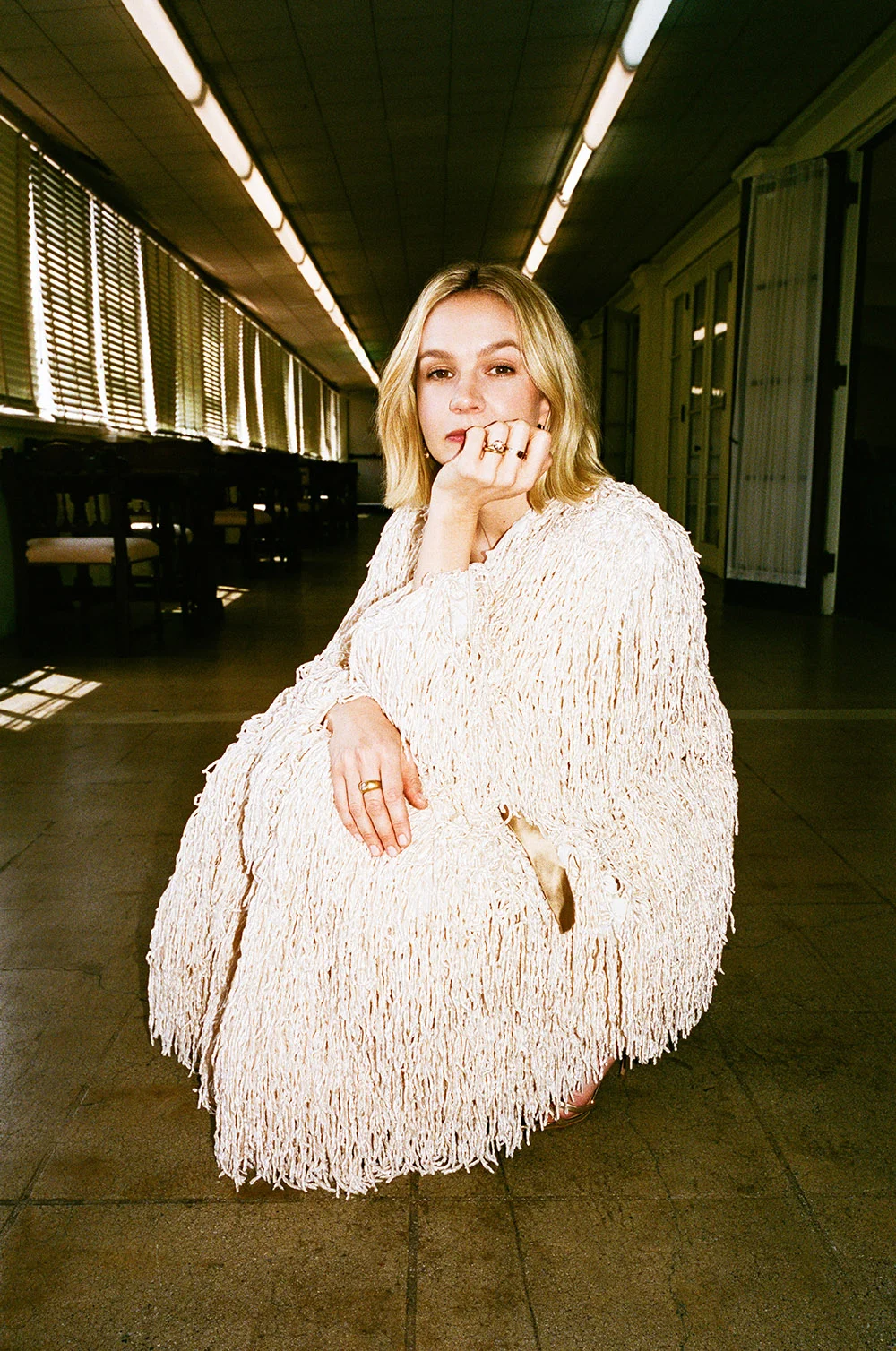
When Carey Mulligan began preparing for her transformative role in the critically acclaimed Netflix anthology series Beef, she found herself in a unique position: questioning the very fabric of on-screen vitriol. The second season, envisioned by creator Lee Sung Jin as a potent blend of the gritty realism of The Sopranos and the introspective depth of Ingmar Bergman, centers on the explosive and hilariously fraught dynamic between Josh, a country club manager portrayed by Oscar Isaac, and his wife Lindsay, brought to life by Mulligan. However, Mulligan’s meticulous approach to character extended to the language of conflict, leading her to propose a significant linguistic shift. "I wrote Sonny [Lee] a list of really awful British swear words," Mulligan revealed, articulating a desire to inject a more authentic, culturally specific venom into their on-screen exchanges. "I was like, ‘I should definitely call someone a cunt.’" This insistence on linguistic authenticity underscores Mulligan’s commitment to inhabiting her characters fully, even when it means challenging the established norms of a production.
The opportunity to dive into the volatile world of Beef arrived on the heels of Mulligan’s extensive promotional tour for Bradley Cooper’s Maestro. In the black-and-white Leonard Bernstein biopic, she delivered a performance of profound subtlety as Felicia Montealegre Bernstein, a role that demanded the portrayal of nuanced emotional landscapes and the slow, agonizing decline of her character. This followed a career trajectory that had solidified Mulligan’s status as a consummate "Serious Actress." Her filmography boasts a distinguished array of British period dramas, Coen brothers-esque indie films, and impactful narratives exploring pivotal moments in social history, such as the origins of the suffragette movement and the #MeToo era. With three Academy Award nominations to her name, Mulligan had achieved the pinnacle of critical recognition within the dramatic sphere. Yet, a significant element remained absent from her celebrated oeuvre: true comedy. Moreover, her on-screen persona had, for years, diverged considerably from her vivacious off-camera personality. Her friend and frequent collaborator, Emerald Fennell, has described Mulligan as “naughty,” a descriptor that Beef would vividly bring to the forefront, offering Mulligan a platform to showcase this often-unseen facet of her artistic identity.
Mulligan’s decision to embrace the visceral and often darkly comedic nature of Beef was cemented by specific, bold character choices. "I was delighted that she punches someone in the face," she confessed, speaking candidly over breakfast at the opulent Hotel Bel-Air. This statement, delivered while grappling with jet lag after a transatlantic journey from her home outside London, highlights a performer eager to explore unconventional territory. The profound impact of parenthood, a subject close to her heart with three children shared with musician Marcus Mumford, was also a subtle undercurrent, as she scrolled through family photos during her sleepless night. The pivotal moment that truly captivated Mulligan was an early plot development in Beef: her character’s cold-blooded killing of a coyote. "I called my agent immediately and was like, ‘There’s this fucking bit with a coyote, I’ve got to do it,’" she exclaimed, her enthusiasm palpable. This willingness to engage with extreme and morally ambiguous actions speaks volumes about her artistic courage and her pursuit of challenging narratives.

The initial season of Beef captivated audiences with the escalating, seemingly minor road rage incident that ignited a fierce feud between the characters portrayed by Ali Wong and Steven Yeun. Season two escalates this conflict into a full-blown, volatile confrontation between Mulligan’s Lindsay and Isaac’s Josh. The incident, captured on video by Josh’s Gen Z employees (played by Charles Melton and Cailee Spaeny), provides them with potent blackmail leverage over a couple who appear to possess everything: financial security and the elusive happiness it promises. The recording serves as the catalyst that rapidly unravels Lindsay and Josh’s carefully constructed facade, exposing the deep fissures within their seemingly perfect lives.
For viewers who have long associated Mulligan with the archetype of the "Serious Actress," her performance in Beef offers a profound revelation. Despite her A-list status, Mulligan has adeptly navigated the treacherous waters of the entertainment industry, largely eluding the relentless glare of tabloid scrutiny and the often-unseemly machinations of the celebrity industrial complex. Her previous work in films such as Suffragette, Promising Young Woman, and She Said frequently placed her at the forefront of discussions surrounding feminism and sexual assault. However, these roles typically required her to address broader societal issues rather than delve into the intricacies of her personal life. In stark contrast, Beef allows her character to grapple with deeply personal and relatable struggles: the desire for children, the contemplation of divorce, and the pervasive anxieties surrounding aging and physical appearance. This thematic resonance extends to nearly all the characters across both seasons of Beef, united by a desperate, often misguided, belief that achieving a singular goal—be it a new job, a physical transformation, or starting a family—will inevitably lead to lasting fulfillment. This common thread provides a natural segue into a discussion about Mulligan’s own experiences with such aspirations.
Mulligan’s response to whether she has ever harbored similar singular desires is a refreshingly candid "no." Her upbringing outside of London, while comfortable and nurturing, was not situated within the rarefied social circles she now inhabits. Her mother, a Welsh university lecturer, and her father, a Liverpool native who ascended from humble beginnings as a hotel busboy to managing a business, instilled in her a strong work ethic and an appreciation for the arts. Though not directly involved in the entertainment industry, art was an accessible and cherished part of her childhood. Regular trips to the theater with her mother, coupled with an inspiring talk by Julian Fellowes, the creator of Downton Abbey, at her high school, ignited her passion for acting and prompted her to apply to drama school. Her initial applications to prestigious conservatories like RADA, Guildhall, and LAMDA were met with rejection. "It actually didn’t feel like the end of the world because I saw how competitive it was," she reflected, adding that her chosen monologue—a piece by Sarah Kane concerning suicide—was hardly a conventional crowd-pleaser, suggesting an early inclination towards challenging and unconventional material.
Following her parents’ counsel, Mulligan pursued an English degree at another university. During a gap year, she worked at a pub and dedicated her time to auditioning. It was during this period that she reached out to Julian Fellowes, her sole acquaintance within the acting profession. Fellowes’ wife, Emma, facilitated an introduction to a casting agent who was holding open calls for the 2005 adaptation of Pride & Prejudice. The opportunity to portray Kitty Bennet arrived shortly before Mulligan was scheduled to begin her university studies. This role served as a springboard, leading to a stage production at London’s Royal Court Theatre, a six-month engagement on the Dickens adaptation Bleak House, and an appearance on the iconic science fiction series Doctor Who. "By that point, I realized, ‘Oh, this is probably my job,’" she remarked, a statement that conveys a sense of dawning realization and acceptance of her chosen path. Her initial expectations were modest: to sustain a career through supporting roles in television, theatre, and minor film parts.

The trajectory of her career dramatically shifted with the lead role in An Education. What began as an independent British film with a modest budget—Mulligan wryly noted that "craft service was a tea and a packet of biscuits"—garnered significant critical acclaim, culminating in a surprising Best Actress nomination at the Academy Awards and catapulting her into the spotlight. The subsequent awards season, a whirlwind of campaigning alongside esteemed nominees like Meryl Streep, Helen Mirren, and Sandra Bullock, proved disorienting. Mulligan confessed to feeling uncomfortable in her own skin, finding the rituals of red carpets and photo shoots "freakish." She credits motherhood with alleviating this discomfort: "Having my first child fixed that for me. Suddenly standing around in your pants is not so awful because you’ve done way worse in front of doctors and midwives." Her initial experience at the Academy Awards was marked by a sense of dissociation. Her return in 2024 for Maestro offered a different perspective. Arriving late due to traffic, she ended up watching the proceedings from the wings alongside theater staff. "I had this vantage point of the audience, and I was looking out at all these brilliant artists, and it was actually just a group of people I’ve known for a long time," she observed, reflecting on a perceived shift in her relationship with the industry’s grandest ceremonies.
Mulligan’s professional connection with Oscar Isaac dates back to 2010, forged on the set of the neo-noir action film Drive. Mulligan starred opposite Ryan Gosling, while Isaac played her estranged husband. During the demanding night shoots in downtown Los Angeles, Mulligan resided in the guest room of director Nicolas Winding Refn’s Hollywood Hills residence. "The first time I ever met Carey was in Nick’s living room before we started shooting, and I remember it was exciting because we were both young and really on the cusp of something," Isaac recalled. "That feeling lasted about a week, and then we became jaded. But it was great." This early collaboration laid the groundwork for their compelling on-screen chemistry in Beef.
At the age of 25, Mulligan experienced a serendipitous reunion with an old camp friend, Marcus Mumford, whose band Mumford & Sons was rapidly ascending the music charts. Their encounter at a concert in Nashville marked the beginning of their romantic relationship, leading to their marriage a year later. "I was conscious that it would be perceived by people as being young to get married, but I was like, ‘Well, we’ve known each other forever, so it doesn’t count,’" she explained, underscoring the deep foundation of their relationship. As a high-profile couple, they frequently appear together on red carpets, and Mulligan is often seen supporting Mumford at his concerts. "I went with him to perform on SNL recently, and it was so nerve-racking, but it’s also fun, as my whole job that day was just to tell them they’re doing great," she shared.
Despite their public visibility, Mulligan actively seeks moments of privacy. In Beef, her character engages in a clandestine text relationship with an ex-boyfriend. "The backstory we created was that she’d gone to university and met a minor royal, and they’d dated for only a month, but she wound up in the tabloids a lot, which gave her social currency," Mulligan elaborated. During the early stages of editing, showrunner Lee Sung Jin utilized Mumford’s headshot as the avatar for these text exchanges. Furthermore, paparazzi photos of Mulligan and Mumford appeared on screen when her character Googled her past fling. "We didn’t want to have to photoshop anything, so it was just easier for us to grab these real pictures of Carey at that age," Lee explained. However, when it came time for the final cut, Mulligan expressed a preference for privacy: "I needed to ask her permission to use Marcus’s pictures in the final version, and she was like, ‘Actually, I’d rather not.’" In lieu of using her husband’s image, Mulligan offered up photographs of her best friend, director Rightor Doyle, with whom she had been frequently photographed in her early twenties while living in New York for The Seagull. "The photos are awful, but there are loads of them," she conceded.

Navigating the Landscape of Leading Roles
Following the breakout success of An Education, Mulligan found herself in a position where many roles offered were relegated to the "girlfriend" or "wife" archetype, requiring her to meticulously sift through scripts in search of more substantial characters. "You can spot it a mile off when someone’s just in the movie to serve that kind of purpose, so you can quickly be like, ‘Oh, that’s just a girlfriend,’" she stated, articulating her discernment in script selection. Her enduring relationship with her U.K. agent, Victoria Belfrage, whom she has worked with since she was 18, has provided a crucial buffer against the industry pressure to accept roles that don’t align with her artistic aspirations, often referred to as the "one for them, one for me" mentality. Nevertheless, this protective measure wasn’t always foolproof. She appeared as wives and girlfriends in films centered on male protagonists, including Inside Llewyn Davis, Drive, and The Great Gatsby. "If there’s a great director or a great writer, and it feels like there’s an opening to do something slightly more interesting, that’s when I’ll jump in," she explained, emphasizing her criteria for selecting projects.
The Transformative Power of Collaboration with Emerald Fennell
A pivotal moment in Mulligan’s career arrived in 2018 when Emerald Fennell approached her about starring in her directorial debut, Promising Young Woman. Fennell sought an actress with the emotional depth and gravitas to anchor the film’s heightened reality. "I’d met Carey once at a friend’s house, and like all the people I love, she is hot and cold," Fennell remarked. "I don’t mean alternately—I mean she is simultaneously a blast of sunshine with an icy stillness." Mulligan recognized the ambitious nature of the project but placed immense trust in Fennell’s directorial vision. The film’s provocative ending, which depicted her character’s suffocation at the hands of her best friend’s rapist, presented a significant challenge. Fennell intended to film the scene for the precise duration it would realistically take to die, a commitment to realism that aimed to convey the grim reality of such an act. "We never see the true grimness of something like that," Fennell noted, estimating the required time based on her father-in-law’s insights as a former police officer.
Mulligan’s dedication to the role was profound; she insisted on performing the suffocation scene herself, without a body double, despite the inherent risks. While safety protocols were in place, the margin for error was exceptionally slim. "The problem is, if you’re literally putting a pillow on someone’s face and they’re literally pretending to suffocate for several minutes, your margin of error is very slim," Fennell explained. During one take, the scene extended beyond its intended duration. Despite a pre-arranged hand signal to halt the action, it took Mulligan a moment to process the situation and communicate her distress. She immediately stepped outside to compose herself, shedding a few tears before returning to complete another take. In a remarkable display of resilience and dark humor, Mulligan volunteered to be her own body double for a subsequent scene where her character’s lifeless body lies beside her as male characters console each other. "I was there with a pillow sitting on my head as they’re bro-ing out," she recalled, adding that the absurdity of the situation provided a cathartic release.
Mulligan’s unwavering commitment to her craft is not merely a matter of a positive attitude but stems from a deep-seated aversion to what she perceives as unprofessionalism. She finds tardiness, unpreparedness, and inconsideration towards the crew to be unacceptable. Her own conduct on set is modeled after the women she admired early in her career. She recalled being impressed by Judi Dench’s remarkable ability to remember every crew member’s name on the set of Pride & Prejudice. Similarly, during a 45-minute overrun on An Education, Emma Thompson generously treated the entire cast and crew to pizza and beer as compensation.

The timing of Promising Young Woman‘s release proved challenging. After premiering to significant buzz at the Sundance Film Festival in 2020, its theatrical release was delayed by the global pandemic, eventually leading to its distribution via Video On Demand. The subsequent awards season was fraught with anxiety for everyone involved. Mumford, seeking to inject a sense of levity, proposed a bet: if Mulligan was overlooked for an Oscar nomination, she would get a tattoo of a statuette; if she received a nomination, he would. He now bears three Oscar statuettes as a testament to her nominations. Following this experience, Mulligan found herself less driven to maintain a streak of leading roles. "I love getting called up from the bench for a two-week shift on something really great," she stated, indicating a newfound appreciation for supporting roles that offer creative satisfaction.
This flexible approach to her career led her to collaborate with Fennell again on Saltburn, where she embraced the opportunity to play the smaller role of Poor Dear Pamela after reading the script as a friend. She also considered a role in an adaptation of Wuthering Heights but ultimately decided against it, preferring to leave room for future collaborations with Fennell. "I was like, [Emerald and I] will cook something else up, and it’s nice to leave some space so that people don’t think, ‘Oh, them again,’" she explained.
The Art of Nuance in ‘Beef’
On the initial day of filming Beef, Mulligan experienced a degree of uncertainty regarding the show’s tonal balance. "I kept being like, ‘Are we meant to be funny?’" she questioned. "There were lines that just ruined me, like when we’re fighting, and Oscar says to me, ‘You wear wonderful dresses, and you drive a nice car, and we had dinner with Bono.’ Every time he did it, I just broke." This admission highlights the delicate tightrope walk between comedy and drama that the series masterfully navigates.
Lee Sung Jin praised Mulligan’s innate ability to discern authenticity: "What’s incredible about Carey is that her radar for bullshit is the most precise I’ve ever seen in my life." He cited an early scene where an errant napkin, caught by a gust of wind, strikes Mulligan’s character directly in the face. "I didn’t have to tell her, ‘Hey, let’s lean into the comedy,’ because she plays everything so grounded that of course she’s going to just play it off like nothing happens," Lee explained. "And the more grounded it is, the funnier it’s going to be." During the post-production phase, Lee was struck by the expressiveness of Mulligan’s eyes, noting her capacity to convey profound vindictiveness with a single glance. "I sent her numerous texts to be like, ‘How do you do this?’ And she was like, ‘I have no idea what you’re talking about,’" he recounted with amusement.

The two lead actors dedicated months to preparing for their roles in Beef. They participated in an intensive workshop designed to flesh out the intricacies of their fictional marriage, including the creation of small, defining details such as matching tattoos commemorating their first trip to Coachella. Mulligan confessed that she and Mumford possess their own set of "cringe" matching tattoos, a testament to their shared experiences. Her inclination towards commemorative tattoos extends to her work; she also got inked to mark the filming of Suffragette, a historical drama co-starring Helena Bonham Carter and Anne-Marie Duff. The tattoo bears a quote from the film: "love that overcometh." She fondly recalled asking her co-stars to join her for the tattoo session after wrapping, only to have them decline.
Mulligan and Isaac also meticulously rehearsed the show’s significant physical fight sequences. "My own confrontation style is that, if I’m with the person I’m angry with, I go silent," Mulligan explained. "But if that person is not there, I will rant and rant to whoever will listen. To the point that my husband will have to be like, ‘OK, we covered that.’" This personal insight into her own conflict resolution methods provides a stark contrast to the explosive on-screen confrontations depicted in Beef.
On the day of filming a particularly intense scene, Mulligan found herself struggling to access the necessary emotional intensity. The script called for her character to hurl a wine glass at Isaac’s head, escalating into a physical struggle involving a golf club. "I was supposed to say something about how I was going to sleep with everyone else at the club, and I just didn’t feel angry enough," she admitted. "But then Sonny came over and said, ‘I don’t think you want to say that. I think you want to say to him that you’ve wasted my whole life.’ And I was like, ‘Yep, that’s what she’s mad about.’" This intervention by the showrunner proved crucial in unlocking the character’s authentic rage and deepening the scene’s emotional impact.
Following the promotional tour for Beef, Mulligan plans to return to her home in Devon to decompress. She will subsequently accompany Mumford and their children on select dates of his upcoming tour during school breaks. Their rural life on a working farm stands in stark contrast to the glamorous environs of the Hotel Bel-Air. As the sole famous individual within her immediate social circle, this grounded existence offers an antidote to the self-absorption that can sometimes accompany a career in acting. She humorously recounted an anecdote: "I was going on to a friend about One Battle After Another, saying it’s the greatest thing I’ve seen in the last 10 years, and she was like, ‘Who’s in it?’ I was like, ‘Leonardo DiCaprio and Sean Penn.’ And she said, ‘Which one’s that? Is he from Shaun of the Dead?’ I was like, ‘I can’t fucking believe you don’t know who Sean Penn is, but also, God, that’s great. Here I am worrying about what people are going to think of my show or how they’re going to compare it to other things, and my best mate is like, ‘Who’s Sean Penn?’" This anecdote underscores her appreciation for a life lived outside the confines of Hollywood and its associated pressures.

However, Mulligan does not claim to live an entirely ordinary life. Before concluding their conversation, she shared photographs from a recent ceremony at Windsor Castle where she received her Commander of the Most Excellent Order of the British Empire (CBE) title, proudly displaying a selfie with the medal pinned to her attire. "I’ve been lording it over Oscar in all our joint interviews," she quipped, referencing her Beef co-star. And, recalling a memorable line from the series, she offered a playful affirmation when asked if she had ever dined with Bono: "Oh, well, yeah," she replied with a knowing smirk. This final exchange encapsulates Mulligan’s ability to seamlessly blend the extraordinary elements of her career with a grounded sense of humor and personal connection.