The opening day of Mexico Fashion Week set a profound intellectual and aesthetic tone for the country’s premier sartorial showcase, as designer Carla Fernández took to the runway to present a collection deeply rooted in historical geopolitics and cross-cultural exchange. Rather than relying solely on contemporary trends, Fernández anchored her latest presentation in the legacy of the Manila Galleon trade route—a maritime commercial network that connected the Mexican port of Acapulco with Asian markets across the Pacific Ocean for more than two and a half centuries. This historical framework allowed the designer to examine how Mexico historically functioned as a vibrant epicenter of global commerce, serving as a cultural bridge that facilitated the exchange of textiles, precious metals, gastronomy, and traditional craftsmanship between the Americas, Asia, and Europe.
The event, held in the heart of Mexico City, drew an international audience of fashion critics, historians, buyers, and cultural preservationists. By choosing to dedicate the inaugural showcase of Mexico Fashion Week to a narrative of historical connectivity, Fernández reinforced her longstanding reputation as a designer who views fashion not merely as a commercial enterprise, but as an anthropological medium capable of preserving and communicating indigenous heritage.
Chronology of the Manila Galleon Trade and Its Legacy
To fully understand the conceptual weight of Fernández’s collection, it is necessary to examine the historical timeline that inspired it. The Manila Galleon trade route officially commenced in 1565 following the successful expedition of Andrés de Urdaneta, who charted a reliable eastward return voyage from the Philippines to Alta California and down the coast to Acapulco. For the next 250 years, until the route was dissolved in 1815 with the Mexican War of Independence, these Spanish trading ships traversed the Pacific Ocean annually.
Acapulco transformed during this era from a modest coastal settlement into a bustling international hub. Silks, porcelains, spices, and ivory from China and the Philippines were unloaded on Mexican shores, destined to be transported overland across the country to Veracruz, where they were subsequently shipped onward to European markets. In exchange, Mexican silver—mined in territories such as Zacatecas and Guanajuato—flowed eastward across the Pacific.
This vast exchange left an indelible mark on Mexican material culture, influencing everything from regional cuisine and architecture to traditional garments, such as the iconic China Poblana dress. By resurrecting this narrative on the modern runway, Fernández connected contemporary Mexican identity to a deeply internationalist history that predates modern globalization by centuries.
The Runway Presentation and Performance Art
The evening’s presentation commenced with a performance art piece that merged modern choreography with historical symbolism. Dancers dressed in minimalist, loose-fitting garments dyed exclusively with natural pigments moved deliberately around a formation of chairs arranged in a manner reminiscent of musical chairs. According to production notes, this choreography was designed to visually explore the fluid dynamics of migration, cultural assimilation, and the friction and harmony that occur when distinct civilizations intersect.
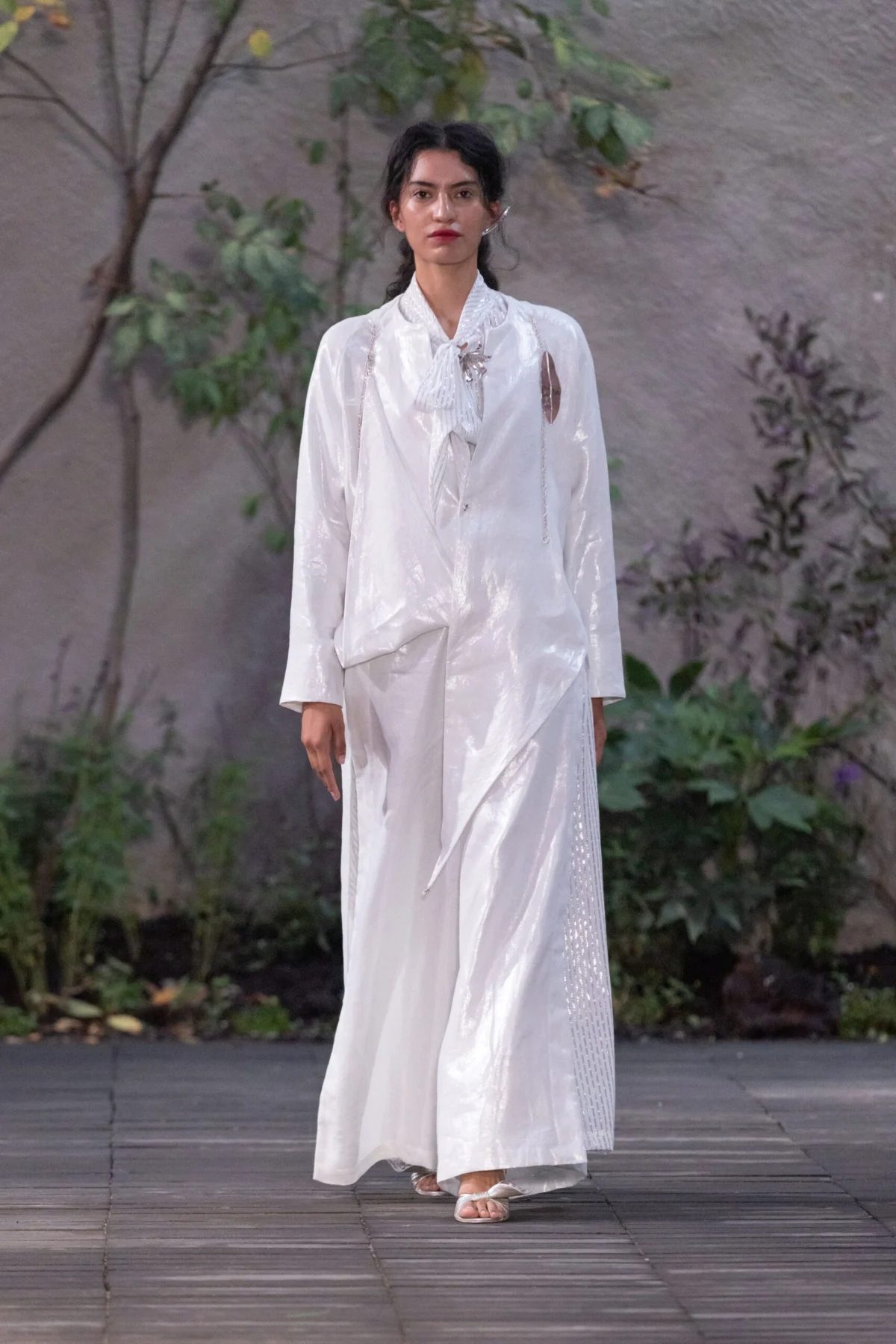
The minimalism of the dancers’ attire provided a stark, deliberate contrast to the intricate garments that followed on the runway. As the first models emerged, the audience was introduced to a sophisticated palette of lustrous fabrics, complex embroidery, and structural innovation. A central motif of this segment was the adaptation of "papel picado"—the traditional cut-paper ornamentation ubiquitous at Mexican festivities and celebrations—translated meticulously into fabric via laser-cut techniques and hand-stitched detailing.
Furthermore, garments featured knots tied at unconventional structural points, such as the hip or shoulder. Backstage, Fernández elaborated on the significance of these design choices. "They are the ties, the interweaving of how we become one," she stated, emphasizing that the physical construction of the garments served as a metaphor for societal cohesion and intercultural synthesis. Accessories were equally considered, with merchants’ bags integrated seamlessly into the looks to honor the itinerant traders who sustained the galleon routes.
Geometric Silhouettes and Artisanal Craftsmanship
True to her signature design ethos, Fernández utilized rigorous geometric silhouettes throughout the collection. Wrap skirts, wide-leg trousers, and impeccably tailored outerwear dominated the runway, demonstrating how traditional indigenous cutting techniques can be adapted for contemporary luxury markets. These architectural pieces were frequently finished with delicate floral embroidery, executed by traditional artisans with whom the designer has collaborated for decades.
The jewelry collection further reinforced the historical theme. Crafted from polished and engraved silver, the pieces included chili pepper-shaped earrings and pendants, intricate hoop earrings etched with pre-Hispanic motifs, and expansive leaf-shaped ear cuffs that climbed the contour of the ear. The prominent use of silver paid direct homage to the mineral wealth that fueled the colonial-era trade economy, while simultaneously highlighting Mexico’s enduring status as one of the world’s leading producers of the precious metal.
Personal History and Academic Roots
Fernández’s academic and anthropological approach to fashion design is not accidental; it is deeply rooted in her personal background and upbringing. Her father served as the director of museums and exhibitions at Mexico’s prestigious National Institute of Anthropology and History (INAH). Growing up surrounded by historical artifacts, conservation projects, and academic discourse, Fernández developed an early and profound appreciation for Mexico’s indigenous craftsmanship and the cultural heritage it represents.
Throughout her career, Fernández has worked closely with indigenous weavers, embroiderers, and artisans across various Mexican states, ensuring fair compensation and ethical production models that preserve ancient techniques rather than exploiting them. Industry analysts note that this collection served as a dual exploration: an examination of a nation’s historical trade routes and an autobiographical reflection on the designer’s own intellectual formation within the halls of Mexico’s cultural institutions.
Background Context of Mexico Fashion Week
The staging of this historical retrospective on the opening day of Mexico Fashion Week highlights the event’s evolution into a serious platform for cultural diplomacy and intellectual discourse. Over the past decade, Mexico Fashion Week has grown significantly in global visibility, attracting buyers and journalists from major fashion capitals such as New York, Paris, Milan, and London.
Organizers have increasingly prioritized sustainability, ethical sourcing, and cultural authenticity, positioning Mexican designers not merely as followers of European trends, but as originators of unique aesthetic perspectives rooted in rich historical traditions. Fernández’s opening show established a high benchmark for the week’s subsequent presentations, signaling to the international fashion community that Mexican design possesses both profound historical consciousness and cutting-edge modernity.
Economic and Cultural Implications
From an economic and industry perspective, collections like the one presented by Fernández carry substantial implications for the domestic and international artisan economies. By translating traditional techniques—such as natural dyeing, hand embroidery, and geometric pattern-cutting—into high-fashion luxury garments, designers create sustainable livelihoods for rural artisans who might otherwise abandon these ancestral practices in search of industrial labor.
Market researchers tracking the luxury sector note a growing consumer demand for authenticity, traceability, and ethical production. Fernández’s transparent supply chain and her commitment to honoring the heritage of indigenous communities position her brand advantageously within the evolving global marketplace. Furthermore, by framing Mexican history through the lens of international trade and exchange, the collection challenges insular narratives and underscores Mexico’s historical position as a central node in global economic networks.
Industry Reactions and Expert Analysis
Fashion critics and cultural commentators offered overwhelmingly positive assessments of the opening night showcase. Industry analysts praised the seamless integration of performance art with high-end garment construction, noting that the thematic execution was both intellectually rigorous and visually arresting.
"Carla Fernández has once again demonstrated that fashion can be an act of historical preservation and political statement without sacrificing commercial viability," remarked one prominent fashion editor in attendance. "By linking the Manila Galleon trade to contemporary discussions on migration and cultural exchange, she has elevated the discourse of Mexico Fashion Week to an international standard."
As Mexico Fashion Week continues its multi-day run, the bar has been set exceptionally high. Fernández’s exploration of the Pacific trade routes has established a thematic precedent that other designers may look to follow, proving that the most compelling contemporary fashion is frequently that which looks backward into history to navigate the complexities of the modern world.