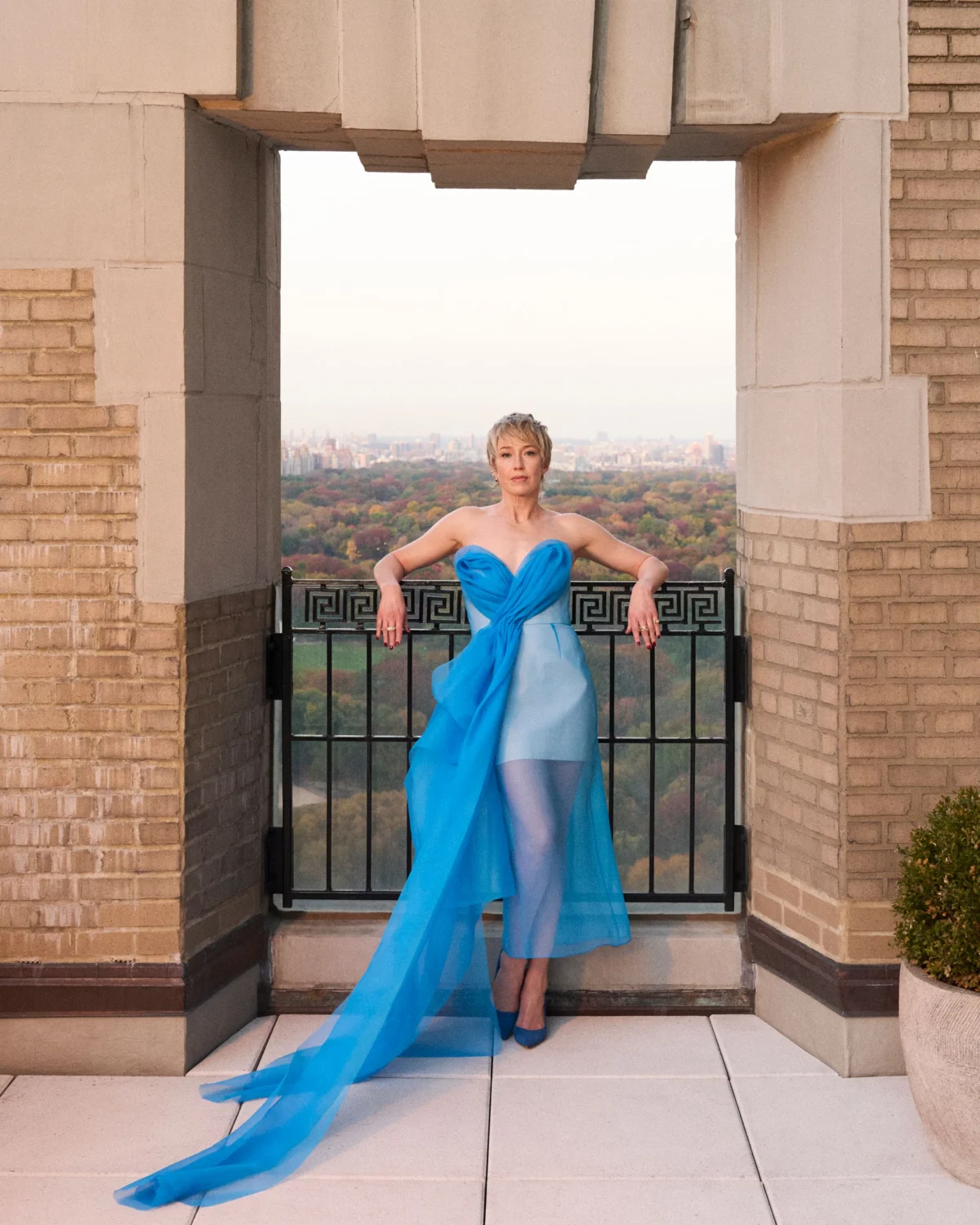
The Council of Fashion Designers of America (CFDA) Awards returned for its annual celebration of American design, drawing a constellation of Hollywood talent, industry veterans, and independent creators to the American Museum of Natural History. Among the most notable attendees was acclaimed actress Carrie Coon, whose presence on the red carpet marked a significant intersection between prestige television, independent cinema, and contemporary American fashion. Known widely for her commanding portrayal of ambitious railroad patron Bertha Russell in HBO’s hit historical drama The Gilded Age, Coon translated her on-screen authority into real-world sartorial diplomacy, arriving in a custom, cerulean silk organza gown designed by American designer and CFDA member Nellie Partow.
While Coon playfully insisted that her relationship with the high-fashion industry remains in its nascent stages, her red carpet debut at the event conveyed the poise and intentionality of a seasoned fashion connoisseur. The collaboration highlights a growing trend among prominent actors who leverage their platform to champion independent female designers, shifting the spotlight away from legacy conglomerates and toward modern, singular artisans.
A Partnership Rooted in Independent Cinema and Shared Ethos
The creative alliance between Coon and Partow is not entirely new. The actress and the designer first crossed paths through the orchestration of celebrity stylist Alicia Lombardini. During the rigorous press tour for the acclaimed independent drama His Three Daughters—where Coon starred alongside fellow heavyweights Elizabeth Olsen and Natasha Lyonne—Coon donned a form-fitting Partow suit that quickly generated widespread industry acclaim. That initial sartorial success laid the groundwork for a deeper, more enduring creative relationship.

For the CFDA Awards, Partow crafted a breathtaking cerulean gown constructed from 100% silk organza featuring a delicate ripstop weave, sourced directly from a historic French mill founded in Lyon during the 1920s. Bringing the vision to life required meticulous dedication; nearly 100 hours of hand craftsmanship were poured into the creation of the custom garment.
Despite the intense technical labor required to construct the piece, the overarching inspiration for the design was rooted in concepts of ease, levity, and air. Partow noted that her creative direction was heavily influenced by Coon’s personal characteristics—qualities the designer finds continually inspiring.
“I’ve always admired women who are tenacious, grounded in who they are, and unapologetically themselves,” Partow remarked regarding the collaboration. “Carrie embodies all of these qualities, which makes collaborating with her all the more meaningful.”
Coon, meanwhile, approached the look as an extension of her internal evolution and self-actualization. Approaching her mid-40s, the actress expressed a profound sense of personal integration that has empowered her to take bolder creative risks.

“At 45, I have never felt more cohesive, and that integration is a solid foundation for taking risks,” Coon shared with Vogue ahead of the event. She explained that the vibrant shade of the silk organza was specifically chosen to project a strong sense of self and unyielding individuality.
The Broader Implications of Fashion as Societal Discourse
Beyond the immediate mechanics of red carpet styling, Coon’s engagement with the CFDA Awards reflects a deeper philosophical interest in the role of personal expression within modern society. Great fashion, Coon observed, frequently transcends the physical act of wearing clothes, serving instead as a vital medium for cultural and political storytelling.
In an era dominated by rapid technological shifts and corporate consolidation, Coon views fashion and the broader arts as essential counterweights. Balancing her demanding professional occupations as both a working actress and a mother, Coon emphasized the necessity of remaining grounded in the present moment while actively shaping an equitable future.
“Honestly, my occupations—actress and mother—always call me back to the present, and I am most focused on how we manifest a future that resists the story of the inevitability of a techno-fascist takeover,” Coon stated. “Personal expression through fashion is a powerful avenue for asserting both our individuality and the creative potency of the human collective.”

This perspective aligns closely with the foundational mission of the CFDA. Founded in 1962, the organization aims to bolster the standing of American design in the global economy, provide professional development for emerging talent, and foster sustainability within the industry. By choosing to wear a design by an independent female creator rather than opting for a mainstream legacy house, Coon actively participated in the organization’s mandate to support grassroots artistry over purely commercial enterprise.
Supporting Emerging Designers and Industry Disruption
The 2026 CFDA Awards served as a vital barometer for the health and future trajectory of American fashion. By gathering established icons alongside a diverse cohort of up-and-coming designers, the event provided a platform for intergenerational dialogue and mentorship.
Coon expressed particular enthusiasm for interacting with the younger generation of creators in attendance, praising the CFDA’s ongoing commitment to uplifting talent based strictly on creative merit and technical skill rather than entrenched business connections.
“I subscribe to the CFDA’s mission to support the arts and specifically to uplift emerging designers purely for their artistry and skill over their connections in the business,” Coon noted. Drawing parallels between creative industries and broader socio-political structures, she added, “It is a model for all systems, politically and otherwise, that one must look outside the system for agents of disruption in order to spur innovation.”

This ethos of disruption and independent thought resonates deeply with Coon’s career choices on screen. Whether portraying sharp, upwardly mobile social climbers in late-19th-century New York or complex, grief-stricken women in independent cinema, Coon consistently gravitates toward characters who challenge established hierarchies. Her red carpet choices reflect a parallel narrative: a deliberate alignment with independent designers who challenge traditional luxury paradigms through uncompromising craftsmanship and unique aesthetic visions.
Chronology of the 2026 CFDA Campaign
The journey from initial concept to the red carpet at the American Museum of Natural History involved a carefully coordinated timeline executed by Coon, designer Nellie Partow, stylist Alicia Lombardini, and a team of beauty professionals:
- Pre-Event Planning: Following their successful collaboration during the press tour for His Three Daughters, Coon and Lombardini reconnected with Partow to conceptualize a look for the 2026 CFDA Fashion Awards that would reflect Coon’s personal evolution and artistic philosophy.
- Material Sourcing and Construction: Partow selected a rare 100% silk organza with a ripstop weave from a historic 1920s mill in Lyon, France. Master artisans dedicated nearly 100 hours to handcrafting the custom cerulean gown.
- Final Fittings: Days before the event, final adjustments were made in New York, ensuring the silhouette balanced structural integrity with a sense of levity and air.
- The Big Night: On the evening of the awards, Coon arrived at the American Museum of Natural History, with hair styled by Jimmy Paul and makeup executed by Rebecca Restrepo. Her appearance on the carpet generated significant media coverage, cementing her status as a formidable presence in both American television and contemporary fashion patronage.
Conclusion: A Lasting Cultural Footprint
As the 2026 CFDA Fashion Awards concluded, the overarching narrative centered on the necessity of creative resilience and the championing of independent talent. Through her thoughtful collaboration with Nellie Partow, Carrie Coon demonstrated that fashion can be much more than a transient red-carpet moment; it can serve as a profound vehicle for personal empowerment, cultural critique, and the celebration of human artistry.
By utilizing her platform to advocate for independent female designers and emphasizing the importance of creative disruption, Coon has firmly established herself not only as a titan of prestige television, but as a thoughtful, dynamic patron of the modern arts whose influence on American fashion is only just beginning.