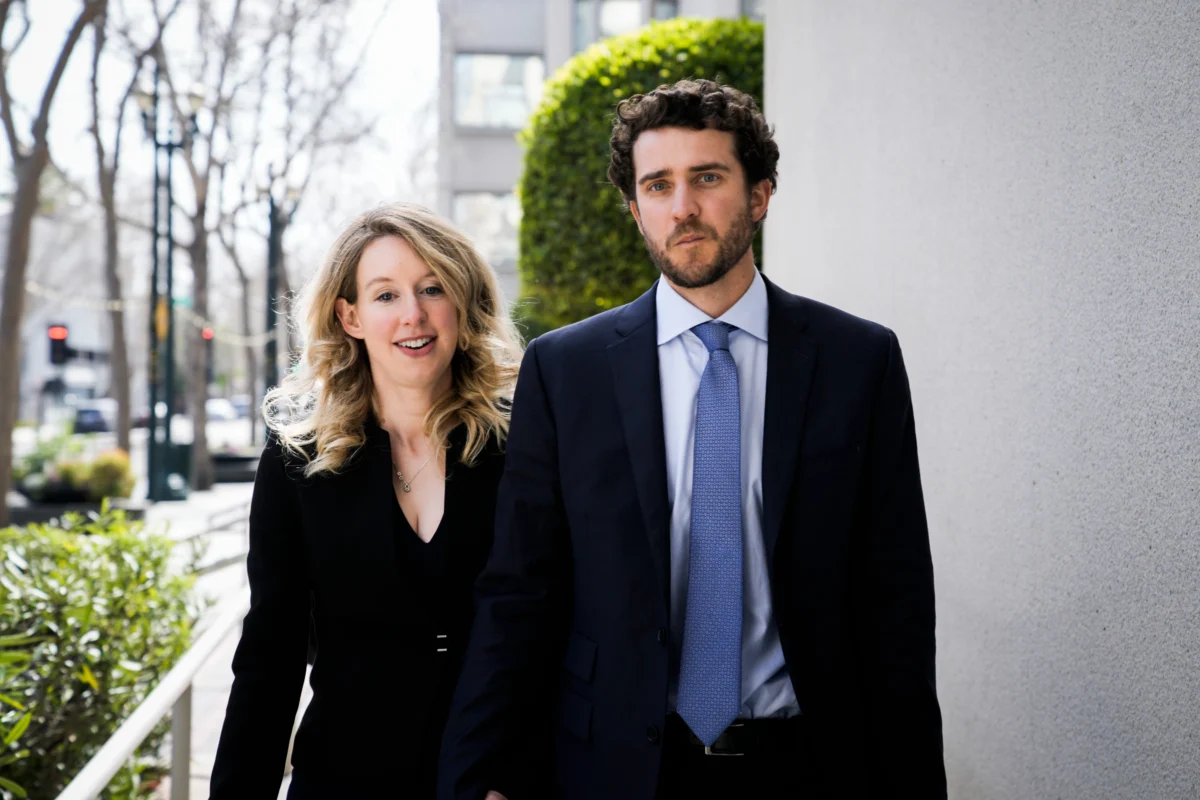
When documentarian Nathan Fielder secured the cooperation of Elizabeth Holmes to chronicle the final days of her freedom before she began serving a multi-year prison sentence for fraud, the project inadvertently became a study of her husband, Billy Evans. The resulting A24 documentary, You Can See Everything, directed by Fielder and Lance Oppenheim, provides an intimate, if fraught, look into the life of the disgraced Theranos founder and the man who has stood by her through a public legal downfall that captivated the global business community. As the cameras rolled, the narrative shifted from a retrospective on the rise and fall of a biotech giant to an exploration of the personal dynamics between Holmes and Evans, a hotel heir whose decision to align himself with one of Silicon Valley’s most controversial figures has sparked intense public and media scrutiny.
The Genesis of the Relationship and Legal Context
The relationship between Elizabeth Holmes and Billy Evans began in 2017, a period defined by the initial cracks forming in the Theranos facade. Holmes, once lauded as the youngest self-made female billionaire, saw her reputation disintegrate following a series of investigative reports—most notably by The Wall Street Journal—that exposed the failure of the company’s blood-testing technology, the Edison machine. Despite the mounting legal pressure and the eventual collapse of the company, which once held a valuation of $9 billion, Evans and Holmes formed a rapid connection.
By 2018, the couple was engaged, and they have since built a family, welcoming a son, William, in 2021, and a daughter, Invicta, in 2023. This timeline is significant because it overlaps precisely with the high-stakes legal battle that ultimately saw Holmes convicted on three counts of wire fraud and one count of conspiracy to commit wire fraud. In January 2022, she was sentenced to over 11 years in federal prison, a term later reduced to nine years. She is currently housed at the Federal Prison Camp in Bryan, Texas, with a projected transition to a halfway house in August 2027.
Who is Billy Evans?
Billy Evans comes from a background of substantial private wealth, rooted in the hospitality sector. His grandparents, William and Anne Evans, established the Evans Hotel Group in 1953, a prominent firm in Southern California that owns and operates luxury properties, including the Bahia Resort Hotel, the Catamaran Resort Hotel and Spa, and The Lodge at Torrey Pines. Evans himself is an MIT graduate, having earned a bachelor’s degree in economics in 2015.
Beyond his familial legacy, Evans has sought to establish his own foothold in the biotechnology sector. He currently serves as the CEO of Haemanthus, an AI-driven medical testing startup he founded in 2022. The company’s stated mission—to analyze blood, urine, and saliva for disease markers using light-based molecular diagnostics—inevitably draws comparisons to the failed ambitions of Theranos. However, Evans and the leadership at Haemanthus have been aggressive in distancing themselves from Holmes. In a 2025 statement to Fortune, the company clarified that Holmes has no role in the firm, explicitly stating, "We’ve learned from her company’s mistakes, but she has no role, now or future."
The Dynamics of the Documentary
The production of You Can See Everything was characterized by escalating tensions between the filmmakers and the subjects. Nathan Fielder, known for his work in reality-bending social commentary, reportedly encountered significant obstacles as Evans attempted to exercise control over the project’s direction. During an L.A. screening, Fielder noted that communication eventually broke down, creating an uncomfortable environment for the production team and A24.
The film reveals several controversial aspects of the couple’s current life, including the revelation that Evans operated Holmes’s social media presence without her knowledge while she was incarcerated. Furthermore, the documentary initially included a deal for the couple’s participation, which Evans eventually rescinded. Neither Holmes nor Evans has viewed the completed film, though Evans has acknowledged his skepticism about the process, telling the All In podcast that he might consider the project the "dumbest thing I have ever done."
Public Perception and Personal Defense
In the aftermath of the documentary’s release, Evans has taken to social media to refute what he characterizes as common misconceptions about his relationship with Holmes. Specifically, he has addressed the public narrative that he exerts control over her. "Anyone who actually knows her would find that idea hilarious," Evans stated on X, emphasizing that he views Holmes as a "fiercely independent" partner.
Evans maintains that his motivation for participating in the documentary was to provide a humanizing counter-narrative to the "ossified" portrayal of Holmes presented by the media. He argued that the film was intended to allow audiences to see her in a "natural environment," suggesting that those who interact with her in person often experience a radical shift in their opinion of her character. He has frequently expressed the personal toll of her incarceration, describing the separation as "hell and torture" and emphasizing his belief in her as a person rather than just the public persona of the "Theranos founder."
Broader Implications and Impact
The intersection of Billy Evans’s life with that of Elizabeth Holmes offers a case study in the intersection of celebrity, scandal, and personal loyalty. For the public, the fascination with the couple stems from the sheer scale of the Theranos fraud and the subsequent questions regarding how one rebuilds a life in the public eye after such a dramatic fall from grace.
The legal implications for Holmes remain fixed; the federal justice system continues its course regardless of the media narrative. However, the involvement of a third party—in this case, a spouse who is himself a business owner—adds a layer of complexity to the public’s understanding of the event. Evans’s decision to launch a startup in the same field where his partner failed represents a high-risk venture that will likely remain under a microscope.
Furthermore, the documentary itself has become a point of contention regarding the ethics of the creator-subject relationship in non-fiction filmmaking. By attempting to "let the audience decide," Fielder and Oppenheim have inadvertently sparked a debate about the responsibility of filmmakers when documenting individuals convicted of major white-collar crimes. The breakdown in communication described by Fielder highlights the difficulty of maintaining objective distance when the subjects are actively attempting to manage their own reputations.
As Holmes continues to serve her sentence and Evans continues to manage his business interests and their family life, the public remains divided. For some, the couple represents a narrative of redemption and support in the face of institutional judgment; for others, they serve as a reminder of the enduring fallout of one of the most significant corporate fraud cases in modern history. The release of You Can See Everything ensures that this discourse will continue, at least until the final chapters of the Theranos saga are closed by the completion of Holmes’s sentence in 2027. Whether the documentary succeeds in its goal of allowing the audience to "make up their own minds" remains to be seen, but it has certainly succeeded in bringing the private life of the couple into the public forum for continued scrutiny.