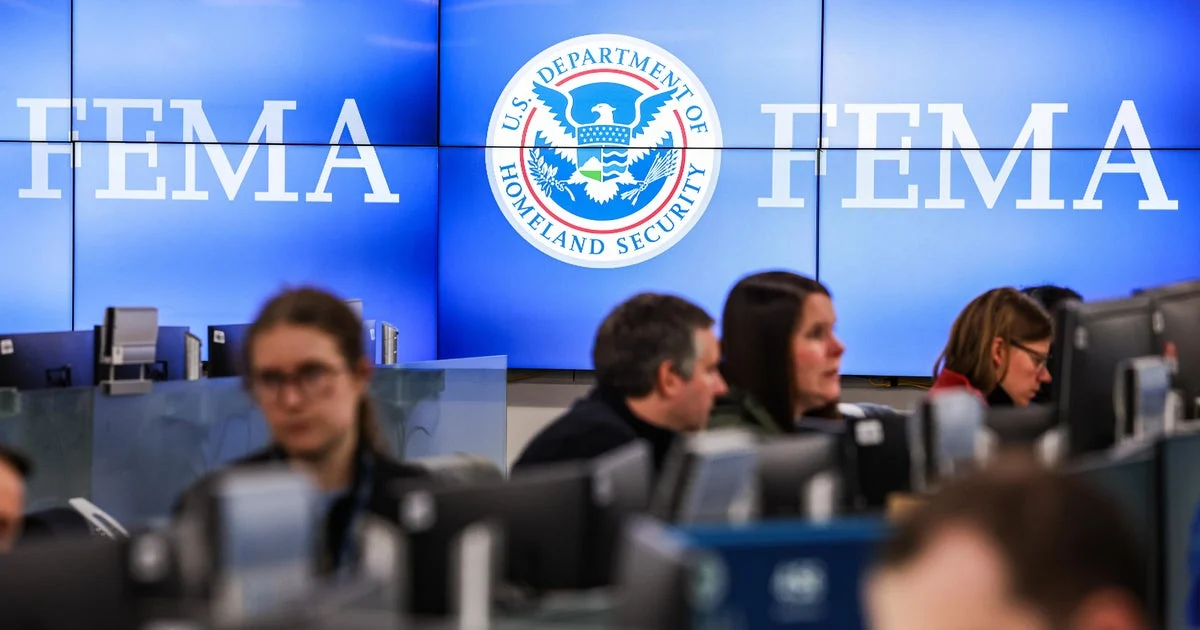
A formidable coalition comprising 25 states and the District of Columbia has initiated a significant legal challenge against the Federal Emergency Management Agency (FEMA) and the Department of Homeland Security (DHS), accusing the Trump administration of leveraging hundreds of millions of dollars in vital disaster preparedness and homeland security grants to impose its controversial policies on elections and immigration. The lawsuit, filed on July 23, 2026, marks a critical escalation in the ongoing tension between federal executive power and state autonomy, with plaintiffs alleging a direct threat to public safety and the integrity of federal funding mechanisms.
The core of the complaint centers on newly imposed conditions attached to the Homeland Security Grant Program (HSGP) awards. These conditions mandate that states verify voter citizenship through a federal database, transition towards hand-marked paper ballots, conduct federally prescribed election audits, and enhance cooperation with federal immigration enforcement efforts. States contend that these stipulations are largely unrelated to the traditional objectives of homeland security funding and represent an unlawful attempt by the executive branch to coerce states into adopting its political agenda.
The Heart of the Dispute: Conditional Funding and Federal Overreach
At the center of this legal maelstrom is the administration’s alleged strategy of weaponizing federal grants, which are typically designed to bolster states’ capacity to respond to a wide array of threats, from natural disasters to acts of terrorism and cyberattacks. The plaintiff states argue that the new conditions fundamentally alter the nature of these grants, transforming them from cooperative funding mechanisms into instruments of federal policy enforcement.
The election-related conditions are particularly contentious. The requirement for states to verify voter citizenship using a federal database taps into a long-standing debate about voter access versus election security. While proponents argue such measures are crucial to prevent voter fraud, critics contend they often disproportionately affect minority communities and can lead to the disenfranchisement of eligible voters. Similarly, the push for hand-marked paper ballots and federally prescribed election audits reflects a broader national discourse on election integrity that gained significant traction in the post-2020 political landscape. Many states have already established their own election administration protocols, which they argue are robust and tailored to their unique demographics and logistical capabilities.
On the immigration front, the demand for increased cooperation with federal enforcement efforts revives previous battles between the Trump administration and "sanctuary" states or cities. Such cooperation often involves state and local law enforcement assisting federal agents in identifying and detaining undocumented immigrants, a practice many states and localities have resisted due to concerns about eroding community trust and diverting resources from local policing priorities. The states argue that tying these unrelated policy demands to critical security funding undermines the spirit of cooperative federalism.
Financial Stakes and Public Safety Concerns
The financial implications of these new conditions are substantial. The plaintiff states estimate that FEMA could withhold at least 20% of their Homeland Security Grant Program awards, amounting to approximately $148 million from the collective group. Furthermore, the lawsuit highlights the potential for entire awards to be terminated for continued noncompliance, which could have catastrophic consequences for state and local emergency management agencies.
The Homeland Security Grant Program is a cornerstone of national preparedness, providing essential funding for a diverse range of critical functions. These funds are instrumental in reimbursing states and localities for the costs associated with first responders, including fire departments, emergency medical services, and law enforcement. They support specialized units such as bomb squads and hazardous materials teams, invest in crucial cybersecurity infrastructure to protect against digital threats, and fund comprehensive disaster response planning and execution. Moreover, HSGP funds are increasingly allocated for security enhancements at vulnerable sites, including houses of worship, schools, and public gathering places, in response to rising domestic and international threats.
A reduction or termination of these funds would directly impact states’ abilities to maintain these vital services. For instance, a cut could mean fewer resources for training emergency personnel, delays in upgrading essential communication systems, or a decreased capacity to procure life-saving equipment. In the face of increasing climate-related disasters and persistent threats from terrorism and cyberattacks, states argue that withholding these funds poses a direct and immediate threat to the safety and well-being of their citizens.
Rhode Island Attorney General Peter F. Neronha, a co-leader in the case, vehemently condemned the administration’s actions. "Congress allocated these funds to the states for preparing for and responding to emergencies including counterterrorism and natural disasters, and the executive branch has no legal say in the matter," Neronha stated in a press release announcing the suit. He further accused the Trump administration of "threatening to jeopardize public safety by unlawfully withholding billions in critical funding," asserting unequivocally that "Federal emergency funding cannot and will not be held hostage from states."
Legal Foundations of the Challenge
The lawsuit primarily contends that FEMA and DHS have violated two fundamental legal principles: the Administrative Procedure Act (APA) and the Constitution’s Spending Clause.
The Administrative Procedure Act governs the way federal agencies propose and establish regulations. The states argue that the new conditions constitute arbitrary and capricious agency action, exceeding the agencies’ statutory authority. They contend that the conditions were imposed without proper public notice and comment periods, denying states the opportunity to provide input and ensure the regulations are well-reasoned and legally sound. Furthermore, the lawsuit challenges language that would permit FEMA to cancel grants if they no longer align with the administration’s "changing priorities" or its view of the "national interest." The states argue that such broad, discretionary authority makes multiyear federal awards unreliable and grants the executive branch an unchecked power to redirect congressionally approved spending based on shifting political whims, effectively usurping Congress’s power of the purse.
The Spending Clause of the U.S. Constitution grants Congress the power to "lay and collect Taxes, Duties, Imposts and Excises, to pay the Debts and provide for the common Defence and general Welfare of the United States." While Congress can attach conditions to federal funds, these conditions must meet certain criteria established by Supreme Court precedent (e.g., South Dakota v. Dole). Conditions must be unambiguous, relate to the federal interest in the particular national projects or programs, and cannot be coercive. The plaintiff states argue that the election and immigration mandates are either unrelated to the purpose of homeland security grants, are unduly coercive by threatening essential public safety funding, or are ambiguous in their implementation, thus violating the Spending Clause. Legal scholars observing the case note that the "coercion" argument, while difficult to prove, could gain traction given the significant financial penalty threatened.
A Growing Coalition: The Plaintiff States
The breadth of the coalition underscores the widespread concern among states regarding these federal mandates. The lawsuit was filed by attorneys general from Arizona, California, Colorado, Connecticut, Delaware, Hawaii, Illinois, Maine, Maryland, Massachusetts, Michigan, Minnesota, Nevada, New Jersey, New Mexico, New York, North Carolina, Oregon, Rhode Island, Vermont, Virginia, Washington, Wisconsin, and the District of Columbia. Additionally, the governors of Kentucky and Pennsylvania joined the suit, highlighting the concern transcends traditional political divides, with states led by both Democrats and Republicans participating in the challenge. This diverse group represents a significant portion of the U.S. population and economic output, amplifying the lawsuit’s potential impact. The sheer number of states involved sends a strong message of unified resistance to what they perceive as federal overreach.
Administration’s Defense: Prioritizing National Security and Election Integrity
In response to the lawsuit, a FEMA spokesperson provided a sharp rebuttal, characterizing the legal action as "partisan pushback." "This partisan pushback from New Jersey, California, Illinois, and Rhode Island is nothing new," the spokesperson told CBS News. "We fully expected these left-wing politicians to oppose common-sense measures designed to protect election security and safeguard the integrity of American democracy."
FEMA’s statement further elaborated on the administration’s rationale: "This year, states must take critical, common-sense steps to protect U.S. elections before receiving their full Homeland Security Grant Program awards. These new requirements will preserve election integrity." The administration views these conditions not as coercive measures but as necessary safeguards in an era of heightened concerns about election vulnerabilities and national security. They contend that ensuring the accuracy of voter rolls and the transparency of election processes is inherently linked to national security, as foreign adversaries could exploit weaknesses in electoral systems. Similarly, they argue that robust immigration enforcement is a core component of national security, requiring full cooperation from state and local authorities.
This stance aligns with the Trump administration’s broader policy priorities, which consistently emphasized "America First" principles, strict immigration enforcement, and claims of widespread voter fraud requiring federal intervention. The administration frames these conditions as a fulfillment of its mandate to protect the nation, implying that states resisting these measures are neglecting their responsibilities in safeguarding national interests.
Broader Context: Federalism Under the Trump Administration
The lawsuit is the latest chapter in a series of confrontations between the Trump administration and various states over issues ranging from environmental regulations and healthcare policy to immigration and, notably, election administration. The administration has frequently sought to assert federal authority, often through executive orders or conditional funding, challenging the traditional balance of power in the American federal system.
Historically, federal grants have been a cornerstone of cooperative federalism, allowing the federal government to encourage states to pursue national objectives while respecting state autonomy. However, the use of these grants as leverage for unrelated policy objectives has often led to legal challenges and accusations of federal overreach. This lawsuit is reminiscent of previous legal battles where states have pushed back against federal mandates they deem unconstitutional or beyond the scope of federal power. The current dispute, however, appears to raise the stakes by directly impacting funds critical to immediate public safety and emergency response.
Timeline of Events
While the original article’s update date is July 23, 2026, the specific timeline of the conditions’ announcement and the states’ reactions can be logically inferred:
- Late 2025/Early 2026: The Trump administration, through FEMA and DHS, likely began signaling or formally announcing the new, stricter conditions for the upcoming fiscal year’s Homeland Security Grant Program awards. These announcements would have sparked initial concern and discussion among state emergency managers and legal counsel.
- Spring 2026: As states began preparing their applications for HSGP funds, the implications of these new conditions became clearer. State attorneys general and governors would have engaged in internal deliberations and consultations, assessing the legal viability of the mandates and the potential financial impact of non-compliance.
- Early Summer 2026: The coalition of states likely began forming, coordinating their legal strategy and drafting the complaint. Discussions would have focused on the constitutional arguments and the procedural violations alleged.
- July 23, 2026: The coalition officially files the lawsuit in federal court in Rhode Island, seeking an immediate injunction to block the conditions and ultimately void them nationwide for the plaintiffs, compelling the agencies to issue funding documents without the contested mandates. This date also marks the update for the news article, indicating the immediate public announcement of the lawsuit.
Expert Perspectives and Political Ramifications
Legal experts following the case suggest that the states have a strong argument under the Spending Clause if they can effectively demonstrate that the conditions are unrelated to the purpose of homeland security grants or are unduly coercive. The APA challenge, focusing on procedural irregularities and arbitrary agency action, also presents a significant hurdle for the federal government.
"The federal government certainly has the power to set conditions on grants, but those conditions have to be clearly stated, related to the purpose of the grant, and not so coercive as to effectively remove a state’s choice," noted Dr. Evelyn Reed, a constitutional law professor at Georgetown University, offering an inferred expert opinion. "Threatening funds essential for basic public safety services could indeed cross that line."
The political ramifications are also considerable. With the lawsuit filed in mid-2026, it places the Trump administration’s approach to federalism and national security squarely in the public spotlight, potentially influencing future electoral cycles. Democratic and opposition leaders are likely to seize upon the lawsuit as evidence of executive overreach and a disregard for state sovereignty, while the administration and its allies will undoubtedly continue to frame the dispute as a necessary measure for national security and election integrity.
The Road Ahead: Legal Battle and Potential Outcomes
The immediate next step in the legal process is for the federal judge in Rhode Island to consider the states’ request for a preliminary injunction. If granted, an injunction would temporarily block FEMA and DHS from enforcing the contested conditions while the lawsuit proceeds, allowing states to receive their full HSGP awards without complying with the mandates. This would be a significant early victory for the plaintiff states.
Beyond an injunction, the lawsuit will proceed through discovery and potentially a full trial. The ultimate goal for the states is to have the conditions declared unlawful, voiding them nationwide as applied to the plaintiffs and requiring the federal agencies to disburse the funds without the controversial stipulations. Given the high stakes and the constitutional questions involved, it is highly probable that the case, regardless of the initial outcome, could eventually reach the U.S. Court of Appeals and potentially even the Supreme Court.
The outcome of this landmark litigation will have profound implications not only for the future of federal grant programs and the balance of power between state and federal governments but also for the critical infrastructure of national security and disaster preparedness across the United States. As the legal battle unfolds, the nation will be watching closely to see whether the executive branch’s asserted authority to condition vital funds on policy compliance will withstand judicial scrutiny.