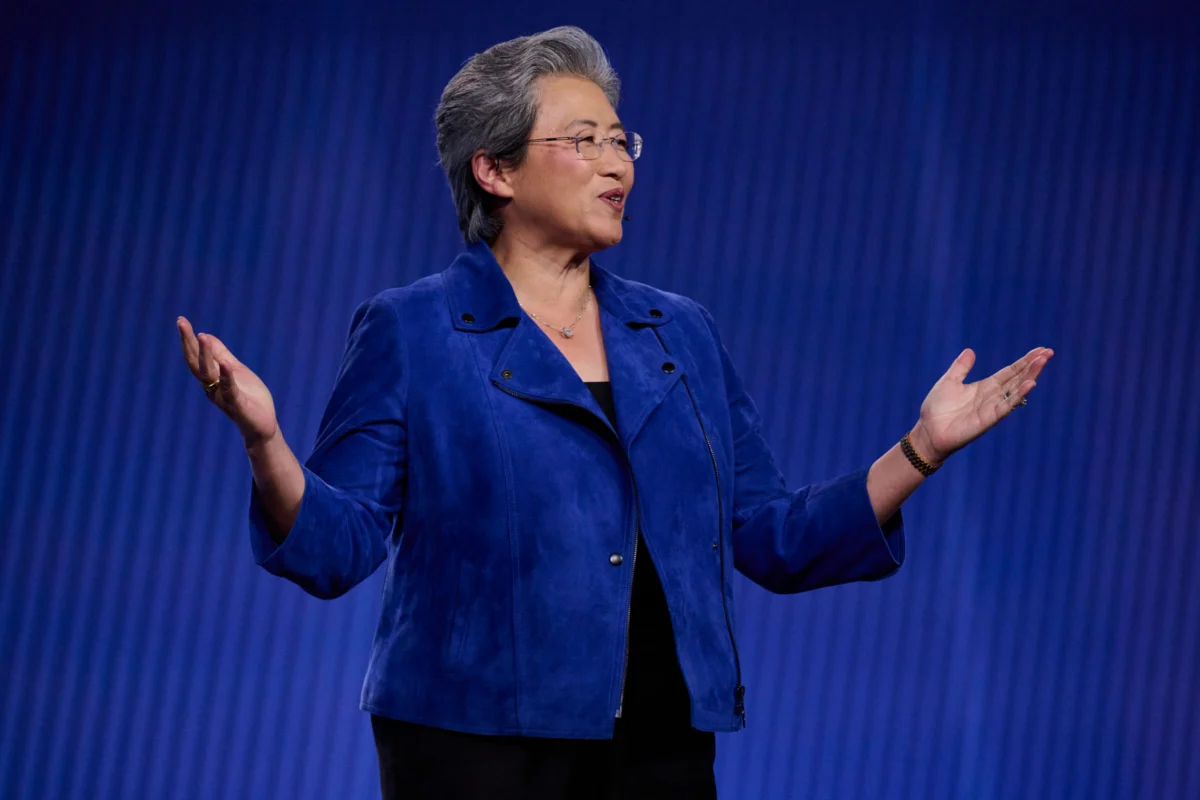
Advanced Micro Devices (AMD) has made a definitive move to challenge Nvidia’s formidable dominance in the burgeoning artificial intelligence (AI) hardware sector with the official launch of its Helios rack-scale system. Designed to power the most demanding computing needs of the world’s largest AI laboratories, Helios represents AMD’s strategic pivot to capture a significant share of the rapidly expanding market for AI infrastructure. The announcement came during the company’s highly anticipated and sold-out Advancing AI conference held in San Francisco, where AMD Chair and CEO Dr. Lisa Su spearheaded the promotion of Helios and unveiled an impressive roster of early adopters, including tech giants like Microsoft, OpenAI, Meta, Oracle, and Anthropic. The system is slated for shipment later this year, intensifying the race for AI compute supremacy.
The Strategic Thrust into Rack-Scale AI Systems
At the core of AMD’s latest offensive is the Helios AI rack system, a formidable integration of numerous processors into a singular, high-powered unit specifically engineered for the rigorous demands of modern data centers. These systems are the backbone of the AI revolution, essential for training vast, complex AI models and executing other compute-intensive workloads that define the cutting edge of artificial intelligence. Dr. Su heralded Helios as the tech industry’s "highest-performance AI rack," emphasizing its capability to "train and run the most demanding frontier models in the world at massive scale." The company further revealed that Helios is poised for deployment by leading AI enterprises at what it described as "gigawatt-scale," underscoring the sheer computational power and energy requirements envisioned for these deployments.
For years, the market for AI rack-scale systems has been largely synonymous with Nvidia, which has meticulously cultivated a near-monopoly through its powerful architectures like Vera Rubin and Grace Blackwell. Nvidia’s integrated approach, combining top-tier GPUs with proprietary interconnect technologies and a robust software ecosystem (CUDA), has set a high bar for competitors. AMD’s entry with Helios, however, signals a serious intent to disrupt this status quo. Early performance metrics reported by outlets like The Register suggest that Helios, in several key aspects, is positioned to outperform Nvidia’s Vera Rubin system, giving AMD a credible opportunity to carve out its niche. This performance advantage, if validated and sustained, could be a critical differentiator in attracting top-tier AI clients who demand the utmost in speed, efficiency, and scalability.
A Chronology of AMD’s AI Ambitions
The journey towards the Helios launch has been a carefully orchestrated one, reflecting AMD’s long-term commitment to the AI market. The Helios system was first publicly revealed in 2025, generating significant industry buzz. Its physical manifestation was showcased onstage earlier this year, in January 2026, at the Consumer Electronics Show (CES), offering a tangible glimpse into its scale and design, reportedly weighing as much as two compact cars. The Advancing AI conference in July 2026 served as the formal launchpad for its market introduction and customer endorsements.
During the conference, Dr. Su meticulously outlined AMD’s comprehensive strategy, which extends beyond the rack system itself to include new generations of chips designed to meet the insatiable demands of the AI industry. The company also introduced its Venice-X CPU, a new central processing unit specifically tailored for data centers and high-computing workloads, with its expected launch in 2027. This dual-pronged approach, integrating advanced CPUs with high-performance GPUs within a rack-scale system, underscores AMD’s ambition to offer a complete, end-to-end solution for AI infrastructure.
The customer validation for Helios has been swift and substantial. Microsoft CEO Satya Nadella, in a statement preceding the conference, confirmed the company’s plans to expand its Azure infrastructure with Helios, a significant endorsement given Microsoft’s vast cloud computing footprint and its deep investments in AI. Furthermore, a strategic partnership between AMD and Anthropic, a leading AI safety and research company, was announced during the conference, detailing plans to deploy an astounding two gigawatts of AMD Instinct MI450 series GPUs via the new rack system. This commitment represents one of the largest single deployments of AI compute infrastructure disclosed to date and highlights the strategic importance of AMD’s offerings to pioneering AI research firms. The inclusion of OpenAI, Meta, and Oracle among planned deployers further solidifies Helios’s market traction, indicating a broad industry acceptance and a diversified customer base eager to explore alternatives to existing solutions.
Supporting Data and Market Projections
The scale of AMD’s ambition is directly tied to the exponential growth trajectory of the AI market. Dr. Lisa Su provided a compelling vision of the future, projecting that by 2030, chips powering AI will constitute a massive portion of the overall computing market. This dramatic expansion is primarily fueled by what she termed a "step change in compute demand," largely driven by the emergence of "agentic AI."
Agentic AI systems, unlike traditional AI models, are designed to perform complex tasks by breaking them down into multiple steps, reasoning through problems, calling upon various tools, and continuously accessing and processing data until a solution is achieved. This iterative and multi-faceted problem-solving approach inherently demands vast amounts of computational power. As Dr. Su elucidated, "When you ask the agent to do something, it actually has dozens of steps, and it has to reason, and it has to call tools, and it has to access data, and it has to keep doing it over and over until it solves the problem, and so you need lots of GPUs to do all that."
This escalating demand translates into staggering market projections. AMD anticipates that the AI accelerator market will reach an astonishing $1.4 trillion by 2030. To put this figure into perspective, Dr. Su highlighted that "by the end of the decade, the AI accelerator market is going to approach the size of the entire semiconductor market today." This projection underscores a fundamental shift in the technology landscape, where AI-specific hardware will become a dominant force, rivaling the entire current semiconductor industry in scale and economic impact.
Furthermore, Dr. Su emphasized the continued primacy of Graphics Processing Units (GPUs) within this burgeoning market. "We do expect that GPUs are going to make up the vast majority of that market because the algorithms are still very much in their infancy, and we’re still continuing to see the workloads change, and that favors programmability in the overall silicon ecosystem," she explained. The inherent flexibility and parallel processing capabilities of GPUs make them uniquely suited to adapt to the rapidly evolving nature of AI algorithms, providing the programmability necessary for ongoing innovation and research in the field. This insight reaffirms AMD’s strategic focus on its Instinct series GPUs as the cornerstone of its AI hardware offerings.
Broader Impact and Implications for the AI Ecosystem
AMD’s aggressive push with Helios carries significant implications for the entire AI ecosystem, extending beyond mere market share battles.
Intensified Competition and Innovation: The direct challenge to Nvidia’s long-held dominance is likely to spur increased innovation across the industry. With a credible alternative now available, customers will have more options, potentially leading to competitive pricing, faster development cycles for new hardware, and a greater focus on energy efficiency and performance-per-watt metrics. This healthy competition benefits end-users and accelerates the overall pace of AI development.
Diversification of AI Compute Supply: For major AI labs and cloud providers, the availability of high-performance alternatives to Nvidia is a strategic imperative. Relying on a single vendor for critical infrastructure carries supply chain risks and can limit bargaining power. The adoption of Helios by Microsoft, OpenAI, Meta, Oracle, and Anthropic signals a clear industry-wide desire for diversification in AI compute, ensuring resilience and fostering a more balanced competitive landscape.
Democratization of Advanced AI: While still an exclusive domain for large enterprises due to cost, the introduction of more competitive and diverse hardware options could, in the long run, contribute to the broader availability of advanced AI compute. This could enable more researchers, startups, and even smaller enterprises to access the processing power needed to develop and deploy sophisticated AI models, fostering a more inclusive innovation environment.
The Rise of Agentic AI and its Hardware Demands: AMD’s emphasis on agentic AI highlights a critical trend in the field. As AI systems become more autonomous and capable of complex, multi-step reasoning, the computational demands will only escalate. Hardware like Helios, designed for "gigawatt-scale" deployments, is not merely an incremental improvement but a foundational requirement for the next generation of AI capabilities. This implies a future where AI models are not just trained but continuously run and iterated upon in real-time, requiring always-on, massive compute resources.
Economic Shift and Strategic Importance of Semiconductors: Dr. Su’s projection of a $1.4 trillion AI accelerator market by 2030 underscores the profound economic shift underway. The semiconductor industry, already a cornerstone of the global economy, is being reshaped by AI. Nations and corporations will increasingly view AI chip manufacturing and design as a matter of strategic national and economic security, leading to further investments, policy initiatives, and potentially geopolitical considerations around supply chains and technological leadership.
In conclusion, AMD’s launch of the Helios rack-scale system marks a pivotal moment in the high-stakes world of AI hardware. Backed by impressive performance claims, a strong customer base, and a clear vision for the future of AI compute, AMD is positioning itself as a formidable contender against Nvidia. This intensified competition promises to accelerate innovation, diversify the supply chain for critical AI infrastructure, and ultimately shape the trajectory of artificial intelligence development for years to come, as the industry hurtles towards a future defined by trillion-dollar opportunities and ever-increasing computational demands.