Reaching a milestone as significant as a 15-year anniversary in the contemporary fashion landscape is an extraordinary feat, particularly for an independent brand navigating the turbulent waters of the global market. For British contemporary label Palmer Harding, founded by design duo Levi Palmer and Matthew Harding, this season marks not only a decade and a half of operation but also the unveiling of their landmark 60th full collection. Amid ongoing shifts in consumer behavior, macroeconomic headwinds, and the well-documented decline of traditional wholesale retail networks, the brand’s latest chapter offers a masterclass in operational resilience, design focus, and the power of direct-to-consumer intimacy.
The Evolution of an Independent Label: A 15-Year Timeline
Founded in 2009, Palmer Harding initially carved out a distinct niche in the British and international fashion scenes by challenging the conventional boundaries of wardrobe staples. Over the past fifteen years, the label has systematically built a reputation for elevated tailoring, innovative draping, and an obsessive dedication to the humble cotton shirt.
The brand’s trajectory over this period mirrors the broader structural transformations within the global fashion industry:
- 2009–2014: The formative years. Palmer Harding launched with a clear design mandate centered on reimagining shirting, quickly gaining critical acclaim and securing stockists in major luxury department stores internationally.
- 2015–2019: Expansion and stabilization. The brand expanded its product categories, introducing full ready-to-wear collections while maintaining its signature architectural cut and focus on crisp poplins.
- 2020–2022: Pandemic disruption and market recalibration. Like many independent labels, Palmer Harding faced severe supply chain disruptions, fluctuating retail demand, and the accelerated decline of wholesale partnerships.
- 2023–2024: The direct-to-consumer pivot. Responding to shrinking wholesale margins, the brand undertook a major operational restructuring, culminating in the opening of an intimate retail space directly within its East London studio.
- 2025: The 60th collection milestone. Celebrating 15 years in business, the brand reflects on its journey by doubling down on core competencies, refining foundational silhouettes, and prioritizing direct customer engagement.
Operational Pivots and the Direct-to-Consumer Shift
The past year has ushered in some of the most profound operational developments in Palmer Harding’s history. Facing the structural contraction of global wholesale retail—a trend that has severely impacted independent designers worldwide—the founders made the strategic decision to pivot toward a direct-to-consumer (DTC) model. Central to this strategy was the opening of a dedicated retail space housed within their East London studio.
This physical integration of design workspace and retail floor has fundamentally altered how the brand interacts with its clientele. According to co-founder Matthew Harding, the environment recaptures the ethos of the brand’s early days.
"It feels almost like when we first started; there’s more interaction between us, the clothes, and the customer," Harding notes. This heightened proximity to the end consumer has eliminated the traditional buffer of department store buyers and floor staff, allowing the designers to receive immediate, unfiltered feedback on fit, fabric, and silhouette performance.
This intimate feedback loop directly informed the creative direction of their milestone 60th collection. Rather than manufacturing a nostalgic "greatest hits" compilation designed solely to evoke sentimentality, the duo chose to analyze real-time sales data and customer responses, zeroing in on the garments that have consistently resonated with their buyer base over time.
Refining the Core: Cotton Shirting as an Alchemical Medium
When Palmer and Harding sat down to evaluate the core identity of their brand, the conclusion was swift and unequivocal. "When we actually hunkered down and said, ‘Okay, what are we about?’ The answer was cotton shirts and shirt dresses. When we find a shape, let’s just really hammer it home," Levi Palmer explains.
This philosophy manifests tangibly throughout the 60th collection. The designers resisted the temptation to over-diversify, choosing instead to elevate their foundational fabric—crisp, structured cotton poplin—through sculptural manipulation and advanced pattern-cutting techniques.
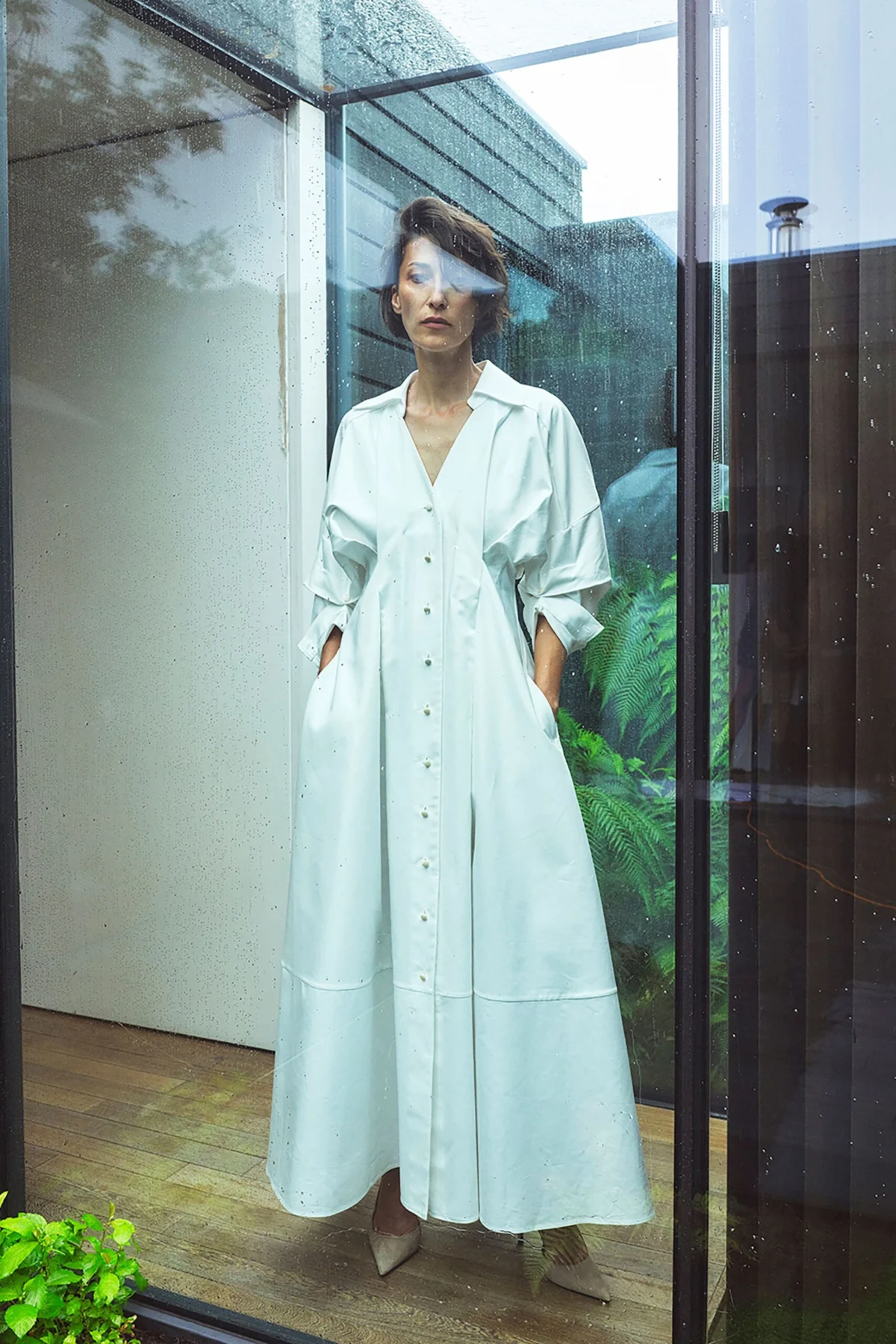
A prime example is the return of the "Intention" shirt, first introduced two seasons ago. Characterized by heavy poplin construction and articulated pleating along the oversized sleeves that creates a distinctive, boomerang-like bend, the garment has been expanded into a broader assortment of plain and striped cottons. Furthermore, the silhouette has been translated into a full-length shirt dress that introduces fluid movement and a satisfying, fanning swish.
Archival Revival and Sculptural Innovation
The collection also marks the strategic return of historical silhouettes from the brand’s archives, re-engineered for the modern wearer. Among them is the "Super" shirt, featuring an asymmetrical hemline. "It’s one of our hero pieces that really launched us way back when, but that we haven’t had in the collection for a long time," Palmer recalls. With its dramatic tie-front closure and cape-like back, the piece underscores the designers’ enduring expertise in sculptural draping and form.
Perhaps the most structurally ambitious garment in the lineup is the newly introduced "Precision" shirt. The design incorporates intricate, origami-like criss-cross pleating concentrated at the waist, resulting in a silhouette that effortlessly skims and accentuates the wearer’s form while maintaining structural integrity.
While crisp cotton remains the undeniable anchor of the collection, the designers have introduced calculated textural diversifications. A denim interpretation of the "Intention" silhouette bridges the gap between utilitarian workwear and high-end tailoring, while a ruby satin dress complete with swooping poet sleeves introduces a rich injection of eveningwear romance.
The Philosophy of Elevated Everyday Wear
The overarching design ethos of Palmer Harding relies on an intentional paradox: taking utilitarian, everyday materials and transforming them into architectural statements.
"There’s something really wonderful about taking what’s seen as a boring, everyday fabric and elevating it in a really sculptural way," Levi Palmer observes. "The result is a blend of something that’s really understandable, but also very special."
This formula has sustained the brand through a decade and a half of shifting aesthetic trends and economic uncertainty. Industry analysts note that independent labels surviving past the ten-year mark typically do so by establishing an unmistakable brand signature and fiercely protecting it. By refusing to chase fleeting micro-trends and instead focusing on the architectural perfection of wardrobe staples, Palmer Harding has cultivated a fiercely loyal demographic.
Broader Market Implications and Industry Outlook
The trajectory of Palmer Harding offers valuable insights into the current state of independent contemporary fashion. As traditional wholesale models become increasingly precarious—burdened by stringent return policies, delayed payments, and high department store markups—more independent designers are following in Palmer Harding’s footsteps by investing in direct-to-consumer infrastructure.
By merging their East London studio space with a retail storefront, the brand has lowered operational overhead associated with external retail leases while simultaneously capturing higher retail margins. More importantly, this physical proximity has proven that modern luxury consumers increasingly value authenticity, provenance, and direct engagement with the creators behind the garments.
Evidence of this strategy’s success is visible outside the studio doors. Despite its off-the-beaten-path location, far removed from London’s traditional luxury shopping corridors in Mayfair or Knightsbridge, the brand continues to draw an eclectic international clientele willing to travel specifically to try on and purchase collections in person.
Looking Ahead: The Next Chapter
As Palmer Harding steps beyond its fifteenth-year milestone and looks toward its future collections, the brand stands as a testament to the viability of focused, independent design. By remaining true to their foundational medium while embracing pragmatic operational evolution—shifting toward direct consumer engagement and localized retail experiences—the founders have secured not only their survival in a demanding industry but their continued relevance.
The 60th collection is neither a retrospective nor a radical departure, but rather a confident reaffirmation of identity. In an industry perpetually obsessed with the new, Palmer Harding demonstrates that true innovation often lies in perfecting what you already know best.