The 2026 midterm elections delivered a dramatic political realignment across the United States, with the Democratic Party decisively reclaiming control of the House of Representatives. Fueled by widespread voter discontent regarding persistent economic headwinds and declining presidential approval ratings, the election results materialized into what party leaders hailed as an "American tsunami." As results poured in from coast to coast, Democrats not only captured the necessary net gains to secure the chamber but surged past expectations, eyeing a historic majority that approaches 255 seats—a legislative powerhouse unseen in Congress for decades.
This seismic shift on Capitol Hill abruptly halts the legislative agenda of President Trump’s administration for the final two years of his term. With Democrats taking control of the committee gavels and the floor agenda, the balance of power in Washington undergoes a complete inversion, setting the stage for aggressive congressional oversight, intense policy battles over the cost of living, and a fierce institutional struggle over executive power.
A Blue Wave Rooted in Economic Discontent and Historical Trends
The trajectory of the 2026 midterms adhered closely to historical patterns while being heavily supercharged by modern economic realities. Since 1934, the sitting president’s party has rarely managed to gain House seats during midterm elections, largely due to voter fatigue, sinking presidential approval ratings, and the absence of a presidential candidate at the top of the ballot to galvanize turnout. President Trump entered the midterm cycle facing severe headwinds, with early exit polls placing his approval rating at a dismal 38%—lower than his previous term and trailing the marks of past presidents who suffered significant midterm losses, such as George W. Bush in 2006.
Exit polls underscored the primary driver behind the voters’ calculus: roughly six in 10 voters indicated that President Trump was a major factor in their vote for the House. Crucially, persistent negative views of the economy served as a massive anchor for the governing Republican party. Voters who reported that inflation remained a heavy hardship, or that their personal financial situation had deteriorated compared to two years prior, overwhelmingly broke for Democratic congressional candidates. This economic frustration allowed Democrats to claw back segments of the electorate that Trump had successfully courted during the 2024 presidential cycle, turning competitive districts into decisive victories.
The battle for the majority was fought across more than 40 fiercely contested districts, heavily influenced by an aggressive cycle of mid-decade redistricting. Republicans had attempted to cement their narrow majority by redrawing maps in seven states to favor GOP candidates in roughly 15 additional districts. Democrats countered by implementing aggressive map changes in states like California, neutralizing Republican gains and ultimately exploiting voter dissatisfaction to flip seats across the map, ranging from traditional battlegrounds to deep-red territories.
The Collapse of the GOP House Majority and Leadership Upheaval
The sheer scale of the Democratic victory sent immediate shockwaves through the Republican caucus, triggering rapid leadership realstakes and recriminations. House Speaker Mike Johnson, who spent the final two years of the 119th Congress navigating a razor-thin, deeply fractured majority plagued by government shutdowns, internal infighting, and ethics scandals, announced to staffers on a Wednesday morning call that he would not seek another term as the House GOP leader.
Johnson, who had publicly insisted leading up to the election that "the polls are wrong" and that Republicans would maintain their grip on power, acknowledged the disappointment of the results while defending his tenure. In a statement from Shreveport, Louisiana, Johnson warned against retaliatory politics, stating that Republicans would not be deterred by the outcome of a single election.
The vacancy at the top of the Republican conference immediately touched off a fierce succession battle. House Majority Leader Steve Scalise announced his candidacy for minority leader, acknowledging in a five-page letter to colleagues that the election outcome was "far worse than any of us expected" and warning that the party would need to be brutally honest about what went wrong. Simultaneously, House Judiciary Chairman Jim Jordan launched a bid for minority leader, arguing in his own letter to the caucus that he is "battle-tested on the oversight front" and uniquely prepared to lead a unified defense against an aggressive Democratic majority. Further down the leadership ladder, outgoing Republican Study Committee Chair August Pfluger challenged House Majority Whip Tom Emmer for the minority whip position, signaling a widespread desire among Republicans for fresh ideas and a complete structural reboot ahead of the 2028 election cycle.
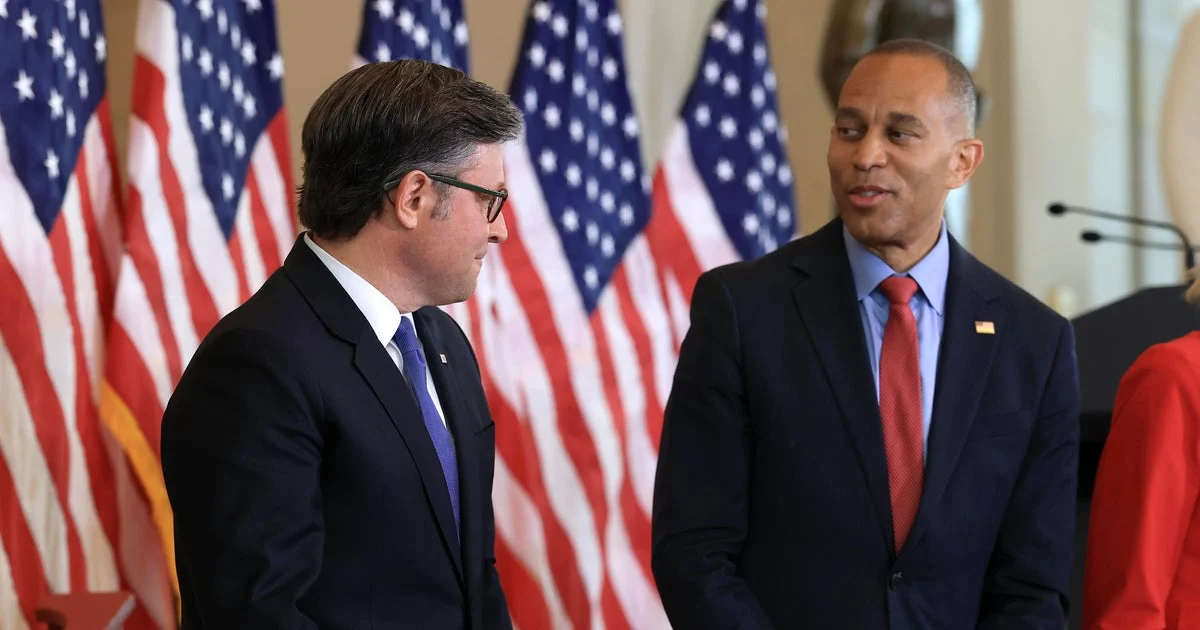
On the other side of the aisle, House Minority Leader Hakeem Jeffries celebrated a triumphant night, declaring that "America is back" and framing the victory as a mandate for transformational economic change. Jeffries, who is poised to make history as the first Black Speaker of the House when the 120th Congress convenes, projected that Democrats would ultimately win at least 255 seats—a historic majority for the 21st century that rivals the 257 seats Democrats held in the 111th Congress in 2009.
Legislative Priorities and the Looming Oversight Battle
With control of the chamber secured, Democratic leaders have outlined an immediate legislative and investigative agenda focused squarely on economic relief and government accountability. Jeffries announced that the caucus’s immediate legislative priorities include reversing cuts to Medicaid and SNAP enacted under the administration’s past tax and spending packages, extending the expired Affordable Care Act premium tax credits, terminating the unauthorized conflict with Iran, and rolling back sweeping executive tariffs.
Simultaneously, the impending Democratic majority is preparing an aggressive oversight blitz that promises to put Trump administration officials and allies directly in the crosshairs. Representative Robert Garcia of California, slated to become the chairman of the House Oversight Committee in the new Congress, laid out a wide-ranging investigative framework during a news conference in his district. Garcia’s committee plans to focus its inquiries on four primary areas: the Trump family’s business dealings, corporate corruption, the enforcement actions of the Department of Homeland Security and Immigration and Customs Enforcement (ICE), and the ongoing fallout surrounding the Jeffrey Epstein scandal.
Targeting high-profile administration figures and allies—including Stephen Miller, Corey Lewandowski, and Kristi Noem—Garcia bluntly advised targets to "lawyer up" and warned that Congress would formally issue subpoenas compelling testimony. While acknowledging that the Department of Justice under the Trump administration is unlikely to enforce criminal contempt charges against uncooperative officials, Garcia emphasized that the House majority retains robust alternative tools, including civil contempt proceedings through the federal courts and direct civil lawsuits filed on behalf of the institution.
The White House immediately pushed back against the impending investigations. White House spokeswoman Lauren Bis issued a statement accusing Democrats of abandoning the American public, noting that while the President remains willing to work with anyone to deliver economic victories, choosing to pursue "sham investigations and radical left policies" is a deliberate choice to work against the interests of hardworking Americans. Despite warnings from the executive branch, Democratic leaders like Jeffries maintained that the caucus remains primarily focused on economic affordability and systemic accountability, noting that impeachment discussions have not been prioritized among members who prefer to focus on tangible legislative solutions for working families.
Historic Electoral Milestones and Noteworthy Races
Beyond the macro-level shift in congressional control, the 2026 midterms were notable for breaking numerous demographic and political barriers. Most notably, the Democratic Women’s Caucus announced that a record-breaking cohort of more than 100 Democratic women won their House elections, marking the first time the caucus has surpassed the century mark in the lower chamber. This surge was propelled by female voters mobilizing against conservative policies affecting healthcare, reproductive rights, and economic security.
In Colorado’s 1st District, 29-year-old Melat Kiros made national history by winning her race, officially becoming the first Generation Z woman ever elected to the United States Congress. Kiros joins Florida Representative Maxwell Frost as part of the vanguard of a generation entering federal legislative politics.
Meanwhile, the election featured the systematic dismantling of several high-profile Republican incumbents and key party figures. Richard Hudson, chairman of the National Republican Congressional Committee and a nine-term incumbent who won reelection by nearly 19 points in 2024, suffered a stunning defeat in North Carolina’s 9th District, conceding the race to Democrat Richard Ojeda. In California’s 22nd District, Republican Rep. David Valadao—the final remaining House Republican who voted to impeach Donald Trump following the January 6, 2021, Capitol riot and chose to run for reelection—lost his seat to Democrat Randy Villegas.
Additional notable flips and close races saw former Democratic Representative Elaine Luria make a dramatic political comeback by unseating Republican Rep. Jen Kiggans in Virginia’s military-heavy 2nd District. In Pennsylvania, New York, Iowa, and Nebraska, waves of competitive races fell to Democratic challengers as suburban and rural districts swung sharply away from the GOP.
As the dust settles on a historic election night, the attention of Washington shifts rapidly toward the finalization of uncalled races and the intra-party leadership elections scheduled for mid-November. With a commanding majority and an aggressive investigative apparatus ready to deploy, House Democrats are positioned to fundamentally alter the balance of power in Washington, setting up a ferocious two-year clash with the executive branch as the country looks toward the 2028 presidential cycle.