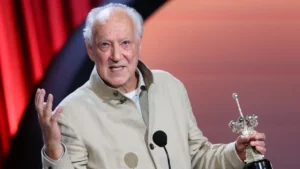
The entertainment world is mourning the loss of Duncan Sheik, the visionary singer-songwriter and composer whose genre-defying work bridged the gap between alternative pop and Broadway excellence. Sheik, who passed away on Thursday at the age of 56 due to organ failure, leaves behind a legacy defined by his immense melodic sensitivity and a singular ability to capture the anxieties of youth. Among those most profoundly affected by his death is actress and singer Lea Michele, who rose to prominence starring in the seminal production of Spring Awakening, a musical that transformed the landscape of modern theater and solidified Sheik’s reputation as a titan of the stage.
A Profound Artistic Connection
Lea Michele’s relationship with Duncan Sheik began long before she became a household name. At just 14 years old, Michele encountered Sheik’s work while preparing for her first professional theater audition. In a touching tribute posted to her Instagram story, the Glee star shared a poignant memory of the composer, highlighting the early influence he had on her trajectory. "I met Duncan when I was 14 years old," Michele wrote, accompanying her message with a reflective post that featured a video of the two performing "Mama Who Bore Me" in a rehearsal space. "I listened to a demo on tape of him singing songs from Spring Awakening outside of my middle school before my first audition."
For Michele, the loss is deeply personal. She described being "at a loss for words," emphasizing the shock of the news. "This one hurts and does not seem real," she noted, extending her condolences to Sheik’s survivors, including his mother, Suzanne, and his family. The bond between the two was forged in the creative crucible of Spring Awakening, a project that demanded emotional vulnerability and technical precision—two qualities that defined both Sheik’s writing and Michele’s performances.
The Life and Legacy of Duncan Sheik
Born in 1969, Duncan Sheik first entered the public consciousness in the mid-1990s as a singer-songwriter with a penchant for introspective, hook-laden pop music. His 1996 self-titled debut album featured the enduring hit "Barely Breathing," a track that spent a staggering 55 weeks on the Billboard Hot 100. The song’s success established Sheik as a mainstay of the adult alternative radio era, but his true creative pivot occurred when he turned his attention to the theater.
In 2006, Sheik and lyricist Steven Sater brought Spring Awakening to the stage. Based on Frank Wedekind’s 1891 expressionist play, the musical was a bold, modern interpretation of adolescence, repression, and tragedy. By infusing the 19th-century source material with a contemporary rock score, Sheik effectively reimagined what a Broadway musical could sound like. The production opened to critical acclaim and went on to win eight Tony Awards in 2007, including Best Musical. Sheik himself secured two of those trophies: Best Original Score and Best Orchestrations.
Chronology of a Final Week
The circumstances surrounding Sheik’s passing were marked by a rapid decline in health that shocked his collaborators and fans alike. Earlier this week, reports emerged that the musician was in critical but stable condition in a hospital, undergoing medical care for an unspecified health issue. Despite hopes for a recovery, the composer’s condition deteriorated, leading to his death on Thursday.
His mother, Suzanne Sheik, confirmed the cause of death as organ failure. On Friday, an official statement was released via Sheik’s social media channels, capturing the gravity of the loss: "It is with profound sadness that we confirm the passing of Duncan Sheik. The world has lost a singular talent and a deeply influential voice in music and theater. Duncan was a father, husband, son, brother, and friend. He will be remembered for his sensitivity, wit, intelligence, and the depth of spirit he brought to those who knew and loved him."
Impact on the Modern Broadway Landscape
The success of Spring Awakening serves as a benchmark for contemporary musical theater. By successfully integrating rock-and-roll sensibilities into a narrative-driven stage show, Sheik paved the way for subsequent hits like Next to Normal and Dear Evan Hansen. His ability to weave melancholic melodies with the raw, volatile energy of teenage angst provided a new vocabulary for Broadway composers.
Industry experts note that Sheik’s influence extended beyond his own compositions. He served as a mentor and an inspiration to a generation of actors, including Lea Michele and Jonathan Groff, who were launched to stardom by the musical. The show’s ability to remain culturally relevant for nearly two decades—evidenced by the 2015 Broadway revival featuring the Deaf West Theatre—is a testament to the enduring quality of Sheik’s score.
Data and Artistic Contributions
Sheik’s discography and stage credits represent a career defined by diversity. Beyond the success of Spring Awakening, he contributed to several other theatrical projects, including American Psycho: The Musical and Alice by Heart. His work was characterized by a distinct "chamber-pop" sound, often utilizing intricate string arrangements layered over driving, rhythmic guitar lines.
- 1996: Debut album Duncan Sheik released, reaching Gold status in the U.S.
- 2007: Wins two Tony Awards for Spring Awakening.
- 2015: Spring Awakening revival on Broadway earns critical praise for its integration of American Sign Language.
- 2026: Passes away at age 56, leaving behind a profound catalog of music that redefined the intersection of pop and theater.
Industry Reactions and Public Sentiment
The news of Sheik’s passing prompted an outpouring of grief from across the entertainment industry. Peers in the music and theater sectors took to social media to highlight his kindness and intellectual curiosity. Many reflected on his ability to remain humble despite his accolades, often citing his soft-spoken nature and his penchant for deep, philosophical conversations.
Theater historians argue that Sheik’s death represents the loss of a rare type of artist—one who could comfortably move between the worlds of commercial pop and the complex, narrative-heavy requirements of musical theater. His work on Spring Awakening effectively revitalized the medium for a younger audience, making the themes of the original 19th-century play feel urgent and necessary for 21st-century theatergoers.
Looking Ahead: The Preservation of a Vision
As the theater community begins to process this loss, attention will undoubtedly turn to the preservation of Sheik’s catalog. The influence of his work on future generations of performers is guaranteed, with his songs remaining staples in audition rooms and classrooms across the country.
For artists like Lea Michele, who grew up alongside Sheik’s music, the focus remains on honoring the legacy of a man who provided the soundtrack to their formative years. "Thank you for everything you gave us," Michele wrote, a sentiment echoed by the thousands of fans who have shared their own memories of how Sheik’s music shaped their lives. As the curtain falls on a career that spanned decades of creative exploration, the impact of Duncan Sheik’s contribution to American culture remains as vibrant and resilient as the melodies he left behind. His death marks the end of a pivotal chapter in musical theater history, but the notes he wrote continue to resonate with the same emotional power they possessed when they were first heard in a quiet rehearsal room nearly two decades ago.