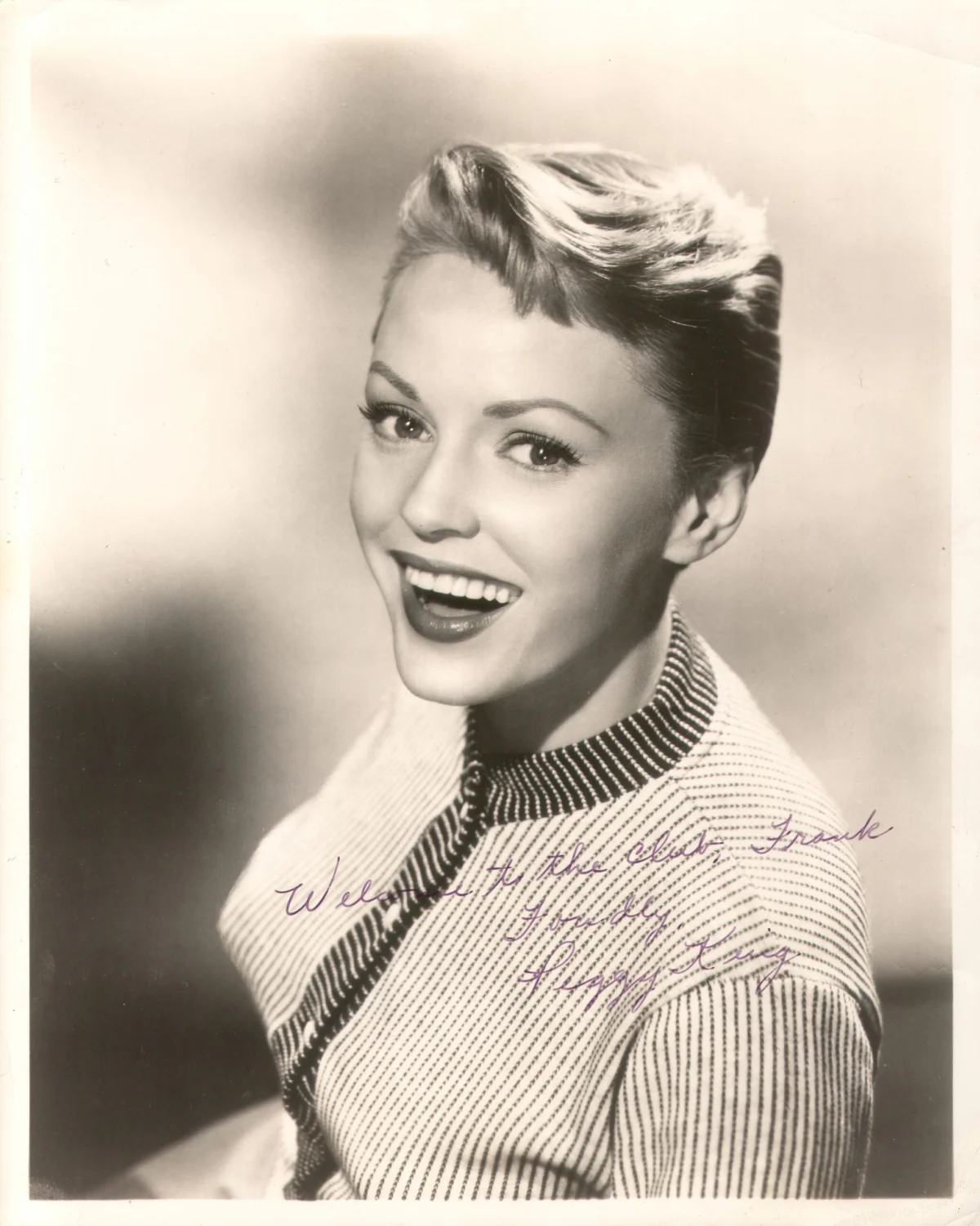
Peggy King, whose effervescent stage presence, crystal-clear vocals, and comedic timing made her a ubiquitous fixture of 1950s American entertainment, passed away on Sunday at the Saunders House Assisted Living facility in Wynnewood, Pennsylvania. She was 96 years old. Her death, which followed a protracted battle with Alzheimer’s disease, was officially confirmed by her publicist, Alan Eicher.
Over a career that spanned decades, King transitioned effortlessly from regional radio and big-band crooning to the cutting-edge medium of early television, feature films, and best-selling studio albums. Best remembered as a bright, smiling fixture of the golden age of broadcasting, she inhabited an era when variety shows commanded massive, nation-unifying audiences. Her passing marks the loss of yet another vital link to mid-century American pop culture, closing a remarkable chapter on a life defined by extraordinary artistic versatility.
Early Life and the Ascent to Radio Stardom
Born on February 16, 1930, in Greensburg, Pennsylvania, Margaret "Peggy" King entered the world as the daughter of Floyd Henry King and Margaret Finan. Growing up in a dynamic household during the tail end of the Great Depression, she displayed an early, undeniable affinity for music. Her vocal talents soon caught the attention of local tastemakers after her family relocated and she graduated from Ravenna High School.
Possessing a natural tonal clarity and a bright, infectious delivery, King quickly found her way into the burgeoning regional broadcast industry. Long before she conquered television screens across America, she honed her craft as a radio singer in Cleveland. Those early studio sessions and live radio broadcasts provided the rigorous training ground necessary for a young vocalist to adapt to shifting musical landscapes.
It was during this formative period that industry veterans recognized her potential not merely as a singer of standard ballads, but as a performer with an uplifting, comedic sensibility. Her radio work eventually led to a high-profile gig as a regular vocalist on The Mel Torme Show for CBS. Collaborating with the legendary jazz singer and velvet-voiced composer exposed King to national audiences and paved the way for her eventual migration to the silver screen and the television studios of Hollywood and New York.
The Golden Age of Television and The George Gobel Show
King’s defining professional breakthrough arrived in 1954 when she joined the cast of NBC’s The George Gobel Show. Starring alongside comedian George Gobel—affectionately known as "Little Georgie"—King became an instant audience favorite. Gobel famously bestowed upon her the moniker "Pretty Perky Peggy King," a descriptive nickname that encapsulated her upbeat persona, bubbly demeanor, and energetic performances. The moniker stuck for the remainder of her career, serving as a shorthand for her signature style.
As a regular on The George Gobel Show from 1954 to 1957, King performed weekly before tens of millions of viewers during the apex of live television broadcasting. Her comedic timing matched her vocal prowess, allowing her to trade barbs with Gobel and participate in elaborate musical sketches. This mainstream exposure catapulted her into the upper echelon of television stardom.
Her contributions to the medium were recognized critically when she earned a Primetime Emmy Award nomination for Best Female Singer in 1955. Cementing her status as television royalty, she performed the classic song "Count Your Blessings" at the 27th Academy Awards ceremony in 1955 and later returned to co-host the Primetime Emmy Awards in 1958.
A Ubiquitous Presence Across the Airwaves
During the 1950s, Peggy King was arguably one of the most recognizable faces on television. Following her success with George Gobel, she became an in-demand guest star and performer, lending her talents to nearly every major variety, game, and talk show of the era.
Her extensive television resume included memorable appearances on Bob Hope’s Chevy Show, American Bandstand, The Steve Allen Show, The Kraft Music Hall with Milton Berle, What’s My Line?, The Perry Como Show, The Garry Moore Show, and The Jack Benny Program. Later, she would transition into the late-night television landscape with appearances on programs such as The Tonight Show Starring Johnny Carson.
While predominantly celebrated for her musical and comedic talents, King also proved her mettle as a dramatic actress. She crossed over into the gritty fictional television worlds of the era, securing guest roles on popular dramatic and western series including Maverick and Dragnet. Furthermore, she achieved crossover commercial success as the face and voice behind a highly popular, memorable commercial jingle for Hunt’s Tomato Sauce, demonstrating the lucrative intersection of television stardom and corporate advertising in post-war America.
Film Career and the MGM Era
In 1952, recognizing her unique blend of beauty, talent, and cinematic potential, Metro-Goldwyn-Mayer (MGM) signed King to a studio contract. While studio contracts during Hollywood’s golden age often came with strict conditions and limited creative freedom, MGM provided King with invaluable exposure to the machinery of feature filmmaking.
Her time at the studio resulted in a notable cameo appearance in Vincente Minnelli’s critically acclaimed 1952 drama The Bad and the Beautiful, starring Kirk Douglas and Lana Turner. Though her screen time was brief, her vocal talents were showcased on the film’s official soundtrack album. Additionally, she capitalized on her growing mainstream appeal by appearing in the comedy-horror feature Abbott and Costello Meet the Mummy (1955), proving her ability to navigate both high-toned studio dramas and slapstick comedy.
In 1957, King stepped into a dramatic supporting role in the gripping aviation thriller Zero Hour!, sharing the screen with established film stars Dana Andrews and Linda Danell. Her portrayal of a stewardess in the film added an authentic touch of mid-century professional poise to a suspenseful narrative that would later heavily inspire the comedic film Airplane! decades later.
The Columbia Records Era and the "Cry Me a River" Legend
In tandem with her television and film pursuits, King forged a highly successful recording career. Legendary producer and musical mastermind Mitch Miller signed her to a long-term contract with Columbia Records. Under Miller’s guidance, King recorded a string of successful hit singles and released two best-selling albums that cemented her status as a premier recording artist of the traditional pop era.
However, one of the most fascinating footnotes in music history involves King and a song that would eventually become a standard of the Great American Songbook: "Cry Me a River." Composed by Arthur Hamilton specifically for King to perform, the haunting, melancholic ballad was envisioned as a career-defining piece. Yet, in a fateful industry decision, Mitch Miller reportedly refused to let King record the tune, deeming it unsuitable for her upbeat, "perky" image.
The song was subsequently given to Julie London, whose sultry, smoky 1955 rendition became a massive international hit and a defining torch song of the twentieth century. Despite missing out on recording "Cry Me a River," King maintained a prolific discography, showcasing her vocal range through lush arrangements and sophisticated phrasing.
Pioneering Television Musicals
Long before modern networks attempted live television musical broadcasts, Peggy King was at the forefront of the genre. As television networks experimented with grand theatrical productions designed specifically for the small screen, King secured leading roles in high-profile adaptations.
She starred alongside heartthrob Tab Hunter in the lavish television musical Hans Brinker or the Silver Skates, bringing classic literature to life for millions of families gathered around their living room television sets. Demonstrating her theatrical versatility, she also starred in a major television musical adaptation of Jack and the Beanstalk, sharing the screen with an illustrious cast that included Joel Grey, Celeste Holm, and Cyril Ritchard. These productions required rigorous rehearsal schedules, live vocal performances, and complex choreography—demands that King met with signature poise and professionalism.
Later Years, Honors, and Continuing Performances
As the television landscape shifted in the 1960s away from traditional variety shows toward serialized dramas and topical programming, King seamlessly adapted by pivoting back to her roots in live performance and recording. She maintained an active presence in the entertainment community, continuing to perform regularly in elite supper clubs and concert venues across the Philadelphia area, New York City, and Los Angeles well into her eighties, with notable live performances reported as late as 2014.
Her enduring contributions to broadcasting and entertainment were formally recognized by her peers and cultural institutions. In 2010, she was officially inducted into the Broadcast Pioneers Hall of Fame, cementing her legacy as a trailblazer of early television. Furthermore, she was among the elite group of foundational celebrities honored with a star on the Hollywood Walk of Fame, a permanent testament to her massive impact on the entertainment industry.
Even in her later years, King’s passion for music remained undiminished. In 2016, she released her final studio album, aptly titled Songs a la King, proving that her vocal dexterity and interpretive abilities had not abandoned her with the passage of time.
Surviving Family and Legacy
Peggy King is survived by her daughter, Suzy Rudofker, and her son-in-law, Dwain Goforth, who have received an outpouring of condolences from fans, historians, and colleagues across the entertainment industry.
The passing of Peggy King closes the book on an extraordinary generation of entertainers who shaped the formative years of modern mass media. From the glow of mid-century cathode-ray tube televisions to the vinyl grooves of Columbia Records, she brought a sense of unbridled joy, elegance, and musical excellence into the homes of millions. While the moniker "Pretty Perky Peggy King" immortalized her public persona, those who knew her work understand that beneath the bright smile and bubbly presentation lay a disciplined, immensely talented artist who helped define the Golden Age of Television. Her legacy endures through her recorded catalog, archival television broadcasts, and the indelible mark she left on the American entertainment landscape.