The intersection of fashion history, industry leadership, and enduring cultural impact was on full display at Gotham Hall, where the Fashion Institute of Technology (FIT) and The Museum at FIT hosted their annual Couture Council luncheon. The premier event of the afternoon centered on honoring legendary designer Diane von Furstenberg with the prestigious 2026 Couture Council Award for Artistry in Fashion. Drawing an illustrious crowd of fashion royalty, cultural icons, and emerging designers, the gathering served as both a retrospective of von Furstenberg’s monumental career and a celebration of her ongoing influence on modern style, entrepreneurship, and female empowerment.

More than five decades after revolutionizing women’s wardrobes with the introduction of the wrap dress, von Furstenberg remains an active, defining pillar of the global fashion community. The room at Gotham Hall was a living testament to her legacy, with numerous attendees donning the iconic silhouette that cemented her status as a design innovator. From intimate reflections on her childhood in Europe to a forward-looking celebration of her mentorship of the next generation of creatives, the afternoon captured the breadth of a career that transcends traditional boundaries of fashion design.
A Legacy Etched in Fashion History
To understand the magnitude of the 2026 Couture Council Award, one must look back at the trajectory of von Furstenberg’s career. Born in Brussels to a mother who survived the Holocaust, von Furstenberg absorbed early lessons in resilience that would define her personal and professional life. Sent to boarding school in Switzerland as a young woman, she cultivated an early appreciation for sophisticated, jet-set elegance—a sensibility that would later inform her design philosophy.

In 1970, von Furstenberg met legendary Vogue editor Diana Vreeland, a pivotal encounter that validated her creative ambitions. By 1974, she had introduced the garment that would forever alter the landscape of women’s fashion: the jersey wrap dress. Designed to be practical, flattering, and effortlessly chic, the dress offered women a sense of liberation during a transformative era in the feminist movement. By 1976, the garment’s cultural saturation reached its peak when von Furstenberg graced the cover of Newsweek, a milestone that solidified her status as a global icon and a formidable business mogul.
Reflecting on her journey during her acceptance speech, von Furstenberg offered a characteristic blend of humility and wit. “All my life, I wanted to be the woman in charge—and then I became a woman in charge of a little dress,” she told the attentive audience, invoking the title of her acclaimed 2024 documentary, Woman in Charge.

Tributes from Industry Titans and Longtime Peers
The presentation of the award was led by Vanessa Friedman, chief fashion critic at The New York Times, who has maintained a professional and personal relationship with the designer for two decades. In her introductory remarks, Friedman masterfully captured the multifaceted nature of the honoree, rejecting any attempt to pigeonhole von Furstenberg into a single category.
“There are a lot of words I could use to describe today’s honoree: designer, entrepreneur, feminist, activist, philanthropist, mother, grandmother, daughter, friend, and mentor,” Friedman told the audience. “But the term I actually prefer is ‘force of nature’—which I know is three words. But that’s the point: it is impossible to reduce her to just one word.”

The sentiment was echoed throughout the room by an array of fashion luminaries who turned out to show their support. The guest list read like a who’s who of the industry, featuring Martha Stewart, Narciso Rodriguez, Nicole Miller, Linda Fargo, Fern Mallis, Erin Walsh, and Candace Bushnell. The pervasive influence of von Furstenberg’s patterns was visible across the venue, highlighted by archival prints worn by guests and custom table runners crafted from FIT menswear students using the designer’s signature 1983 ikat print.
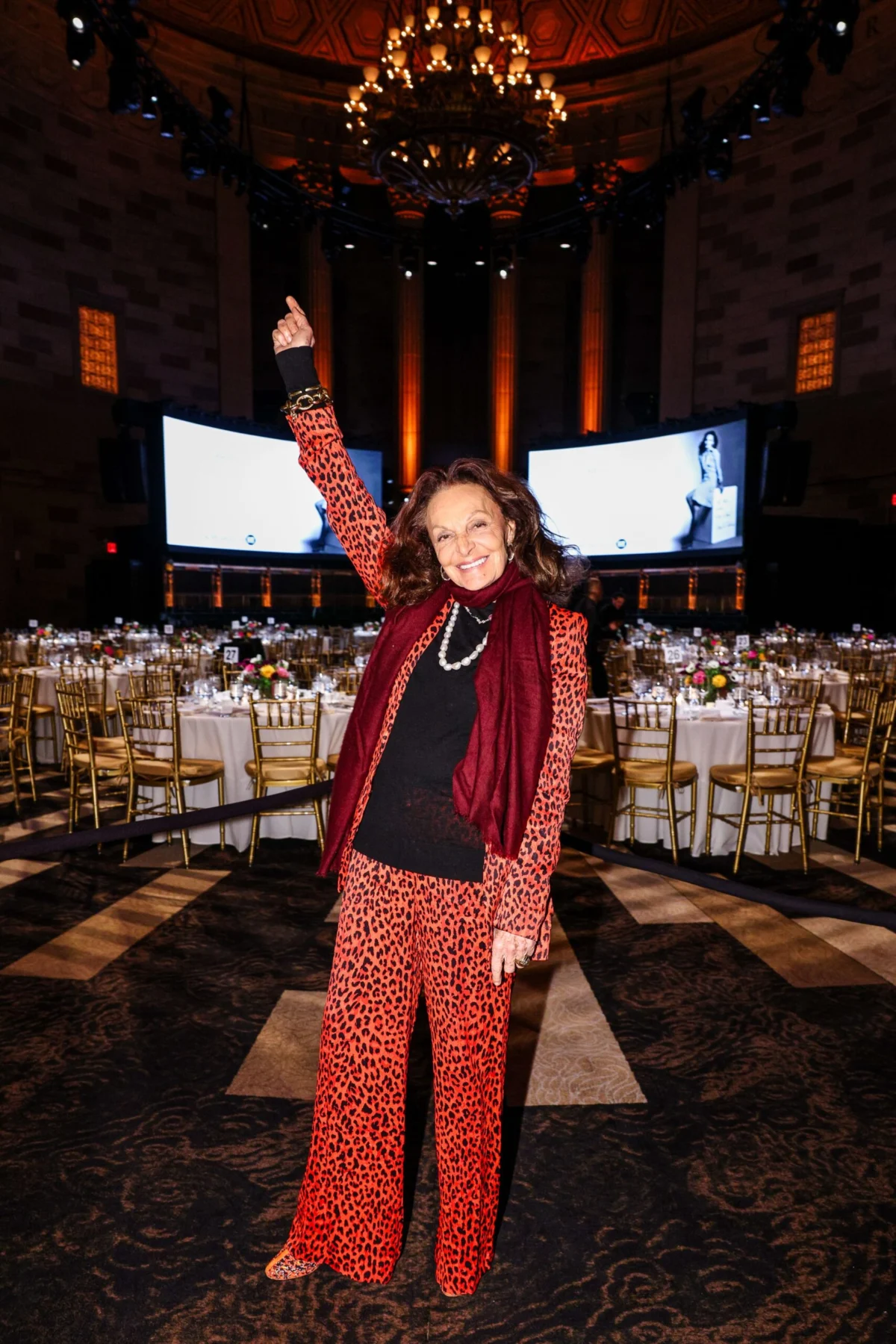
For the momentous occasion, von Furstenberg chose a red leopard-print ensemble from her namesake label’s Fall 2026 collection, designed by the brand’s new artistic director, Henry Zankov. Zankov, a graduate of FIT, noted the poetic symmetry of the moment, emphasizing the deep generational ties fostered by the institution and its celebrated alumni.

Championing the Next Generation of Creatives
While the afternoon honored past achievements, a significant portion of the dialogue focused on the future of the industry. Von Furstenberg, a dedicated and active member of the Council of Fashion Designers of America (CFDA) board, used the occasion to engage directly with emerging talent.
Among those in attendance and conversing with the icon were Zane Lii, the recent winner of the CFDA/Vogue Fashion Fund Award; runner-up Emily Dawn Long; and Daniella Kallmeyer, who was crowned Designer of the Year at the preceding CFDA Fashion Awards. Other notable contemporary designers present included Jonathan Cohen, Danielle Frankel Hirsch, Jasmin Hekmat Larian of Cult Gaia, and Sarah Bonnello. The strong representation of FIT alumni among these modern talents underscored the cyclical nature of fashion education and industry success.

FIT President Jason Schupbach praised von Furstenberg not only for her aesthetic innovations but for her unwavering commitment to lifting up others. “Thank you, Diane, for being such an icon and deeply supporting and lifting up so many young creatives, especially women, throughout your entire career,” Schupbach stated before presenting The Museum at FIT Student Award honoree to Chloe LaBel. Dr. Valerie Steele, director and chief curator of The Museum at FIT—New York’s premier institution dedicated exclusively to the art of fashion—similarly lauded the designer for her enduring inspiration.
Broader Implications and Cultural Resonance
The presentation of the 2026 Couture Council Award to Diane von Furstenberg arrives at a critical juncture for the global fashion industry. As contemporary brands navigate rapid economic shifts, digital transformation, and evolving consumer values regarding sustainability and longevity, von Furstenberg’s career offers a masterclass in enduring relevance.

The wrap dress, which celebrated its golden anniversary in recent years, remains a rare example of a garment that bridges socioeconomic, generational, and geographic divides. Its ongoing commercial viability and cultural resonance demonstrate that thoughtful, functional design possesses permanent value. Furthermore, von Furstenberg’s transition from a pioneering female entrepreneur to a dedicated philanthropist and mentor highlights the evolving expectations placed upon modern fashion icons.
By consistently leveraging her platform to champion women, support education through institutions like FIT, and foster new generations of designers via the CFDA, von Furstenberg has institutionalized a culture of empowerment that extends far beyond the runway. The Gotham Hall luncheon ultimately served as a celebration of a living legend whose contributions to art, commerce, and culture continue to shape the architecture of modern fashion.