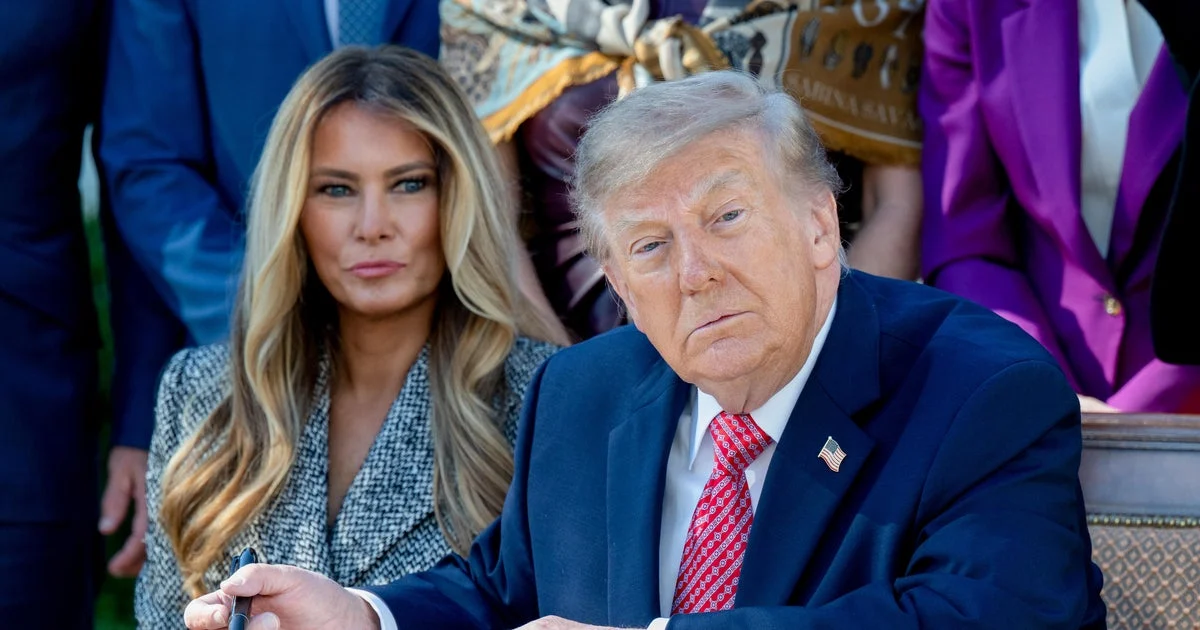
President Donald Trump and First Lady Melania Trump arrived at the Palm Beach County Supervisor of Elections building on Saturday morning to cast their ballots in person, marking the official opening of early voting in the state of Florida for the midterm elections. The high-profile appearance at the polling station in South Florida initiated a crucial stretch of electoral activity in a state that remains a focal point of American political dynamics.
The weekend voting stop was strategically woven into a densely packed, multi-state travel schedule for the president. Immediately after completing their civic duty at the Palm Beach facility, the Trumps prepared to board Air Force One bound for Georgia, where the president was scheduled to headline a high-stakes evening campaign rally in Perry. The event was organized to bolster the candidacies of Republican Representatives Mike Collins and Rick Jackson, both of whom face competitive contests as the party fights to maintain or expand its legislative majorities.
The decision to vote early and in person represents a notable operational pivot for the president. While Mr. Trump has historically maintained registration in Palm Beach County, his voting methods have varied across recent election cycles. In previous years, the president utilized mail-in ballots to cast his votes from Florida. This practice has frequently run parallel to his vocal, sustained public skepticism regarding widespread mail-in and absentee voting systems, a stance that has heavily influenced the broader Republican Party’s messaging on electoral security and ballot integrity.
Despite his own past reliance on postal voting, the president’s appearance at the Palm Beach County supervisor’s office underscores a concerted effort by Republican leadership to encourage conservative voters to utilize all available voting modalities—including early voting and mail-in options—rather than waiting exclusively for Election Day. Party strategists have increasingly emphasized banking votes early to mitigate the impact of unforeseen weather events, technical disruptions, or logistical bottlenecks on the final day of voting.
A Chronology of the Campaign Trail and Electoral Logistics
The Saturday morning voting session in Florida capped off a grueling week of cross-country travel and political campaigning. The president’s itinerary over the preceding days highlighted the immense pressure facing both political parties as the midterm window enters its final, decisive fortnight.
The week’s travel schedule began earlier in the week with high-profile stops designed to energize the base in key geographic regions. On Wednesday night, Mr. Trump addressed a large crowd in South Carolina, a reliable stronghold where he focused heavily on economic messaging and border security. By Thursday evening, the focus shifted to the Midwest, with the president delivering a keynote speech in Iowa to rally conservative voters and endorse local Republican contenders ahead of crucial congressional races.
On Friday, the campaign trail brought the president back to his home state of Florida. Mr. Trump delivered an address in Fort Myers, synthesizing national economic and social themes while reinforcing his support for state and local Republican officeholders. Following the Friday night event, the president remained in the state overnight, setting the stage for Saturday morning’s early voting appearance in Palm Beach County alongside the first lady.
Saturday’s early voting period in Florida represents the official opening bell for a ten-day window that runs continuously through Halloween, concluding on October 31. Under Florida law, individual counties determine the exact hours and additional locations for early voting, provided they offer a minimum number of mandatory days. Palm Beach County officials reported robust turnout at multiple locations as polls opened across the region, reflecting heightened voter enthusiasm and intense partisan mobilization efforts from both major political organizations.
With the early voting period now underway in Florida, the schedule for Election Day itself remains somewhat fluid for the nation’s chief executive. When queried by White House reporters earlier in the week regarding his exact itinerary and location for November 3, the president did not provide specific details, leaving open the possibility of last-minute campaign stops in critical battleground districts as the national map crystallizes.
The Georgia Rally and Partisan Rhetoric
Following their departure from Palm Beach County, the president and first lady traveled directly to Perry, Georgia, for a Saturday afternoon and evening rally designed to galvanize the state’s conservative electorate. The primary objective of the Georgia stop was to lend executive backing to Republican Representatives Mike Collins and Rick Jackson, whose reelection campaigns are viewed by national strategists as critical barometers of suburban and rural voter sentiment in the Deep South.
Ahead of the rally, the president utilized his platform on Truth Social to champion the two lawmakers while launching sharp rhetorical broadsides against their Democratic opponents. Writing on the platform, Mr. Trump described Collins and Jackson as "two incredible people" while characterizing their political adversaries in stark terms.
"Their opponents are Radical Left Lowlifes and Lunatics who want to Take Away Your Guns, Open Your Borders, Allow Men To Play In Women’s Sports, and have Transgender nonsense for everyone," the president wrote. He also recalled his past electoral performance in the state, adding, "I Won Georgia in a Record Vote. See you later!!!"
This messaging reflects the core thematic pillars of the Republican midterm strategy, which heavily emphasizes border security, Second Amendment rights, fiscal conservatism, and cultural debates surrounding gender identity and scholastic athletics. By anchoring these national talking points to specific local congressional races in Georgia, the campaign sought to bridge the gap between broader macroeconomic anxieties and localized legislative contests.
Broader Context of Florida’s Early Voting Landscape
Florida has evolved over the past decade from a notoriously razor-thin swing state into a significantly more consolidated operational territory for the Republican Party. The expansion of early voting infrastructure across the state’s 67 counties has transformed how campaigns approach voter turnout, shifting the operational timeline from a single-day mobilization effort to a multi-week chess match of ballot collection and voter contact.
Under current Florida statutes, early voting must be offered for at least eight days in every county, beginning on the tenth day before Election Day and running through the third day before the election. However, supervisors of elections are legally permitted to offer up to 14 days of early voting, a flexibility that populous counties like Miami-Dade, Broward, and Palm Beach frequently utilize to accommodate their massive electorates.
The mechanics of early voting have also become a major focal point for election administrators and political operatives alike. In recent cycles, both Democrats and Republicans have invested heavily in "ballot-chasing" operations during the early voting window. While Democrats traditionally held an advantage in early and mail-in voting numbers across the state, recent registration trends and strategic adjustments by the Florida Republican Party have significantly narrowed, and in some areas reversed, that historical partisan gap.
State election officials reported high volumes of turnout during the initial hours of Saturday’s rollout. Security protocols at the Palm Beach County Supervisor of Elections building and other satellite locations across the state were heightened to ensure orderly processing and to maintain public confidence in the integrity of the voting infrastructure. Bipartisan poll watchers, election monitors, and law enforcement personnel maintained a visible presence to oversee the smooth execution of the process.
Implications for the National Midterm Landscape
The decision by President and Mrs. Trump to participate directly in the early voting process carries significant symbolic and strategic weight for the national political landscape. By publicly embracing the early voting window—despite his longstanding rhetorical reservations regarding postal and remote voting methodologies—the president models a pragmatic approach to electoral participation that party leaders hope will be replicated by millions of conservative voters nationwide.
Political scientists and data analysts note that banking votes early fundamentally alters the strategic calculus for both major political parties. When a substantial portion of the electorate casts ballots prior to Election Day, campaigns can redirect precious financial resources and manpower away from already-voted individuals and focus exclusively on low-propensity voters and undecided segments of the population during the final 72 hours of the campaign.
Furthermore, the simultaneous execution of high-profile rallies in states like Georgia, South Carolina, and Iowa demonstrates the intense pressure on the executive branch to exert personal influence over competitive legislative districts. With congressional majorities hanging in the balance, every rally, endorsement, and public appearance is carefully calibrated to mobilize enthusiasm, counter opposition messaging, and maximize turnout in districts that could ultimately determine control of Capitol Hill.
As the early voting period expands across Florida and other states in the coming days, election administrators will closely monitor daily turnout metrics, wait times, and administrative logistics. For the Trump campaign, the successful execution of Saturday’s Palm Beach vote and subsequent Georgia rally signals the commencement of the final, high-intensity sprint toward the conclusion of the midterm cycle, setting the stage for what promises to be a fiercely contested finish across the national electoral map.