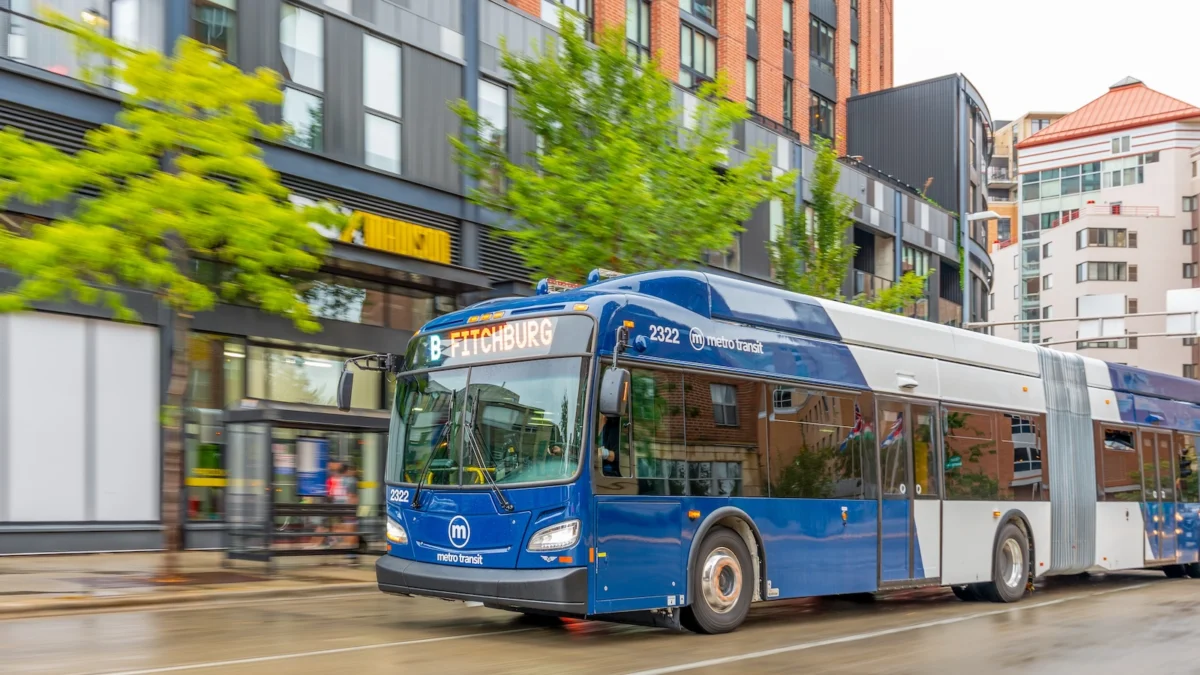
As the executive director of the Living Independent Network Corp, Jeremy Maxand spends his days navigating a formidable logistical challenge: helping residents who cannot drive get around southern Idaho. Like much of rural America, public transportation options in the region are sparse, fragile, and chronically underfunded. His nonprofit organization, which primarily serves individuals with disabilities, relies on an annual $100,000 state allocation derived from federal appropriations to finance transit payment cards. Yet, Maxand characterizes the area’s transit network not as a robust public utility, but as a "bare-minimum lifeline service" and a "piecemeal" patchwork. Even that precarious safety net, however, could soon unravel.
The surface transportation programs authorized under the $1.2 trillion Infrastructure Investment and Jobs Act—signed into law by President Joe Biden in November 2021—are slated to expire at the end of the year. As federal lawmakers on Capitol Hill negotiate the details of the bipartisan BUILD America 250 Act to reauthorize these crucial programs, transportation advocates and policy analysts are sounding the alarm. While critics argued that the Biden-era legislation fell short of adequately shifting American mobility away from its heavy automobile dependence, transit experts view the proposed BUILD Act as a dramatic and alarming step backward.
The impending legislative transition arrives at a vulnerable time for public transportation networks nationwide. Many transit agencies have struggled financially since the onset of the COVID-19 pandemic, which precipitated a catastrophic collapse in ridership from which some systems have only partially recovered. This sudden shock compounded decades of systemic underinvestment in public infrastructure. Now, facing the prospect of reduced federal backing, transit operators, municipal planners, and community advocates warn that the consequences of the proposed funding reductions could be severe, threatening to isolate vulnerable populations, inflate household budgets, and exacerbate regional economic disparities.
A Sharp Contraction in Federal Investment
According to data compiled by the American Public Transportation Association (APTA), the BUILD America 250 Act would authorize $103.3 billion for public transit over a five-year period. This represents a stark $16.5 billion decrease compared to the $119.9 billion baseline established by the 2021 Jobs Act. When adjusted for inflation, the disparity grows even wider; the Urban Institute estimates that the BUILD Act would require an additional $24 billion just to maintain parity with the previous funding level.
Under the proposed legislation, every state in the nation would experience a reduction in formula funding—receiving at least $10 million less over the five-year lifespan of the law. Yonah Freemark, a researcher at the Urban Institute, highlighted the disproportionate impact these cuts would have on capital projects.
"There would be a large decline in funding for public transit, and that would especially be true for projects that require what’s called capital investment funding—projects that require major investments for new lines," Freemark explained.
Freemark also emphasized that the negative ramifications of the bill extend far beyond major metropolitan centers. Public transit is frequently visualized through the lens of dense urban infrastructure, such as the subterranean subway networks of New York City. However, millions of residents in smaller towns, rural outposts, and tribal communities rely heavily on regional transit to access employment, education, healthcare, and commerce. Because rural transit systems operate on razor-thin margins, they are significantly more dependent on federal subsidization to remain operational than their urban counterparts.
Deep Vulnerability in Rural America
The regional impacts of the proposed formula funding reductions vary widely across the United States, but rural states face some of the steepest proportional declines. According to Urban Institute projections, Idaho is poised to endure the nation’s largest percentage drop in federal formula transit funding, estimated at an 18 percent reduction.
Maxand noted that local municipal and county governments in Idaho possess limited fiscal capacity to generate alternative revenue streams for public transportation. "When the federal funding goes away, everything goes away," he warned. For residents with disabilities, the disappearance of these services translates directly to social isolation, restricting their mobility strictly to emergency medical appointments.
Maine faces a strikingly similar predicament, with the Urban Institute projecting a 16 percent drop in federal formula funding. Josh Caldwell, a co-facilitator of Transportation for Maine and an advocate with the Natural Resources Council of Maine, pointed out that the state’s transit infrastructure is already inadequate to meet baseline public needs. "Nowhere in the state do we have service that is at the standard that we’d like to see, which is a regularity of every 15 minutes," Caldwell said.
Maine’s transportation network currently derives approximately 38 percent of its operating capital from federal sources. Compounding the federal funding threat, the Maine Department of Transportation is already grappling with a massive $400 million transportation funding shortfall. This deficit has been driven largely by declining state gas tax revenues—a trend exacerbated by a 2011 legislative decision to freeze the state gas tax relative to inflation.
While more densely populated and less rural than Maine, Indiana faces a comparable contraction in federal transit support under the BUILD Act. Austin Gibble, a transit planner based in Indianapolis, warned that the cuts could force regional agencies like IndyGo to postpone essential bus acquisitions, compelling them to continue operating aging, less reliable vehicles.

More concerning to Gibble, however, is the cascading effect the cuts will have on non-urbanized regions. "Rural agencies in Indiana are already horrifically oversubscribed," he noted. In Hamilton County, the most populous county in Indiana lacking a fixed-route transit service, the waitlist for the Hamilton County Express—a reservation-based transit option—frequently stretches for weeks.
Metropolitan Repercussions and Legislative Pushback
The prospective contraction of federal transit spending is not confined to rural sectors; major urban centers will absorb substantial absolute losses. The Urban Institute estimates that New York City alone would forfeit $2.3 billion in federal transit support over a five-year period.
These urban cuts have drawn sharp opposition from key federal lawmakers. Representative Jerry Nadler, a Democrat representing portions of New York City, stood out as the sole Democratic member of the House Transportation and Infrastructure Committee to vote against the BUILD America 250 Act.
In a formal statement, Nadler criticized the underlying priorities of the legislation. "It continues a familiar pattern: Highways are treated as the default national priority, while rail and transit are left fighting for insufficient resources, despite carrying millions of people, supporting regional economies, and reducing congestion," Nadler said.
Danny Pearlstein, policy and communications director at the Riders Alliance, argued that federal lawmakers should adopt a more ambitious vision for national infrastructure rather than settling for diminished compromises in the name of bipartisanship. "The Biden infrastructure bill was not the high-water mark," Pearlstein asserted. "We could do much better than that in a variety of different ways, and we shouldn’t hold up bipartisanship as a core value of how we fund transportation when we have such sharply diverted views of the role of government to invest in people and communities."
Broader Economic Implications and Household Budgets
Beyond the direct logistical challenges faced by transit agencies, advocates argue that reductions in public transit funding have direct economic repercussions for American households. LeeAnn Hall, campaign manager for the Alliance for a Just Society’s National Campaign for Transit Justice, emphasized that transportation constitutes the second-highest expenditure in the typical American household budget, trailing only housing.
When public transit systems deteriorate or reduce their service hours, working-class families are often compelled to absorb the high costs of automobile ownership. Hall noted that purchasing, insuring, fueling, parking, and maintaining a personal vehicle places a heavy financial burden on families already straining under inflationary pressures. "They have to pay more for gasoline. They’re going to be paying more for insurance. They have to think about parking. They have to think about maintenance and repair," Hall said. "It’s expanding their household budget."
Furthermore, Hall argued that robust public transit investments yield broad societal dividends that benefit non-riders and motorists alike. "Every dollar that we invest in public transit reduces congestion numbers, makes driving safer, and creates opportunities for families to have options," she observed.
An Unsustainable Trajectory
As federal lawmakers continue negotiations over the BUILD America 250 Act ahead of the year-end expiration of current surface transportation authorizations, local transit operators are preparing for difficult fiscal realities. In southern Idaho, Jeremy Maxand remains committed to maximizing mobility options for his community, but rising operating costs—particularly persistent surges in diesel and fuel prices—compound the pressure.
Maxand fears that impending federal budget reductions will strike seniors and individuals with disabilities the hardest, severing critical lifelines that permit independent living. Summarizing the profound operational crisis facing regional transit providers across the country, Maxand offered a stark analogy for the federal government’s retrenchment:
"It’s like saying you’re not going to pay for electricity to power the ventilator, but you’re going to leave the ventilator," he said. "What are we doing here? This is not sustainable."