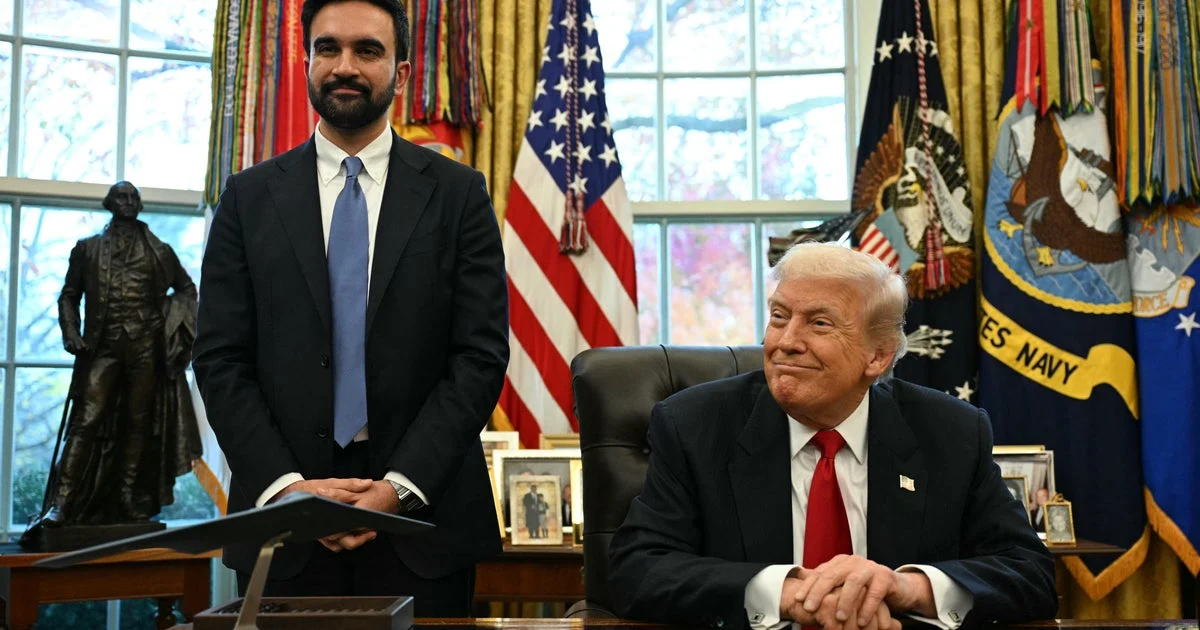
President Donald Trump and New York City Mayor Zohran Mamdani are scheduled to convene on Monday at Gracie Mansion, the historic official residence of the mayor situated along the East River in Manhattan. Representatives from both the municipal government and the White House formally confirmed the upcoming discussions on Sunday, highlighting a continued, albeit surprising, working relationship between the unconventional political figures. While the exact time of the meeting has not been publicly released due to security and scheduling protocols, municipal insiders indicate that the agenda will heavily prioritize critical economic and administrative concerns facing the nation’s largest metropolis, specifically focusing on housing affordability, municipal infrastructure financing, and federal-local cooperation.
This high-profile encounter marks a significant milestone as the first time the two leaders will meet face-to-face within the boundaries of New York City since Mamdani assumed office. Previously, the mayor made at least two separate official trips to Washington, D.C., engaging in direct talks with the president inside the Oval Office. Despite their starkly contrasting ideological backgrounds—with Trump representing the nationalist wing of the Republican Party and Mamdani serving as a prominent democratic socialist—the pair have repeatedly signaled a pragmatic willingness to set partisan divisions aside in pursuit of tangible policy outcomes for millions of New Yorkers.
Background Context and the Evolution of a Pragmating Working Relationship
The forthcoming summit at Gracie Mansion represents the latest chapter in a rapidly evolving political dynamic that initially baffled political observers and pundits nationwide. During the fiercely contested mayoral campaign, the race was characterized by intense rhetorical hostility. President Trump openly opposed Mamdani’s candidacy, utilizing campaign rallies and social media platforms to launch aggressive attacks against the democratic socialist platform, going so far as to issue extreme political threats regarding the candidate’s residency and civic status.
Conversely, Mamdani’s campaign was built largely on a progressive platform that sharply criticized Trump-era federal policies, corporate deregulation, and conservative economic frameworks. Yet, following the certified conclusion of the election and Mamdani’s subsequent victory, both leaders quickly pivoted from campaign trail antagonism to institutional pragmatism.
Political analysts have noted that this transactional yet surprisingly cordial relationship is rooted in mutual necessity. For President Trump, maintaining an open line of communication with the mayor of America’s financial and cultural capital offers a powerful counter-narrative to claims of hyper-partisan governance, while providing a direct channel to influence policy in a crucial urban center. For Mayor Mamdani, securing federal funding, infrastructure grants, and cooperative administrative alignment is vital for executing his ambitious municipal agenda, particularly regarding affordable housing initiatives that require federal backing and regulatory coordination.
Chronology of Federal-Municipal Engagements
To understand the trajectory of the Trump-Mamdani relationship, one must examine the timeline of their diplomatic engagements since the mayoral transition:
- November 2025: Following his electoral victory, Mayor Mamdani traveled to Washington, D.C., for an initial summit with President Trump at the White House. The meeting stunned political analysts as both leaders struck a conciliatory tone, publicly pledging to bridge ideological gaps and collaborate on urban improvement and cost-of-living reductions.
- February 2026: The two executives held a secondary round of formal discussions, narrowing their policy focus toward large-scale housing development and zoning modernization to combat the metropolitan housing crisis.
- Spring 2026: Throughout the spring legislative session, Mayor Mamdani maintained quiet, off-the-record communication channels with the White House. In an interview with CBS News earlier in the year, Mamdani underscored the importance of discretion, stating that he preferred to keep the frequency and substance of those ongoing conversations confidential to preserve the trust necessary for productive dialogue.
- September 20, 2026: Both the White House and municipal officials formally announce the upcoming Monday meeting at Gracie Mansion, marking the president’s first official visit to the mayoral residence under the current administration.
Core Issues on the Table: Housing, Affordability, and Urban Infrastructure
While municipal spokespeople have kept specific agenda items tightly guarded, administration insiders and urban policy experts agree that the primary focal point of Monday’s talks will be the persistent affordability crisis in New York City. Rent burdens, property tax frameworks, and the scarcity of middle-income and low-income housing units continue to challenge city hall’s administrative capacity.
Mayor Mamdani has consistently championed aggressive tenant protections, increased social housing investments, and rent stabilization measures. However, many of these sweeping local interventions require federal housing vouchers, Department of Housing and Urban Development (HUD) block grants, and cooperative federal loan guarantees. By bringing these issues directly to the commander-in-chief, Mamdani aims to unlock federal capital streams that have historically been sluggish or politically contentious for progressive municipalities under conservative federal administrations.
Additionally, infrastructure projects, mass transit modernization, and regional economic competitiveness are expected to feature prominently in the closed-door discussions. The Metropolitan Transportation Authority (MTA), which manages the city’s vast subway and commuter rail networks, continually requires federal capital investment for resiliency upgrades, accessibility renovation, and state-of-the-art signal modernization. Securing federal bipartisan backing for these infrastructure investments remains a paramount priority for the mayor’s office.
Official Responses and Public Reactions
The announcement of the Gracie Mansion summit has elicited a diverse array of responses from political stakeholders across the ideological spectrum. Progressive allies of Mayor Mamdani have expressed cautious optimism, viewing the direct dialogue as a pragmatic strategy to secure vital federal resources for New York City working families. At the same time, some progressive purists remain watchful, wary of potential policy compromises that could dilute the core democratic socialist principles upon which the mayoral campaign was built.
Conversely, conservative figures and local moderate business groups have generally welcomed the pragmatic pivot. Business leaders in the financial district and commercial real estate sectors have argued that adversarial relations between City Hall and the White House ultimately harm the city’s economic vitality, tourism, and investment climate. A working relationship grounded in economic development and administrative efficiency is seen by many financial stakeholders as a stabilizing force for the local economy.
Federal lawmakers from both parties have also monitored the unique alignment. While congressional Democrats view the engagement as a necessary mechanism to safeguard federal funding for urban constituencies, some congressional Republicans have voiced surprise at the president’s willingness to build a working rapport with a self-described democratic socialist mayor. Nevertheless, the White House has maintained that executive pragmatism regarding America’s largest cities transcends partisan factionalism.
Broader Implications and Future Outlook
The upcoming meeting at Gracie Mansion transcends a mere photo opportunity; it serves as a barometer for contemporary American federalism. In an era marked by intense political polarization, the ability of a populist conservative president and a progressive democratic socialist mayor to find common ground offers a compelling counter-narrative to gridlock.
The implications of Monday’s discussions will likely ripple through future urban policy debates nationwide. If Mamdani and Trump can successfully negotiate concrete federal-local partnerships on housing and infrastructure, it may establish a new template for cross-ideological governance in other major American cities grappling with similar structural crises.
As President Trump motorcades up to Gracie Mansion on Monday, all eyes will be on the historic residence. The outcome of their dialogue will not only shape the immediate legislative and economic landscape of New York City for the remainder of the mayoral term, but it will also test the limits of what pragmatic governance can achieve when ideological extremes are temporarily set aside in the service of local constituencies.