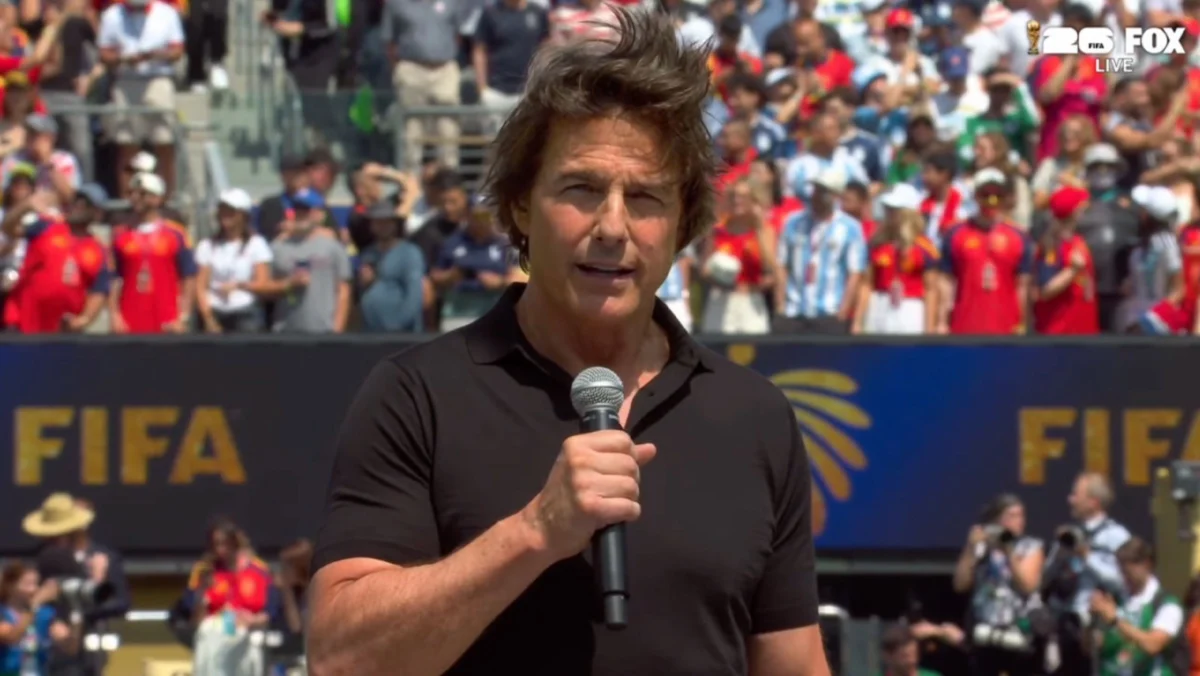
Hollywood megastar Tom Cruise made a surprise appearance on the global stage this past weekend, gracing the pre-show festivities for the highly anticipated 2026 FIFA World Cup final. In a moment that blended the worlds of cinema and international sport, Cruise took to the stage to offer a powerful and unifying message to a global audience, just hours before Spain and Argentina were set to clash for the coveted championship title. His presence, a notable departure from his usual cinematic endeavors, underscored the profound cultural significance and universal appeal of the world’s most popular sporting event.
The actor, known for his daredevil stunts and commanding screen presence in films like Mission: Impossible and Top Gun, shifted his focus to the unifying power of football. Addressing the immense crowd gathered at the stadium and the billions watching worldwide, Cruise spoke with a gravitas that resonated beyond the cheers of the fans. His words were a poignant reflection on the journey of the tournament and the very essence of the sport itself, emphasizing its ability to transcend borders and connect humanity.
"More than 30 days ago, 48 nations began a journey," Cruise began, his voice carrying a tone of awe and respect. "They crossed oceans. They crossed borders. They crossed cultures. And together they showed us why this game belongs to the world." This opening statement immediately set the stage for his broader message, highlighting the expansive reach of the World Cup and the diverse tapestry of nations that participate. The inclusion of 48 nations, a recent expansion of the tournament, was a key element of his narrative, signifying a more inclusive and globally representative event than ever before.
Cruise continued to elaborate on the shared experiences and emotions that define the World Cup. "From three countries across them, and from every corner of the globe, we have witnessed greatness, and we have shared in moments of joy, moments of hope, moments we will all never forget," he stated. This sentiment tapped into the collective memory of football fans, recalling the dramatic upsets, the breathtaking goals, and the sheer emotional rollercoaster that characterizes the tournament. The mention of "three countries" likely refers to the host nations of the 2026 tournament – the United States, Canada, and Mexico – underscoring the collaborative effort behind organizing such a monumental event.
The actor’s speech then delved deeper into the intrinsic nature of football as a universal language. "Football is a language spoken without words, a force that unites people, that turns strangers into friends and reminds us of what we all have in common," he eloquently put it. This powerful analogy resonated with the core of the sport’s appeal, illustrating how the game’s rhythm, passion, and shared understanding can foster connection and camaraderie among people from vastly different backgrounds. In an era often marked by division, Cruise’s message served as a timely reminder of sport’s capacity to bridge divides and promote a sense of global community.
Concluding his address, Cruise offered a final, resonant call to unity and celebration. "As we gather for one final chapter, let us celebrate a tournament that brought the world together. Let us celebrate each other. This is football. This is unity. And this is greatness." These words served as a fitting crescendo to his speech, encapsulating the spirit of the World Cup and encouraging a spirit of shared appreciation for the athletes, the fans, and the game itself. The emphasis on "celebrating each other" further amplified the message of solidarity, urging attendees and viewers alike to acknowledge the collective human experience that the tournament represents.
The Global Spectacle of the FIFA World Cup
The FIFA World Cup is not merely a sporting competition; it is a quadrennial global phenomenon that captivates billions. The 2026 edition, jointly hosted by the United States, Canada, and Mexico, marked a significant expansion of the tournament, increasing the number of participating teams from 32 to 48. This strategic decision aimed to provide more opportunities for nations to compete on the world stage and to further globalize the sport. The tournament’s journey, as highlighted by Cruise, began over a month prior to the final, involving an extensive group stage followed by an increasingly intense knockout phase.
The selection of Spain and Argentina for the final itself was a testament to the enduring powerhouses of international football. Both nations boast rich footballing histories, boasting multiple World Cup titles and producing some of the sport’s most iconic players. Argentina, led by legendary figures throughout their history, and Spain, known for their technical prowess and tactical sophistication, represented a compelling narrative for the championship match, pitting two distinct yet equally formidable footballing philosophies against each other. The anticipation for this specific final had been building for weeks, fueled by the teams’ impressive performances throughout the tournament.
Tom Cruise: A Hollywood Icon on the World Stage
Tom Cruise’s presence at the World Cup final pre-show was a deliberate choice by FIFA and the organizing committee to leverage his global star power and align with the event’s universal appeal. Cruise, an actor whose films have grossed billions worldwide and have been enjoyed by audiences across continents, embodies a level of international recognition that few individuals possess. His involvement served to elevate the pre-game festivities and underscore the World Cup’s status as a truly global event, attracting attention from those who might not typically follow football closely. This strategic integration of entertainment and sport is a common practice for major global events seeking to maximize their reach and impact.
His carefully crafted speech reflected a deep understanding of the World Cup’s significance. By acknowledging the journey of 48 nations, he implicitly recognized the efforts of every team, not just the finalists. His emphasis on shared experiences, joy, and hope resonated with the emotional core of the tournament, which often brings nations together in shared passion and national pride. The World Cup, in its essence, is a celebration of human endeavor, skill, and the unifying power of a shared love for the game.
Supporting Data and Context
The 2026 FIFA World Cup, being the first to feature 48 teams, represented a significant logistical and organizational undertaking. The tournament spanned across 16 host cities in three North American countries, requiring extensive infrastructure, transportation networks, and security measures. The expanded format meant an increase in the total number of matches played, from 64 in previous editions to 104 in 2026. This expansion aimed to democratize the tournament further, allowing more nations to participate and experience the World Cup firsthand.
FIFA’s decision to expand the tournament was met with a mix of reactions. While many celebrated the increased inclusivity, some expressed concerns about potential dilution of quality and an overly long tournament schedule. However, the sheer passion and global reach of the World Cup consistently prove its ability to overcome such challenges, drawing record-breaking viewership figures. In the lead-up to the final, global media attention was intense, with analysts and fans dissecting every aspect of the tournament, from individual player performances to tactical approaches.
The economic impact of the World Cup is also substantial. Host nations typically experience a significant boost in tourism, hospitality, and related industries. The event generates considerable revenue through ticket sales, broadcasting rights, sponsorships, and merchandise. The 2026 World Cup, with its expanded scope and North American locations, was projected to be one of the most economically impactful sporting events in history.
Official Responses and Broader Impact
While no direct official statement from FIFA was immediately available regarding Tom Cruise’s appearance, his inclusion in the pre-show festivities was widely perceived as a strategic move by the governing body to enhance the event’s global appeal. FIFA has a history of incorporating prominent cultural figures into its major events to broaden their reach and celebrate the universality of football.
The implications of Cruise’s appearance extend beyond the immediate pre-show entertainment. It reinforces the narrative of the World Cup as a unifying force, a sentiment that resonates deeply in today’s interconnected yet often fragmented world. His message of "football is a language spoken without words" and "a force that unites people" serves as a powerful reminder of sport’s capacity to foster empathy, understanding, and shared human experience.
In the broader context of international relations and cultural exchange, events like the World Cup, amplified by the involvement of global icons, play a crucial role in fostering goodwill and promoting dialogue. Tom Cruise, as a universally recognized figure, lent his considerable influence to this endeavor, transcending national boundaries and speaking to a common human desire for connection and shared celebration. His participation underscored that the World Cup is more than just a competition; it is a global festival that brings people together, reminding us of our shared humanity and the power of collective joy. The memory of his words, delivered on the cusp of crowning a new world champion, will likely linger as a testament to the enduring spirit of the game.