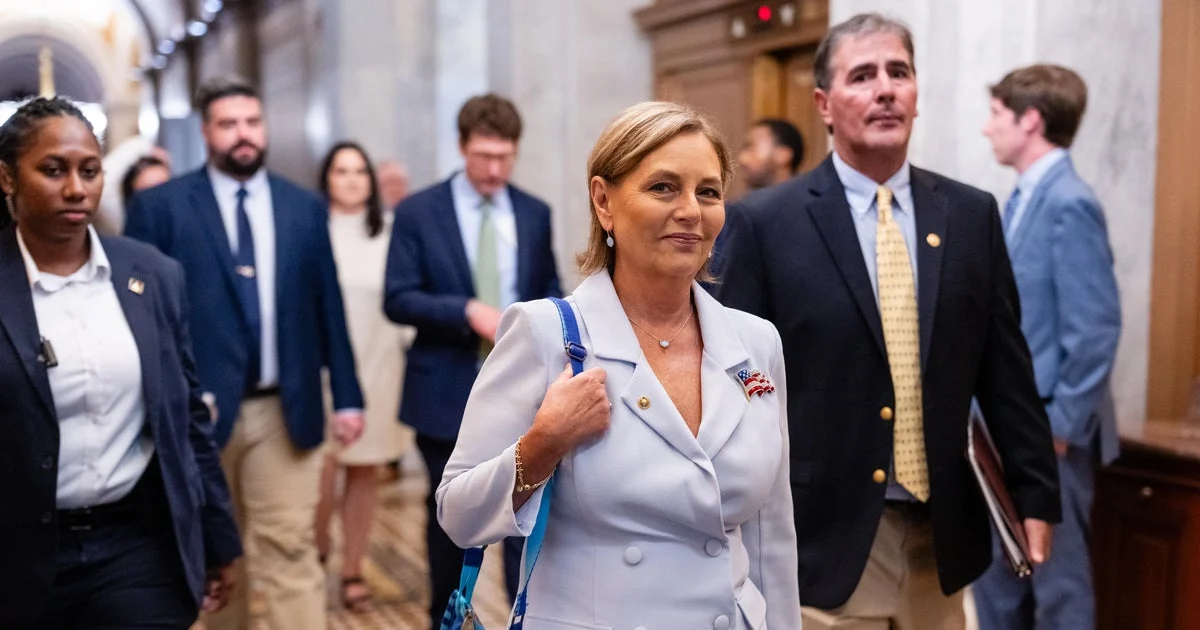
Sen. Darline Graham of South Carolina, recently appointed to fill the vacancy left by the unexpected death of her brother, veteran GOP Sen. Lindsey Graham, is now engaged in serious discussions regarding a potential bid for a full six-year term in the United States Senate. Her nascent consideration for the high-stakes race has already garnered the formidable backing of former President Donald J. Trump, whose unequivocal support could prove to be a decisive factor in what promises to be a keenly contested Republican primary.
The prospect of Darline Graham, a newcomer to elected office, entering the race gained significant momentum following a pivotal meeting at the White House on Thursday, July 16, 2026. During this session, the newly sworn-in senator conveyed to administration officials that she was actively weighing a full campaign, a development independently confirmed by CBS News through two sources intimately familiar with her emerging plans. The revelation immediately sent ripples through South Carolina’s political establishment, which is still reeling from the sudden loss of one of its most prominent figures. The Palmetto State is scheduled to hold a special Republican primary on August 11, 2026, the winner of which will advance to the November general election to compete for a six-year term commencing in January 2027.
Just one day after her crucial White House visit, President Trump moved swiftly to publicly endorse Darline Graham, leveraging his influential Truth Social platform. In a post published Friday afternoon, July 17, 2026, the former president unequivocally promised his "Complete and Total Endorsement" should she decide to officially enter the race. Describing her as a "spectacular person," Trump revealed that he personally urged Darline Graham to pursue the Senate seat during their White House encounter. "I hope Darline does this, in that there would be nobody better to honor the legacy of her beloved brother, Lindsey," Mr. Trump wrote, concluding with a potent campaign slogan: "RUN, DARLINE, RUN!" The initial reports of Darline Graham’s consideration for the full term were first broken by Semafor, highlighting the rapid pace at which the political landscape in South Carolina has shifted.
The Genesis of a Candidacy: A Rapid Succession of Events
The chain of events leading to Darline Graham’s potential candidacy unfolded with remarkable speed, reflecting the urgency inherent in filling a Senate vacancy and the intense political maneuvering that often accompanies such transitions. The previous weekend, Senator Lindsey Graham, a towering figure in Republican politics, passed away following a brief and sudden illness, plunging the Senate and his home state into mourning. His death, unexpected and profoundly impactful, necessitated immediate action from South Carolina Governor Henry McMaster.
On Monday, July 13, 2026, Governor McMaster announced his decision to appoint Darline Graham as Lindsey Graham’s interim replacement for the remainder of his unexpired term, which was set to conclude in early January 2027. This decision was met with widespread approval, seen by many as a fitting tribute to her late brother’s legacy and a means of ensuring continuity during a period of grief. Darline Graham, 62, was formally sworn into office on Tuesday, July 14, 2026, marking a historic moment as she became the first woman to represent South Carolina in the United States Senate. Her ascension to the Senate, initially framed as a temporary stewardship, quickly evolved into a much larger conversation following her White House visit and President Trump’s subsequent, powerful endorsement.
Lindsey Graham’s Enduring Legacy and the Void He Leaves
Lindsey Graham’s sudden departure from the political stage leaves a significant void, both in South Carolina and within the national Republican Party. Having served in the U.S. House of Representatives from 1995 to 2003 before being elected to the Senate in 2003, Graham had amassed over two decades of experience in federal office. During his tenure in the upper chamber, he cultivated a reputation as a highly influential voice on national security, foreign policy, and judicial matters. He held prominent positions, including Chairman of the Senate Judiciary Committee and a senior member of the Senate Armed Services Committee, where he played critical roles in legislative debates and oversight functions.
Graham’s political trajectory was notable for its evolution. Initially a close ally of Senator John McCain and often viewed as a more moderate conservative, he became one of President Trump’s most staunch and vocal defenders during his presidency. This transformation showcased his adaptability and keen political instincts, solidifying his standing within the modern Republican Party. His ability to navigate complex political currents, combined with his deep institutional knowledge and extensive network, made him a formidable legislator and a key figure in the Senate. He was widely expected to win his fifth term in the upcoming November general election, underscoring the political strength he commanded in South Carolina. His death, therefore, not only created a vacancy but also removed a seasoned political operative whose presence will be deeply missed in the halls of power.
Darline Graham’s Entry into the Political Arena
Darline Graham’s background stands in stark contrast to her late brother’s extensive political career. With no prior experience in elected office, her professional life has been dedicated primarily to public service in the field of disability services. Most recently, she served as the Commissioner of the South Carolina Commission for the Blind, a role that involved advocating for and implementing programs to support visually impaired citizens across the state. This experience, while not directly political, has provided her with a deep understanding of constituent needs and the intricacies of state government bureaucracy.
Despite her lack of electoral history, Darline Graham expressed confidence in her ability to carry out the duties of a senator, particularly with the support of her brother’s experienced staff. "I feel confident in my ability to step into this role, especially with the invaluable assistance and guidance of Lindsey’s dedicated team," she stated upon her appointment. Her initial role as an interim senator was largely perceived as a caretaker position, designed to maintain continuity and provide a period of stability before the special election. However, President Trump’s immediate and enthusiastic endorsement has swiftly transformed this narrative, positioning her as a serious contender for a full term and adding a layer of intrigue to her unexpected political debut. Her status as the first woman to represent South Carolina in the Senate adds another historical dimension to her nascent political journey.
The Power of the Presidential Endorsement in South Carolina
President Trump’s swift and decisive endorsement of Darline Graham underscores his enduring influence within the Republican Party, particularly in states like South Carolina, where his base remains exceptionally strong. For many Republican primary voters, a "Complete and Total Endorsement" from Trump is often considered the gold standard, capable of significantly boosting a candidate’s profile, fundraising efforts, and overall viability. Political analysts across the spectrum universally acknowledge that in a crowded Republican primary, a candidate endorsed by the former president gains a distinct and often insurmountable advantage.
Trump’s rhetoric, calling Darline Graham a "spectacular person" and emphasizing the importance of honoring her brother’s legacy, is strategically crafted to resonate with his base and with voters who held Lindsey Graham in high regard. The explicit call to action, "RUN, DARLINE, RUN!", serves as a powerful signal to his supporters to rally behind her potential campaign. For Darline Graham, this endorsement immediately elevates her from an appointed interim senator to a frontrunner, potentially deterring other established Republican figures from entering the race or at least making their path significantly more challenging. It also provides an immediate narrative for her campaign: continuing the work of her brother with the full blessing of the party’s most influential figure.
South Carolina’s Special Election: A High-Stakes Contest
The special election for the U.S. Senate seat in South Carolina is poised to be one of the most closely watched races of the 2026 election cycle. The primary on August 11, 2026, will be a critical test for any Republican hopefuls. South Carolina is a deeply conservative state, reliably voting Republican in federal elections. The last time a Democrat won a U.S. Senate seat in South Carolina was in 1998, and the state has consistently supported Republican presidential candidates by wide margins for decades. This political reality means that the Republican primary is often the de facto general election, with the nominee typically facing an easier path in November.
Given this context, the dynamics of the August 11 primary will be particularly intense. Without President Trump’s endorsement, a crowded field of established state politicians – including current members of the state legislature, statewide officeholders, or even well-known local figures – might have emerged. However, with Trump’s backing, Darline Graham now commands a significant advantage, potentially narrowing the field or forcing other contenders to recalibrate their strategies. State party strategists suggest that while other candidates might still launch bids, they will face the daunting task of overcoming both the Graham legacy and the formidable Trump endorsement. The general election in November, while likely favoring the Republican nominee, will still require a robust campaign against a Democratic challenger who will undoubtedly highlight Darline Graham’s lack of prior electoral experience.
Navigating a Campaign: Strengths, Weaknesses, and Strategy
Should Darline Graham formally declare her candidacy, her campaign will face a unique set of strengths and weaknesses that will dictate her strategic approach.
Strengths:
- Name Recognition and Legacy: The Graham name is synonymous with South Carolina politics, providing instant recognition and a potential sympathy vote in the wake of her brother’s passing. The narrative of honoring and continuing his legacy will be a powerful emotional appeal.
- Presidential Endorsement: As discussed, President Trump’s "Complete and Total Endorsement" is a monumental asset, providing a direct line to a significant portion of the Republican base, crucial fundraising support, and unparalleled media attention.
- Outsider Appeal: Her lack of prior elected office could be framed as a positive, appealing to voters tired of career politicians and signaling a fresh perspective, despite her deep connections to the political establishment through her brother.
- Issue Focus: Her background in disability services could provide a unique platform to advocate for specific policies, demonstrating a commitment to public service beyond traditional political posturing.
Weaknesses:
- Lack of Electoral Experience: This is her most significant vulnerability. Opponents will undoubtedly highlight her absence of a voting record or experience navigating the rigors of a campaign or legislative debates.
- Rapid Campaign Build-Out: Launching a statewide Senate campaign in a matter of weeks, complete with fundraising, volunteer recruitment, and message development, is an immense logistical challenge.
- Policy Scrutiny: As a senator, she will be expected to articulate clear positions on a wide range of complex national and international issues, areas where she has not previously had to declare public stances.
Campaign Strategy:
Darline Graham’s strategy will likely involve several key components. She will undoubtedly lean heavily on her brother’s legacy, positioning herself as the natural successor to his work and values. Leveraging President Trump’s endorsement will be paramount, requiring her to align closely with his "America First" agenda and appeal directly to his loyal supporters. She will need to quickly build a professional campaign infrastructure, relying on experienced political operatives, potentially drawing from her brother’s former staff and network. Her background in disability services could be highlighted to demonstrate a compassionate and service-oriented approach to governance, distinguishing her from other potential primary contenders. Additionally, the support of her fellow South Carolina Senator, Tim Scott, who also chairs the National Republican Senatorial Committee (NRSC), could provide crucial fundraising and strategic backing. When asked about Darline Graham’s potential bid on Wednesday, July 15, 2026, Senator Scott expressed an openness to the idea, stating, "Darline has so far been off to a remarkable start. Why not her?" This indicates a willingness from the party’s establishment to embrace her candidacy.
Broader Implications for the Senate and National Politics
The potential candidacy of Darline Graham, and the subsequent special election in South Carolina, carries broader implications for the U.S. Senate and the national political landscape. While a Republican replacing a Republican will not alter the partisan balance of power in the Senate, the individual occupying the seat can influence internal dynamics, committee assignments, and legislative priorities. A Senator Darline Graham might forge her own path, or she might align closely with her brother’s later political positions, particularly those supportive of President Trump.
This election will also serve as another significant test of President Trump’s "kingmaker" status within the Republican Party. A successful primary victory for his endorsed candidate would further cement his influence over GOP nominations, demonstrating that his backing remains an indispensable asset for aspiring Republican politicians. Conversely, if his endorsement were to falter, it could signal a subtle shift in the party’s internal power dynamics. The race will also highlight the evolving role of family legacies in American politics, particularly when combined with the powerful force of a presidential endorsement.
South Carolina, often viewed as a bellwether for conservative movements, will once again be in the national spotlight. The outcome of this special election could offer insights into the mood of the Republican electorate heading into the 2026 midterm elections, particularly regarding the enduring appeal of Trump-backed candidates and the desire for continuity versus change within the party.
As the political gears grind forward, the coming weeks will be critical. Darline Graham’s decision to formally enter the race will set off a cascade of events, initiating what promises to be a fast-paced, high-stakes campaign for one of the most coveted seats in American politics. The eyes of the nation, and particularly the Republican Party, will be firmly fixed on South Carolina as it navigates this pivotal moment in its political history.