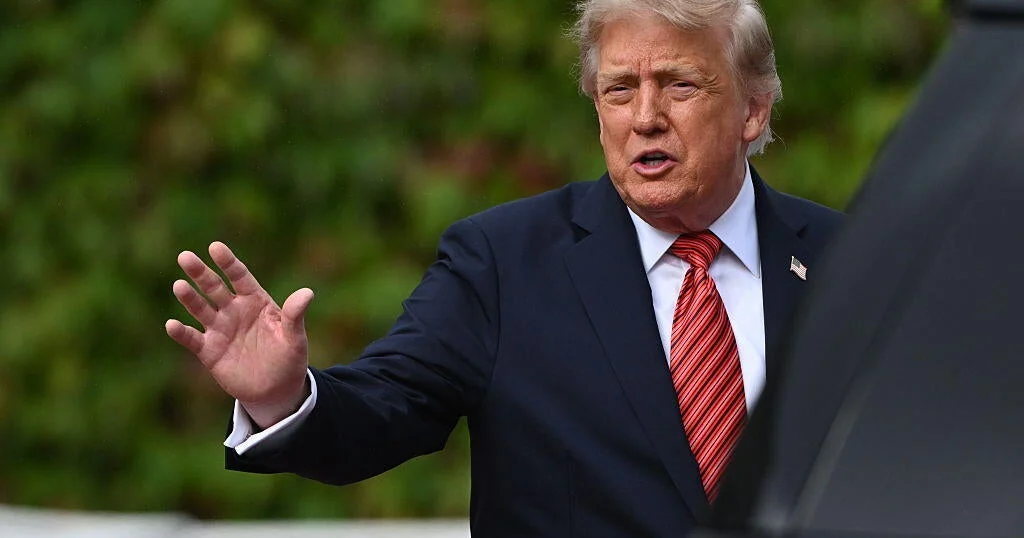
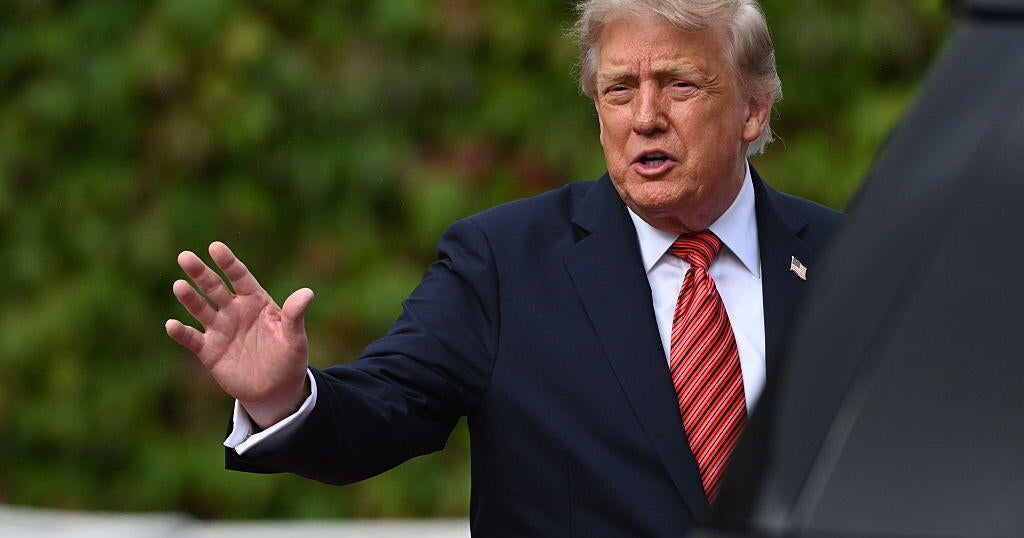
President Donald Trump touched down in Ireland for a high-profile, multi-day visit that seamlessly blended high-stakes international diplomacy with personal business interests, sparking immediate controversy and widespread political debate across the Atlantic and throughout the British Isles. The trip, which commenced on Saturday, September 12, 2026, quickly grabbed global headlines when the American leader openly endorsed the concept of a unified Ireland—a delicate and historically fraught geopolitical question that previous U.S. administrations have carefully avoided.
Kicking off his itinerary in Dublin, Mr. Trump held high-level discussions with key Irish officials, including Prime Minister Micheál Martin and Irish President Catherine Connolly. While the meetings covered a spectrum of bilateral issues, the American president’s unscripted remarks regarding Northern Ireland’s constitutional status dominated the news cycle, drawing immediate pushback from pro-British unionist leaders in Belfast and cautious, measured responses from London. Following his diplomatic engagements in the Irish capital, Mr. Trump traveled westward to his oceanfront luxury resort in Doonbeg to take in the action at the prestigious Irish Open golf tournament, continuing a pattern of utilizing presidential travel to spotlight his private commercial portfolio.
Diplomatic Sparks in Dublin: The Unification Question
The defining moment of the visit’s opening day occurred during President Trump’s bilateral meeting with Prime Minister Micheál Martin. Speaking freely to reporters in Dublin, Mr. Trump did not mince words regarding the long-standing division of the island, suggesting that the Republic of Ireland and Northern Ireland "may as well happen now."
"I don’t want to cause any problems, but I’d love to see it unified. I think it would be a fantastic thing," Mr. Trump stated during the exchange, though he briefly acknowledged the geopolitical reality by adding, "The U.K. will have something to say about it, obviously."
The remarks represent a significant departure from standard American foreign policy doctrine. For decades, successive U.S. administrations—including both Democratic and Republican White Houses—have meticulously maintained a neutral stance on the constitutional future of Northern Ireland. This careful diplomacy was designed to safeguard the fragile peace process established by the 1998 Good Friday Agreement, an accord brokered with substantial American mediation. Democratic predecessors, notably Joe Biden due to his deeply personal and emotional ties to the island, routinely praised the peace settlement while refusing to take a stance on whether Northern Ireland should remain within the United Kingdom or merge with the Republic.
The political fallout was swift. Gavin Robinson, leader of the pro-British Democratic Unionist Party (DUP), took to social media platform X to issue a sharp rebuke of the American president’s statements. "As unionists, we are not interested in the destruction of our country by joining with the Irish Republic," Robinson wrote.
Meanwhile, official reaction from the United Kingdom government pointed back to recent statements made by U.K. Prime Minister Andy Burnham. Just last month, Burnham explicitly stated that a unity referendum was firmly "off the table," reiterating on Wednesday that London would only consider entertaining calls for a border poll "when public opinion has changed to the point where the call has to be considered."
Historical Context of the Border Question
To fully understand the weight of President Trump’s comments, one must examine the complex and violent history underpinning the partition of Ireland. When the island achieved self-governance a century ago, creating what is now the Republic of Ireland as a predominantly Roman Catholic state, a distinct six-county region in the north—characterized by a Protestant majority—chose to remain part of the United Kingdom.
This division sowed the seeds for decades of bitter sectarian conflict known colloquially as The Troubles. Spanning roughly three decades from the late 1960s onward, the region was torn apart by paramilitary violence, civil rights abuses, and profound societal division between Protestant unionists (who favored maintaining the union with Great Britain) and Catholic nationalists (who advocated for reunification with the south).
The violence was largely brought to a close by the landmark 1998 Good Friday Agreement. While the peace accord successfully dismantled checkpoints, ended systemic paramilitary campaigns, and normalized cross-border cooperation, it deliberately left Northern Ireland’s ultimate sovereignty ambiguous. The agreement established a clear legal mechanism stipulating that a referendum on Irish unity must be called by the British Secretary of State if it appears likely that a majority of voters in Northern Ireland would support breaking away from the United Kingdom. However, defining the precise threshold for that likelihood remains a persistent point of political contention.
Addressing business leaders from both the United States and Ireland at the U.S. ambassador’s residence on Sunday, Mr. Trump appeared to walk back the definitive nature of his earlier remarks, acknowledging that there is ultimately "no good answer" to the reunification dilemma.
A Tense Encounter at Áras an Uachtaráin
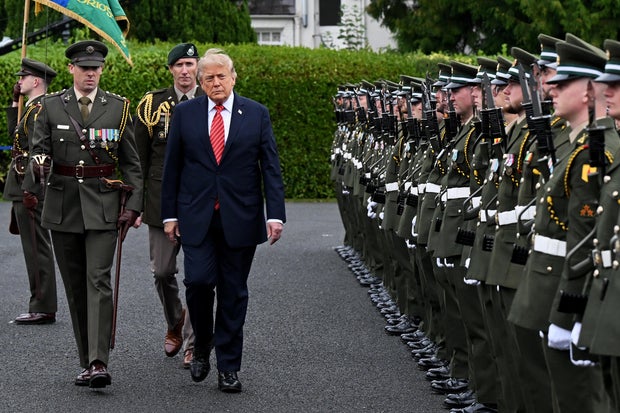
In addition to his talks with Prime Minister Martin, President Trump participated in a formal arrival ceremony and subsequent meeting at Áras an Uachtaráin, the official residence of Irish President Catherine Connolly. The encounter was closely watched by international observers given Connolly’s distinct political background and previous friction with the American leader.
Connolly, a prominent left-wing politician, previously participated in public protests against Mr. Trump when he visited Ireland in 2019 during his first term in office. Now serving as Ireland’s elected, largely ceremonial head of state, Connolly has maintained a vocal platform, frequently criticizing U.S. foreign policy in the Middle East, championing the Palestinian cause, and having once publicly characterized Mr. Trump as a "bully."
Following their closed-door meeting, President Connolly released a carefully worded official statement indicating that she had conveyed to Mr. Trump "the strong view of the Irish people that the normalization of war and genocide can never be accepted." In a culturally poignant gesture, Connolly presented the American president with a selection of literary works by the late Irish poet Michael Longley, notably featuring the powerful sonnet "Ceasefire," which draws parallels between classical mythology and the Northern Irish peace process.
When questioned by reporters following the engagement about the tone and substance of the meeting, Mr. Trump initially deferred to his protocol chief, Monica Crowley. Pressed further by the press corps, the president offered a brief and minimalistic assessment, calling the encounter "very nice" and noting that "we discussed a lot of things, quickly."
Public Protests and Demonstrations in Dublin
Away from the polished halls of government buildings and diplomatic residences, the streets of Dublin bore witness to vocal public dissent. A broad coalition comprising left-wing opposition parties, anti-military organizations, pro-Palestinian advocacy groups, and environmental campaigners organized coordinated demonstrations across the city on Saturday.
Protesters expressed outrage over various aspects of U.S. foreign policy, current Middle Eastern conflicts, and the environmental implications of the current administration’s domestic and international policies. While the demonstrations drew significant crowds and heavy police monitoring, local law enforcement reported that the rallies remained largely peaceful, causing only minor traffic disruptions in the city center.
Merging Diplomacy with Enterprise: The Irish Open
With his political and diplomatic engagements in Dublin concluded, President Trump transitioned to the sporting world, flying across the country to his premier oceanfront golf club in Doonbeg, County Clare. There, the president spent time watching the action at the Irish Open, blending personal recreation with his extensive international business empire.
An avid golfer who frequently utilizes his properties in Florida, New Jersey, and Virginia for both leisure and official meetings, Mr. Trump’s visit to Doonbeg underscores a consistent intersection between his political platform and his family’s commercial hospitality ventures. His attendance at the Irish Open marks the second major European Tour event hosted or spotlighted at a Trump-owned property this year, following the Nexo Championship held last month at his golf course in Aberdeen, Scotland.
Critics have frequently raised ethical and conflict-of-interest concerns regarding the promotion of Trump-branded properties during official presidential travel. Conversely, supporters argue that the president’s personal investments bring substantial international tourism revenue and economic stimulation to rural communities like Doonbeg and Aberdeen.
As President Trump wraps up his itinerary in Ireland and prepares for the next leg of his international schedule, his unscheduled commentary on Irish unification will undoubtedly leave a lasting ripple effect across British and Irish politics, demonstrating once again the capacity of modern presidential rhetoric to instantly reshape decades-old diplomatic norms.