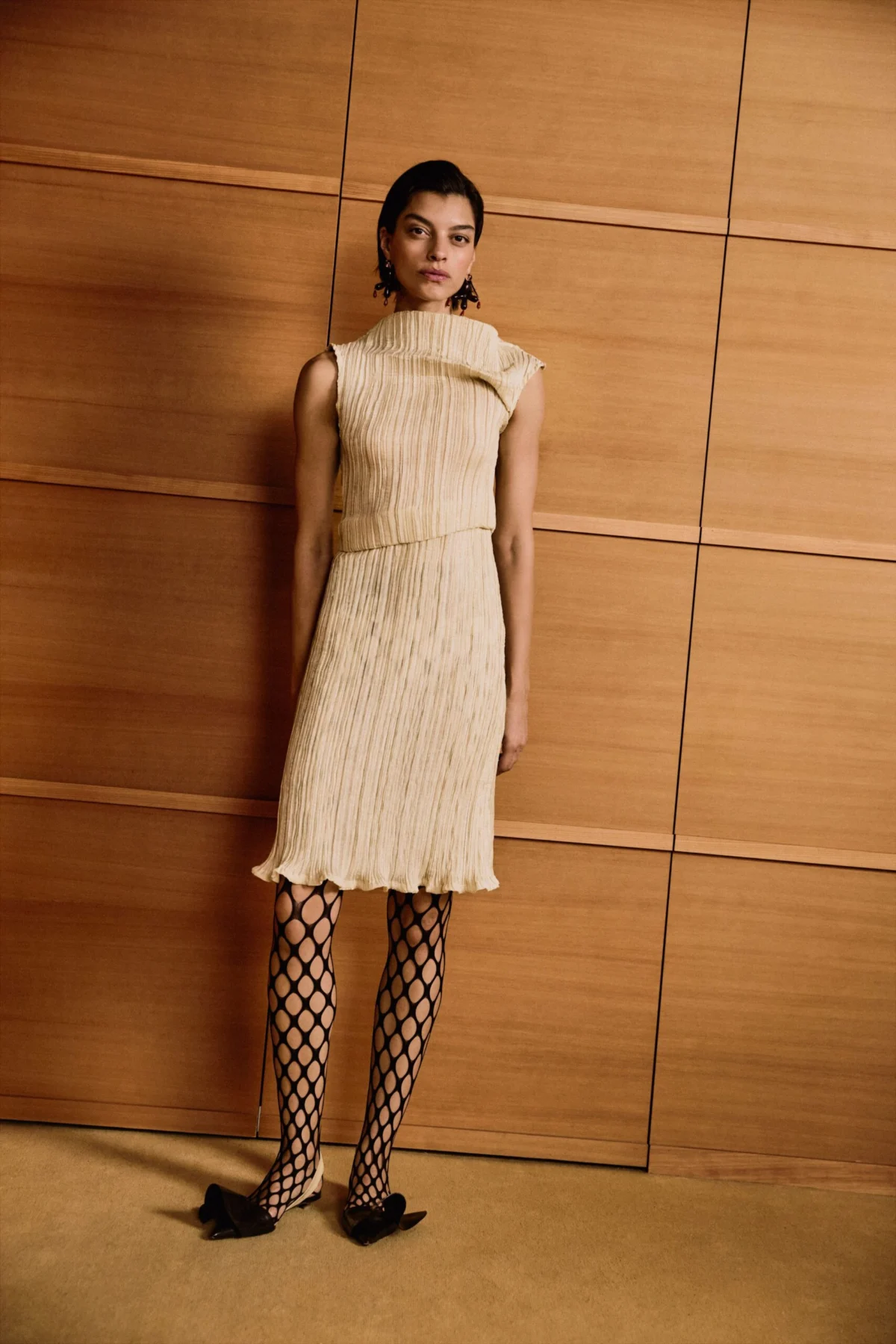
The contemporary fashion landscape is increasingly defined by designers who draw upon their multicultural upbringings to forge unique aesthetic pathways. Few, however, manage to weave their foundational dualities quite as seamlessly as Amir Taghi. Positioned at the intersection of his Iranian heritage and his Texan upbringing, Taghi debuted his highly anticipated Spring 2027 ready-to-wear collection to critical acclaim. The presentation served not merely as a display of sartorial craftsmanship, but as a deeply personal exploration of identity, memory, and geopolitical urgency.
For Taghi, whose family emigrated from Iran during the 1980s, the duality of his existence is the cornerstone of his creative philosophy. Having grown up surrounded by the polished, impeccably styled Southern swans of Houston who frequented legendary department stores like Neiman Marcus, Taghi developed an early appreciation for refined, classic elegance. Yet, this American Southern aesthetic has always been inextricably linked in his mind with the rich, sensory tapestry of his Persian roots. Marrying these two distinct perspectives has allowed the designer to cultivate a thoughtful, highly focused design vocabulary that resonates with an increasingly discerning clientele.
A Tapestry of Personal Memory and Familial Archives
The Spring 2027 collection represents a watershed moment for the brand, drawing extensively from a broad breadth of Taghi’s childhood memories and familial archives. Rather than relying on superficial tropes, the designer delved deep into the physical artifacts of his heritage, translating them into modern luxury silhouettes.
Among the standout pieces of the collection were prints derived from historical domestic spaces. Wallpaper patterns from homes he visited during his youth, alongside delicate florals harvested directly from his grandfather’s garden in Fasham, Iran, were meticulously rendered onto contemporary textiles. These motifs found new life asymmetrically draped on a sophisticated skirt and a flowing daytime dress, bridging the gap between nostalgic remembrance and modern wearability.
Furthering this architectural narrative, the distinct structural curves of his grandmother’s home in Iran informed the complex, precision-cut neckline of an elaborately embellished evening dress. Perhaps most striking, however, was Taghi’s utilization of traditional textiles. The reverse side of a Qashqai kilim rug—sourced from his grandfather’s vast collection numbering in the thousands—was ingeniously transformed into a structured printed jacket, as well as a intricately beaded top-and-skirt ensemble.
In a particularly poignant nod to historical regalia, Taghi engineered a military jacket modeled after those worn during the Qajar Court era. Steering clear of expected conventions, he replaced traditional precious gems with earthy, grounding stones, most notably turquoise, infusing historical majesty with tactile, organic warmth.
The Geopolitical Backdrop and the Urgency of Humanization
While the collection is rooted in personal nostalgia, its creation was catalyzed by a profound sense of urgency brought on by the outbreak of regional conflict earlier this year. For Taghi, the escalation of geopolitical tensions in the Middle East introduced a heavy emotional undercurrent to the design process, driven by fears of cultural erasure and the destruction of invaluable historical artifacts.
Beyond the preservation of material culture, the designer expressed deep concern regarding the prevailing Western perception of Iran. In an environment often dominated by hostile political headlines, Taghi views his platform as a vital tool for cultural diplomacy and humanization.
"You look at the country and the first thing you think of is the government, but the government is not the people," Taghi observed regarding the impetus behind his latest works. "How can I as an Iranian with a voice show and humanize the people?"
By embedding authentic Persian history, artistry, and architectural beauty into high-end luxury garments, Taghi is actively challenging monolithic stereotypes. He presents a narrative of Iran defined by gardens, craftsmanship, intricate domestic architecture, and centuries-old nomadic artistry—elements that transcend contemporary political friction and speak to a shared human appreciation for beauty and heritage.
Direct-to-Consumer Resilience in a Challenging Wholesale Market
Beyond the cultural significance of the runway, Taghi’s business model offers a fascinating case study in contemporary brand building amidst a shifting retail economy. In an era where many independent designers struggle against the high overheads and stringent terms of traditional wholesale distribution, Taghi has carved out a remarkably resilient niche through direct engagement.
Approximately 90 percent of the brand’s total sales are generated through an intimate network of trunk shows spanning affluent American enclaves, including Houston, Palm Beach, Aspen, Dallas, and Nashville. This direct-to-consumer approach fosters a symbiotic relationship between the designer and his clientele. By interacting face-to-face with his buyers, Taghi gains immediate, unfiltered insight into their lifestyle desires, wardrobe needs, and aesthetic preferences, allowing him to hone his designs with exceptional precision.
This hyper-targeted retail strategy has insulated the brand from the broader volatility plaguing the wholesale market, enabling steady, organic growth—or what industry observers describe as building a brand "inch by inch."
Subtle Departures and the State of Things
Even within a framework of refined luxury and commercial stability, the Spring 2027 collection demonstrates a willingness to evolve stylistically. Known historically for immaculately structured, precisely finished garments that appeal to his loyal Southern clientele, Taghi introduced subtle disruptions to this season’s lineup.
Most notably, the incorporation of undone hems marked a deliberate departure from his signature polish. While subtle, these raw edges function as a poignant sartorial metaphor for the fractured state of the world, reflecting the unease and turbulence that inspired the collection’s urgent creative genesis. It is a calculated risk that bridges the gap between classic couture sensibilities and the gritty reality of modern global anxieties.
Broader Implications for the Future of Independent Fashion
Amir Taghi’s Spring 2027 collection arrives at a critical juncture for independent fashion designers navigating identity, commerce, and global consciousness. As consumers increasingly demand authenticity, purpose, and narrative depth from the brands they support, Taghi offers a masterclass in how to honor one’s roots without falling into the trap of pastiche.
By anchoring his luxury garments in personal history while addressing contemporary geopolitical realities, Taghi elevates fashion from a purely transactional pursuit into an act of cultural preservation and dialogue. Simultaneously, his reliance on localized trunk shows highlights a viable economic roadmap for independent labels seeking autonomy in a consolidating luxury market.
As the fashion industry looks toward the future, designers like Amir Taghi prove that the most compelling clothes are those that carry the weight of lived experience, serving as wearable testaments to where we come from, who we are, and the complex worlds we navigate.