The arrival of the 2025 Volkswagen ID.Buzz in the United States marks the culmination of a decades-long journey, transforming one of the most recognizable silhouettes in automotive history into a modern, fully electric flagship. For Volkswagen, the stakes could not be higher. The ID.Buzz is not merely another entry into the burgeoning electric vehicle (EV) market; it is a calculated effort to recapture the emotional resonance of the original Type 2 Microbus while meeting the rigorous demands of the contemporary American family. By blending nostalgia with the modular efficiency of the MEB platform, Volkswagen has positioned the ID.Buzz as a vehicle that attempts to bridge the gap between a counterculture past and a sustainable future.

A Decadelong Prelude: The Chronology of the Return
The path to the American release of the ID.Buzz has been characterized by a series of false starts and conceptual teases that date back more than twenty years. The lineage of the modern electric bus can be traced to the 2001 Microbus Concept, which debuted at the North American International Auto Show to immense critical acclaim but failed to reach production. This was followed by the 2011 Bulli concept and the 2016 BUDD-e, both of which explored various powertrain and design directions.
The definitive turning point occurred in 2017 at the Detroit Auto Show, where the ID.Buzz concept was unveiled. Unlike its predecessors, this iteration was built on Volkswagen’s dedicated electric architecture, signaling a firm commitment to production. However, the transition from concept to American showroom was further delayed by Volkswagen’s decision to launch a specific long-wheelbase (LWB) version for the North American market. While Europe received a short-wheelbase version and a cargo variant in 2022, U.S. customers had to wait an additional two years for a three-row configuration that met domestic expectations for space and utility.
Design Philosophy: Balancing Heritage and Aerodynamics
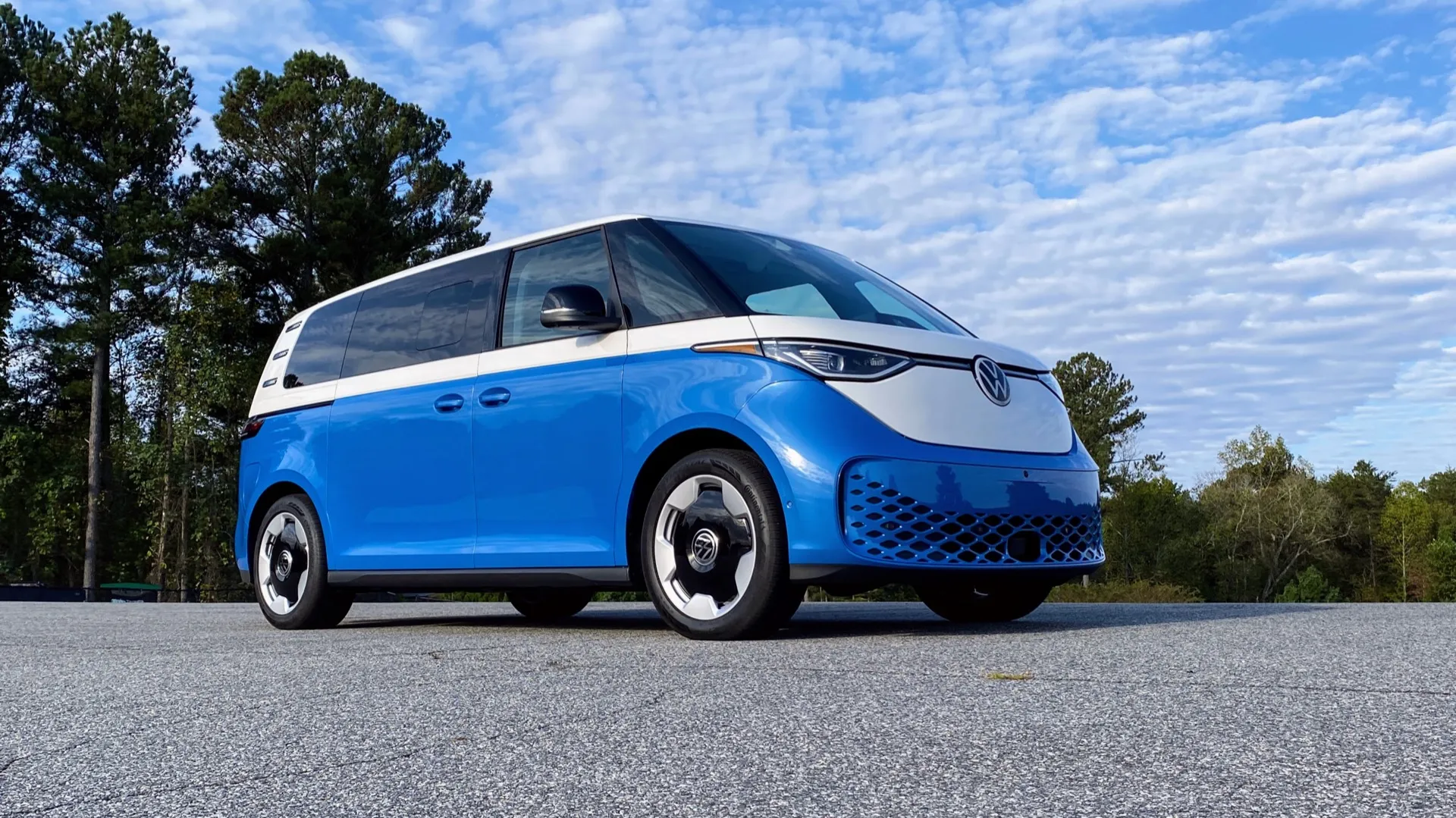
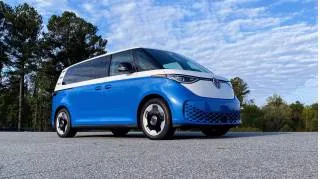
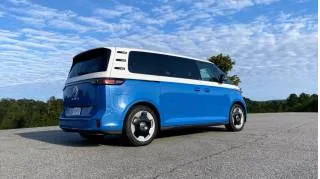
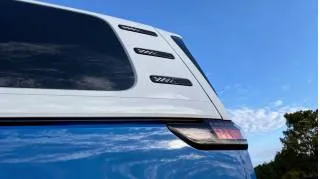
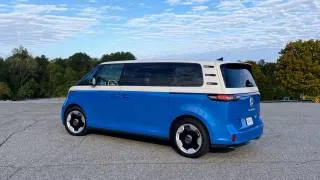
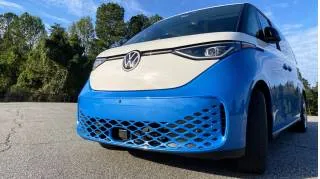
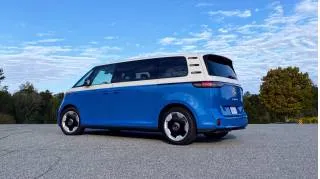
The 2025 ID.Buzz succeeds where many retro-inspired vehicles fail by avoiding the trap of being a caricature. While it retains the iconic "V" shape on the nose and offers signature two-tone paint schemes, the design is fundamentally driven by modern requirements. With a coefficient of drag of 0.29, the ID.Buzz is remarkably aerodynamic for a vehicle that is essentially a large, upright box.

In its U.S. specification, the vehicle measures 195.4 inches in length, riding on a 127.5-inch wheelbase. This is a significant 10-inch stretch over the European model, a modification necessary to accommodate a standard third row. Standing at 76.2 inches tall, it towers over the ID.4 crossover by 10 inches, yet maintains a manageable ground clearance of 6.1 inches. The visual impact is immediate; during testing on the rural and suburban roads of North Georgia, the vehicle drew attention from a wide demographic, ranging from classic truck enthusiasts to owners of the ultra-modern Tesla Cybertruck. This cross-generational appeal suggests that the ID.Buzz may possess the unique ability to transcend the polarized political and cultural discourse currently surrounding electric vehicles in America.
Technical Specifications and Powertrain Performance
Volkswagen has equipped the U.S. version of the ID.Buzz with its most advanced electric components. At the heart of the vehicle is a 91-kWh battery pack, an upgrade from the 82-kWh unit found in the standard-wheelbase European models. This larger battery powers the new AP550 rear-mounted electric motor, which produces 282 horsepower and 413 lb-ft of torque in the rear-wheel-drive (RWD) configuration.

For those requiring more power or all-weather capability, an all-wheel-drive (AWD) version adds an inductive motor to the front axle. This configuration brings the total output to 335 horsepower. Despite its significant mass—the RWD version weighs nearly 6,000 pounds, while the AWD model reaches 6,197 pounds—the ID.Buzz remains surprisingly agile. In RWD form, the van boasts a turning circle of just 37.4 feet, a figure that rivals much smaller sedans and makes navigating tight parking lots or narrow city streets remarkably easy.
Performance metrics are respectable for a vehicle of this class. The AWD version can accelerate from 0 to 60 mph in approximately 6.0 seconds, while the RWD model completes the sprint in 7.5 seconds. Top speed is electronically limited to 99 mph, an increase from the 90 mph limit on earlier European iterations, reflecting the higher speeds typical of American interstate travel.

Range, Efficiency, and Charging Infrastructure
The EPA has rated the 2025 ID.Buzz at a combined 234 miles of range for the RWD model and 231 miles for the AWD variant. During real-world testing in temperate conditions (approximately 50 degrees Fahrenheit), the vehicle demonstrated efficiency consistent with these ratings. On a 110-mile mixed-use loop involving mountain roads and highways, the trip computer reported 2.6 miles per kWh. A steady highway cruise at 65-70 mph saw efficiency dip slightly to 2.4 miles per kWh.
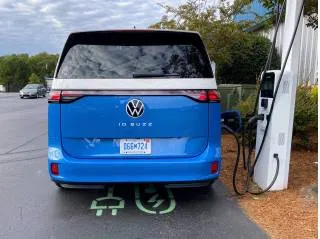
Charging capabilities are designed to mitigate range anxiety during long-distance travel. The ID.Buzz supports DC fast charging at rates up to 200 kW, allowing the battery to go from 10% to 80% state of charge in approximately 26 minutes. For home or destination charging, the 11-kW onboard charger can fully replenish the battery overnight. A notable feature for the U.S. market is the inclusion of battery preconditioning, which can be activated manually or automatically via the navigation system to ensure optimal charging speeds upon arrival at a station.
Interior Versatility and the "Bus" Experience
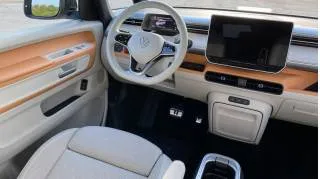
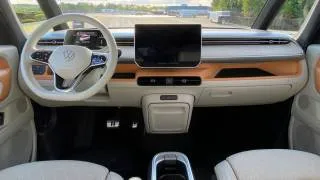
The interior of the ID.Buzz is perhaps its strongest selling point, offering a level of modularity and space that justifies its "Bus" moniker. Volkswagen claims the vehicle offers best-in-industry third-row legroom, and the flat floor architecture provides an airy, lounge-like atmosphere. The vehicle is available in six- or seven-passenger configurations, with the AWD models defaulting to second-row captain’s chairs.
Storage solutions are abundant. The "Buzz Box" center console is removable and features multiple drawers and compartments, while the dashboard includes a dedicated shelf with a grippy surface for wireless phone charging. However, the interior is not without its quirks. Volkswagen has carried over its controversial window control system from the ID.4, which uses a single pair of switches and a "Rear" toggle to operate all four windows—a design choice that remains a point of contention for many users.
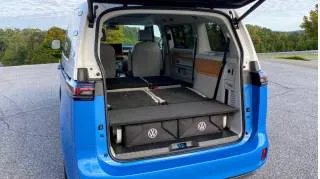
Cargo capacity is substantial, though the floor is not perfectly flat when the seats are folded. A sturdy, hinged shelf in the rear cargo area creates a level loading surface with the folded third row, but removing the heavy seats is required for maximum volume. This suggests that while the ID.Buzz is an excellent passenger carrier, it may require aftermarket modifications for those intending to use it as a full-time "camper" or mobile living space.
Market Positioning and the Pricing Paradox
The most significant hurdle for the ID.Buzz may not be its range or its weight, but its price. With a starting MSRP of $61,545 (including destination fees) for the base Pro S trim, the ID.Buzz is positioned as a premium lifestyle vehicle rather than a utilitarian people-mover. The mid-tier Pro S Plus starts at $65,045, and a fully loaded 1st Edition AWD can exceed $71,000.

To put this in historical context, the 1965 Microbus retailed for approximately $2,550. When adjusted for inflation, that equates to roughly $25,400 in 2024 dollars. Today, the ID.Buzz enters the market at more than double that inflation-adjusted price point. Furthermore, because the ID.Buzz is currently manufactured in Hannover, Germany, it does not qualify for the $7,500 federal EV tax credit for purchases, though it may be eligible for savings through lease programs.

Volkswagen executives have indicated that they view the ID.Buzz as a niche product intended to pull customers from large, premium SUVs rather than the traditional minivan segment. By pricing it significantly above the average new car price of $48,000, Volkswagen is betting that the vehicle’s unique charm and "smiles-per-mile" factor will outweigh the pragmatic considerations of more affordable competitors like the Kia EV9 or the Toyota Sienna.

Broader Impact and Future Outlook
The 2025 Volkswagen ID.Buzz arrives at a pivotal moment for the American automotive industry. As the initial wave of early EV adopters gives way to the mass market, manufacturers are finding that technical specs alone are no longer enough to drive sales; emotional appeal is becoming increasingly vital. The ID.Buzz possesses this appeal in spades, serving as a "halo" vehicle that could improve the perception of the entire ID. brand.

However, the decision to keep production in Europe and maintain a high entry price limits the vehicle’s potential to become the "people’s car" of the electric era. Had Volkswagen pursued a more localized production strategy in its Chattanooga, Tennessee plant—similar to the ID.4—a $45,000 ID.Buzz could have fundamentally disrupted the family vehicle market.
As it stands, the ID.Buzz is a brilliantly executed, high-tech homage to a cultural icon. It offers a driving experience that is quiet, comfortable, and undeniably joyful. Whether it can sustain its "buzz" once the initial novelty wears off and consumers begin to weigh its $70,000 price tag against its 234-mile range remains to be seen. For now, the electric Bus is back, and it is successfully turning heads across the American landscape, proving that even in the age of the algorithm, soul still matters in automotive design.