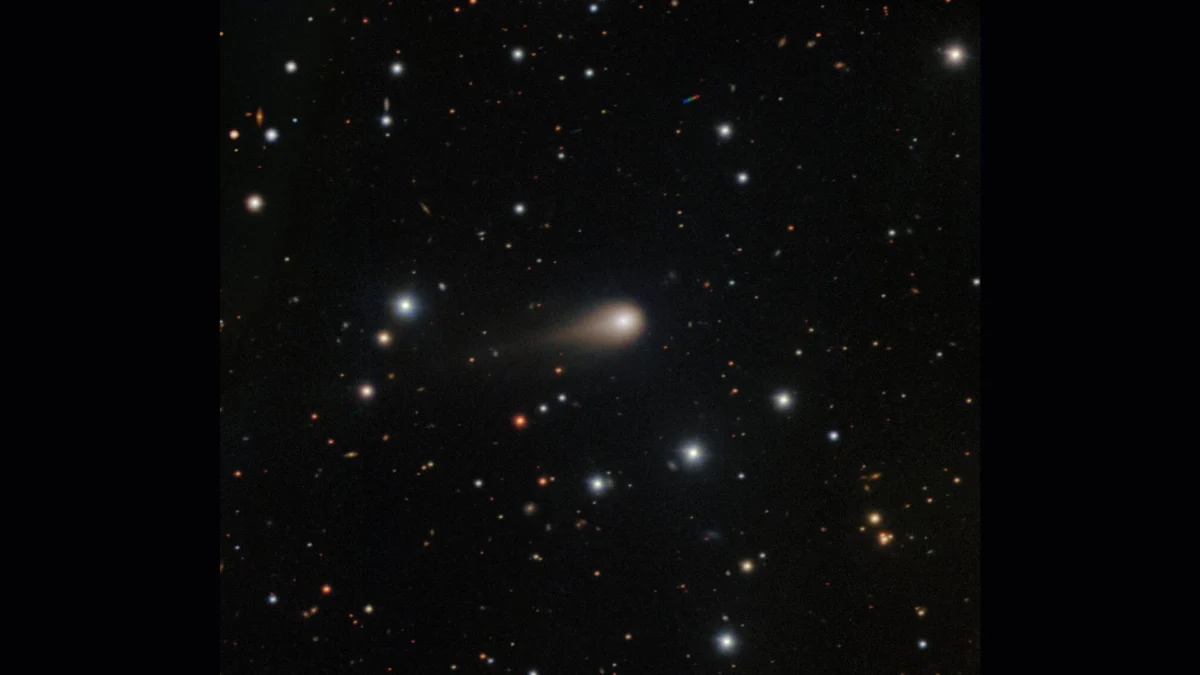
More than a year after the celestial visitor known as 3I/ATLAS first crossed into our solar system, triggering global excitement and intensive observation campaigns, astronomers have unlocked a profound new chapter in its history. For the very first time, researchers have successfully studied charged particles within the tail of an interstellar comet. This breakthrough analysis has revealed that 3I/ATLAS is remarkably rich in nitrogen, boasting a chemical composition drastically different from typical comets native to our own planetary neighborhood.
The finding serves as a compelling forensic clue, pointing directly to the extreme, freezing conditions of the interstellar traveler’s distant birthplace. As the third confirmed interstellar object ever detected passing through our system—following the landmark arrivals of ‘Oumuamua in 2017 and 2019’s Comet 2I/Borisov—3I/ATLAS continues to reshape our understanding of how planetary building blocks form and evolve across the broader universe.
Decoding the Tail: A Technological Milestone in Spectroscopy
Comets are renowned for the luminous displays they put on as they approach the sun. Solar radiation heats their solid, icy nuclei, causing frozen volatiles to sublimate into a glowing shell of gas known as a coma. Simultaneously, the relentless torrent of the sun’s solar wind strips material away, battering molecules and ionizing them into a brilliant, trailing tail.
While previous studies of interstellar objects have focused heavily on analyzing the coma through spectroscopy—a technique that splits incoming starlight into distinct spectral fingerprints to determine chemical makeup—inspecting the tail has historically remained an elusive challenge. When 2I/Borisov visited our solar system, telescopes detected faint traces of ions in its wake, but the signals were too weak to definitively identify specific chemical constituents.
That limitation evaporated with the application of advanced astronomical instrumentation located in Spain’s Canary Islands. Utilizing the William Herschel Telescope, a research team led by Lea Ferellec, a research fellow at Northumbria University, turned its sights toward 3I/ATLAS using WEAVE, a powerful new fiber-optic spectroscopic instrument that came online in 2023.
WEAVE’s exceptional sensitivity allowed the research team to capture and measure charged ions—including nitrogen, carbon monoxide, and carbon dioxide—streaming directly out of the comet’s tail. The results of this unprecedented observation were published on September 7 in the Monthly Notices of the Royal Astronomical Society.
An Icy Origin Story: Clues to a Distant Deep Freeze
By comparing the relative ratios of these ionized chemicals, astronomers can effectively read a comet’s cosmological pedigree. Particular molecular ratios, such as the balance between nitrogen and carbon monoxide, serve as direct thermometers for the environment in which the object originally coalesced billions of years ago.
Ferellec and her colleagues discovered that 3I/ATLAS possesses a nitrogen-to-carbon-monoxide ratio significantly higher than that of native solar system comets. Mathematical modeling of these ratios indicates that 3I/ATLAS likely condensed in an environment plunging below -240 degrees Celsius.
"Finding that it’s so rich in nitrogen tells us it likely formed in extremely cold conditions, far from its home star," Ferellec explained in an official statement released by the Royal Astronomical Society.
Such extreme frigidity implies that the interstellar object was born in the deep outer reaches of its parent star system—a distant realm where stellar radiation was virtually negligible, preserving pristine primordial material from the dawn of that system’s formation.
A Chronology of Interstellar Discoveries
To understand the significance of the findings surrounding 3I/ATLAS, planetary scientists view the discovery through the evolving timeline of interstellar astronomy:
- October 2017: The discovery of ‘Oumuamua shakes the astronomical community. Initially classified as a comet and later as an asteroid-like object, it becomes the first confirmed interstellar visitor to pass through the solar system.
- August 2019: Crimean amateur astronomer Gennady Borisov discovers 2I/Borisov, the first clearly active interstellar comet. While scientists manage to study its coma, attempts to analyze its ionic tail are severely limited by existing technology.
- 2023: The cutting-edge WEAVE spectrograph is fully activated on the William Herschel Telescope in the Canary Islands, providing unprecedented spectroscopic resolution for mapping faint celestial structures.
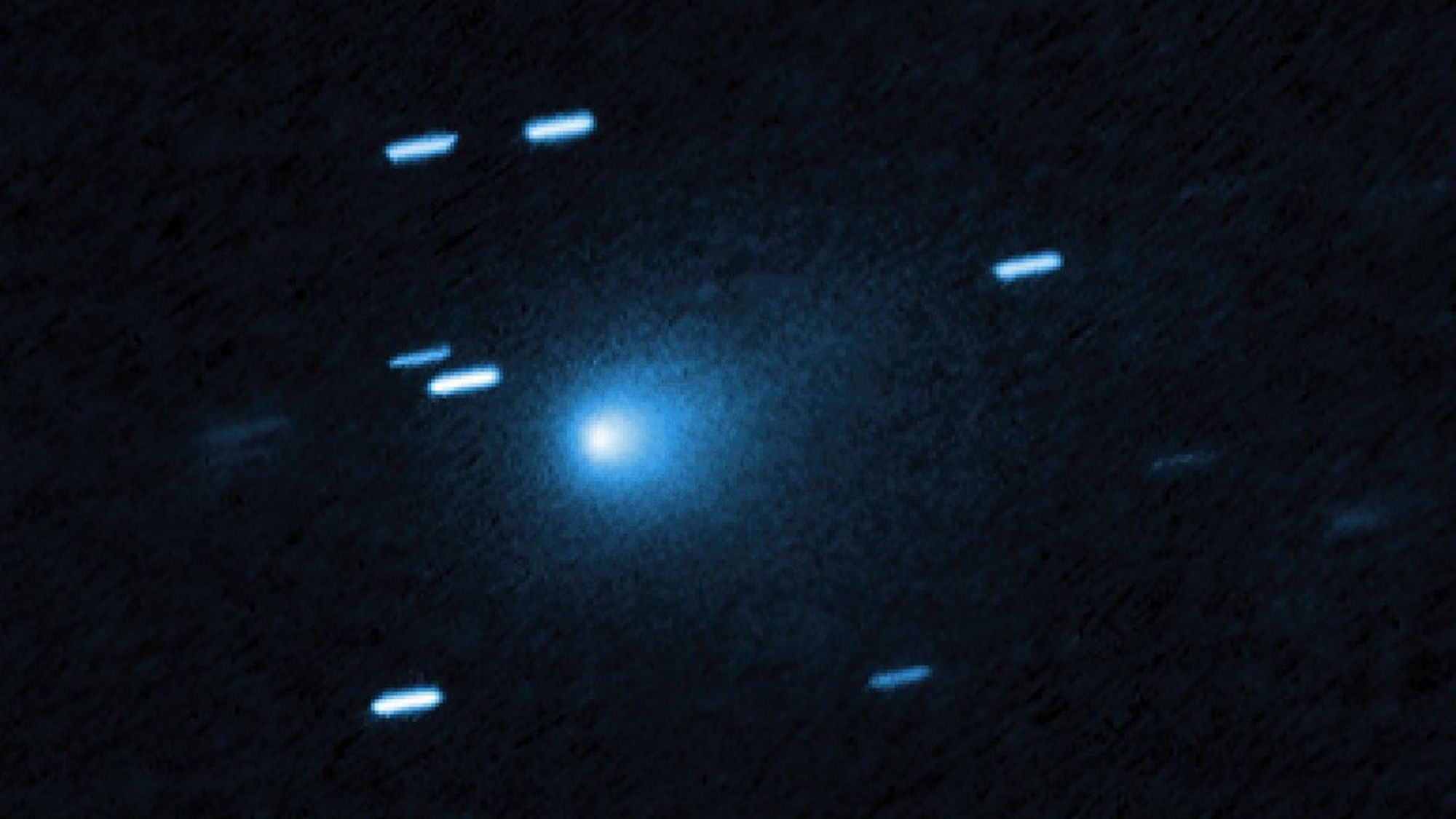
- Mid-2025: Telescopes like the Hubble Space Telescope image 3I/ATLAS as it journeys closer to the inner solar system, revealing a distinctive teardrop-shaped cocoon of dust surrounding its icy nucleus.
- Late 2025: Ferellec’s research team targets 3I/ATLAS with the WEAVE instrument, successfully isolating and quantifying charged particles within the comet’s tail for the first time in history.
- September 2025: The findings detailing the ultra-cold, nitrogen-rich composition of 3I/ATLAS are officially published in the Monthly Notices of the Royal Astronomical Society.
Implications for Planetary Formation Across the Galaxy
The implications of the WEAVE observations extend far beyond the specific chemistry of a single wandering ice ball. For decades, our theories of planetary formation have been heavily constrained by studying bodies that formed exclusively within our own solar neighborhood—the asteroid belt, the Kuiper Belt, and the Oort Cloud.
Interstellar interlopers like 3I/ATLAS act as natural messengers, delivering raw materials forged in alien stellar nurseries directly to our cosmic doorstep. By analyzing the structural and chemical variance between our system’s comets and those originating elsewhere, astronomers can test whether the fundamental recipes for building planets are universal or heavily dependent on local galactic environments.
"This object gives us a rare chance to study material that formed somewhere completely different to our own solar system," Ferellec noted. "Every one of these objects we study helps us understand a little more about how planets form around other stars."
As technological advancements in ground- and space-based telescopes continue to accelerate—bolstered by next-generation facilities like the Vera C. Rubin Observatory coming online—astronomers anticipate detecting a growing number of interstellar visitors in the coming decades. Each new detection brings humanity closer to answering whether the chemical conditions that birthed life on Earth are rare anomalies or common occurrences scattered throughout the Milky Way.