The modern fashion landscape has undergone a significant paradigm shift over recent seasons, stepping away from the voluminous, hyper-oversized silhouettes that previously dominated runways and steering decisively toward figure-skimming, form-fitting designs. While this sleek aesthetic represents uncharted territory for many contemporary design houses that must pivot their production strategies, designer Mark Fast has championed a body-first philosophy since the very inception of his career. During an exclusive preview of his upcoming spring collection, Fast reflected on the foundational advice he received while studying at the prestigious Central Saint Martins under the tutelage of the late, legendary educator Louise Wilson. Recalling her prophetic encouragement to steadfastly commit to his artistic instincts, Fast noted that Wilson famously told him, “People are going to come to you for the bodycon dress.” Nearly two decades after making his professional debut, Fast remains remarkably true to that original passion, proving that his unwavering dedication to the sculpted silhouette was not merely a fleeting trend, but a lifelong design vocation.
Inspiration and Palette: The Veruschka Influence
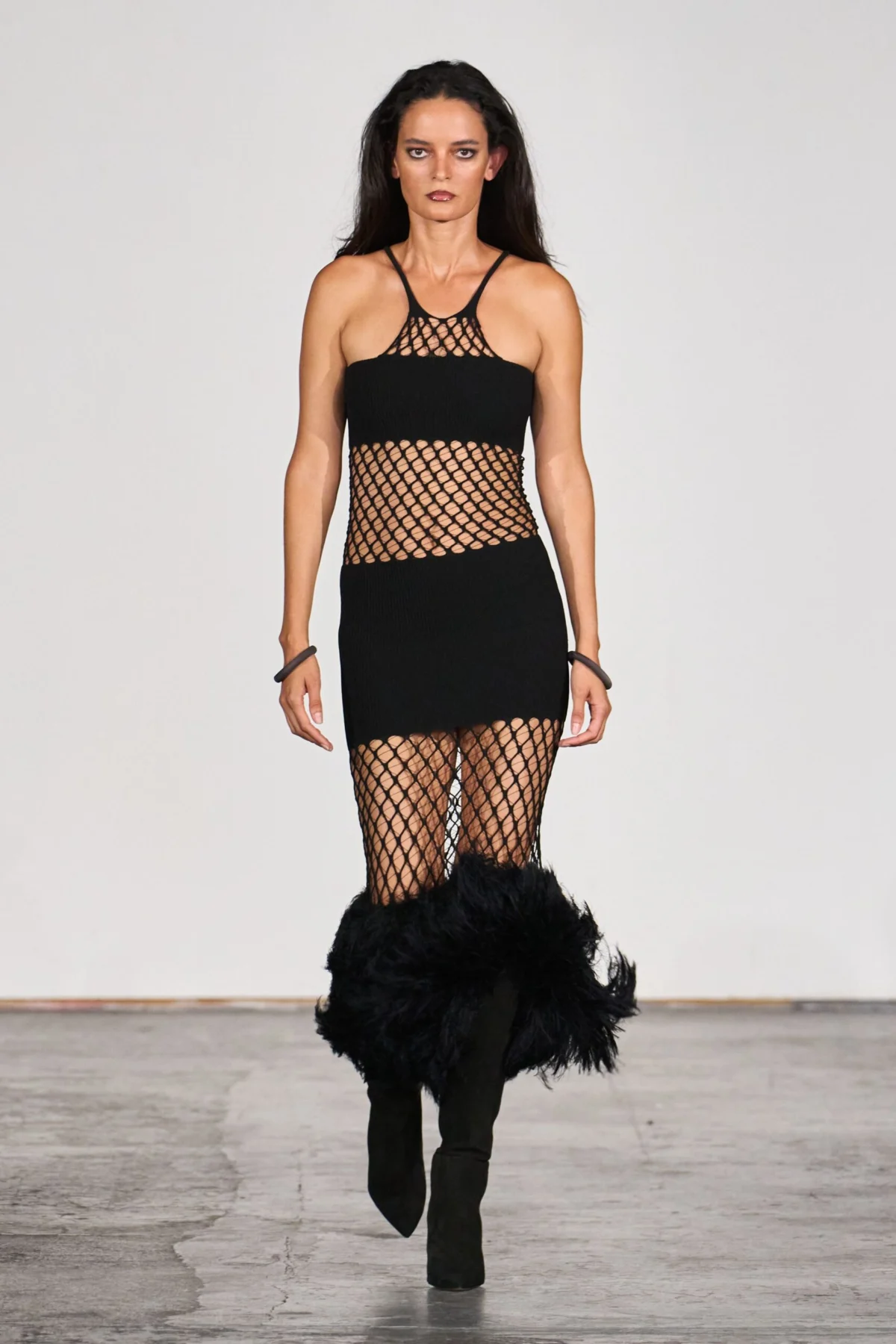
For the spring collection, Fast looked to the striking, evocative imagery of the legendary model Veruschka, specifically drawing inspiration from vintage photographs captured by iconic fashion photographer Franco Rubartelli. These images provided the conceptual foundation for the collection’s dusty, desert-hued color palette, which translates the arid warmth of sun-bleached landscapes into wearable art. Powdered-tone yarns were meticulously knotted and knitted into Fast’s signature sculptural forms, creating intricate webs that artfully splayed across the models’ décolletages and torsos.
To achieve this depth of texture, the designer employed a variety of fabrication techniques. More intricate and tighter weaves were utilized on daring minidresses and miniskirts, designed to accentuate the natural lines of the body. Several of these garments featured calculated splices at the sides, paired with oscillating, fringed edges along the hemlines that introduced movement and fluidity to the otherwise structural pieces. This careful balancing act between architectural rigidity and fluid grace underscored the overarching theme of the collection: a celebration of the human form through advanced textile engineering.
Daring Silhouettes and Technical Innovation
The quintessential Mark Fast woman is undeniably daring, a sentiment fully realized in the provocative yet sophisticated pieces showcased for spring. Several of the collection’s signature caged knits offered minimal coverage, pushing the boundaries of conventional resort and spring wear. For instance, wide-weave shorts and catsuits were designed with high-cut lines that left the curves of the body prominently on display. Other areas of the body were strategically covered with carefully placed panels, which Fast described during the preview as functioning akin to “second skins.”
Beyond his established mastery of stretch knits, Fast introduced a select few garments showcasing an innovative new technique. This process involved closely threading heavy beads onto each individual row of fabric, adding substantial weight and gravity to otherwise barely-there stretch knits. Fascinatingly, Fast likened these beaded creations to modern armor, merging the delicate nature of knitwear with the protective, imposing nature of metallic plating. “I wanted to focus on the craft,” Fast explained, highlighting the intense labor and technical precision required to bring the pieces to life.
Commercial Realities and Everyday Wearability
While the runway was dominated by high-impact, avant-garde bodycon creations, Fast also recognized the necessity of addressing the needs of the broader commercial customer. Alongside his signature experimental knitwear, the designer integrated thoughtful forays into more accessible wardrobe staples, including fine-gauge jersey separates and low-slung denim jorts. According to the designer, these grounded pieces were intentionally introduced to “bring things back down to earth,” offering consumers a bridge between high-concept runway artistry and wearable daily fashion.
Summarizing the core ethos of the collection during the preview, Fast offered a succinct and definitive assessment of the season’s overarching direction: “Everything is tight.” This uncompromising commitment to the fitted silhouette serves as a bold statement of intent in a market that is continually searching for distinct points of view.
Chronology and the Evolution of Bodycon Fashion
To understand the weight of Mark Fast’s spring collection, it is necessary to examine the broader timeline of body-conscious fashion over the past two decades. When Fast launched his label in the late 2000s, the fashion industry was heavily entrenched in indie sleaze aesthetics, bohemian layering, and, eventually, a prolonged embrace of normcore and streetwear. During eras where voluminous silhouettes and gender-neutral oversized garments reigned supreme, bodycon fashion was frequently dismissed by mainstream critics as overly provocative or commercially limited.
However, Fast persevered, steadily building a reputation as a pioneer of luxury knitwear engineering. By developing proprietary techniques that allowed stretch knits to behave architecturally rather than simply clinging to the body, he carved out a unique niche. Over the last three years, the industry pendulum has steadily swung back toward tailored, form-fitting attire, driven by post-pandemic desires to showcase personal style and a renewed cultural appreciation for physical expression. Fast’s spring presentation thus arrives at a critical juncture, positioning him not as a follower of the current bodycon revival, but as its foundational architect.
Industry Implications and Market Analysis
The debut of Fast’s spring collection carries significant implications for both the independent designer sector and the wider luxury retail market. As consumer preferences shift away from the pandemic-era obsession with loungewear and oversized comfort, brands are increasingly challenged to offer garments that provide both visual impact and tactile innovation. Fast’s ability to merge high-end knitwear craftsmanship with commercial viability—exemplified by the introduction of denim jorts and jersey basics—demonstrates a mature business strategy designed to capture both editorial attention and retail sales.
Furthermore, the integration of heavy beadwork and armor-like stretch knits reflects a growing consumer demand for artisanal value. In an era dominated by mass production and fast-fashion imitation, luxury buyers are placing a higher premium on visible craftsmanship, intricate hand-work, and garments that tell a distinct story. By honoring the advice given to him by Louise Wilson nearly twenty years ago and focusing relentlessly on what he loves, Mark Fast has not only validated his own career trajectory but has also set a high benchmark for technical excellence in contemporary fashion design.