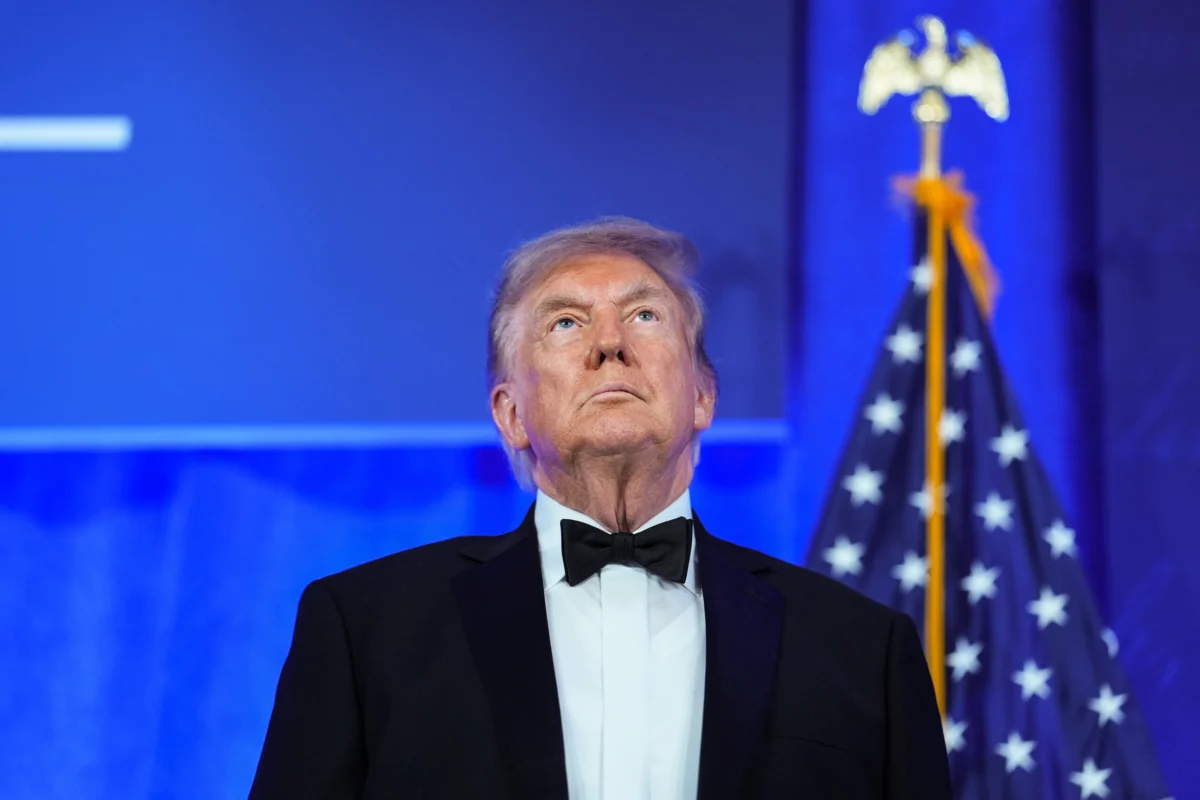
President Donald Trump made his inaugural appearance at the White House Correspondents’ Association (WHCA) Dinner, a traditionally lighthearted event that took on a markedly contentious tone on Friday evening in Washington, D.C. The rescheduled gala, disrupted earlier in the year by a security incident, saw the President deliver a sprawling, hour-long address characterized by pointed critiques, personal insults, and a pervasive skepticism toward the assembled journalists. This marked a significant departure from the typical presidential engagement with the press corps, underscoring the deeply fractured relationship between the current administration and many news organizations.
The President, upon taking the podium, initially projected an air of uncertainty regarding the expected tenor of his remarks. He suggested that, in comparison to the more aggressive barbs he had reportedly prepared for the initial, canceled dinner, he was exercising a degree of restraint. "I said, ‘What do we do here? Is this supposed to be fun? Am I supposed to be serious? Am I supposed to be a comedian?’ So I guess you said, maybe a little bit of everything," Trump commented, alluding to the extraordinary circumstances that had led to the event’s postponement.
However, this initial hesitancy was quickly shed as Trump launched into a sustained critique of the media, labeling much of the reporting as "fake news." He drew a parallel between the perceived fabrication of stories by journalists and the Academy Awards, arguing that the latter’s decline in ratings was a direct consequence of its perceived anti-Trump stance. "This evening it’s really all about the fake news media and your handling of prizes — writing and producing and performing made-up stories like the Academy Awards," he declared. He lamented the perceived downfall of the awards show, stating, "The Academy Awards used to be the the epitome of ratings outside of the Super Bowl… Now it’s down in the dumps. Nobody wants to watch it anymore because they took on Trump. They hit me all night long."
Trump then articulated a starkly transactional view of the media’s dependence on his presence, predicting financial ruin for news organizations once his time in the public eye concluded. "When I’m gone. You’re all going to be broke. Your business model is going to be finished. No, it’s true. When I’m not around, you’re going to be broke. There’s not going to be anybody to report on. Nobody gives a damn about anybody else," he asserted. He further elaborated on his perceived detachment from traditional media, claiming he had "given up" on them and highlighting his popularity on platforms like TikTok as evidence of a successful pivot. "I gave up on you, people. I gave up on traditional press, and it obviously worked because we did win in a landline," he stated, misstating "landslide" and boasting about his role in a purported sale of TikTok to American investors.
The President’s absence from previous WHCA dinners was attributed to his belief that the press had treated him "very, very unfairly." He maintained that his decision not to attend for four years was a justified response to this perceived mistreatment. He also addressed the decision by the WHCA to forgo a comedian this year, offering withering assessments of late-night television hosts, including Jimmy Kimmel, Jimmy Fallon, and Stephen Colbert, whom he dismissed as lacking talent and being "angry people" and "sick people."
A History of Contentious Engagement
The White House Correspondents’ Dinner has historically served as a unique forum where the President and the press engage in a ritual of humor and mutual acknowledgment. Founded in 1920, the WHCA’s primary mission is to support and promote the work of White House journalists and to foster a free and robust press. The annual dinner, typically held in the spring, has long been a tradition of presidents using the occasion to playfully skewer the media and, in turn, be the target of journalistic wit. However, the relationship between President Trump and the press has been notably adversarial throughout his tenure.
From his early days as a candidate, Trump has frequently employed the term "fake news" to describe reporting he finds unfavorable. This rhetoric has been consistently amplified on social media and in his public addresses. The WHCA dinner, in particular, has been a focal point of this tension. While presidents such as Barack Obama and George W. Bush participated with a degree of good humor, Trump’s approach has been markedly different, often characterized by a combative stance rather than playful banter. His attendance at this rescheduled event, the first of his presidency, carried significant weight, signaling either a potential shift in his engagement or a continuation of his confrontational style.
The Evening’s Program and Key Remarks
Trump took the stage at 9:33 p.m. and spoke for approximately 64 minutes. The event, held at the Waldorf Astoria hotel, featured a performance by mentalist Oz Pearlman, a departure from the traditional booking of a comedian. This change in format, according to the WHCA, was made in consideration of the sensitive nature of the rescheduled event, following the earlier security incident.
During his remarks, Trump touched upon various figures and entities, often with a critical edge. He alluded to a conversation with Paramount CEO David Ellison, who he claimed had suggested renaming the dinner the "Trump White House Correspondents’ Dinner" in the future, a notion Trump seemed to embrace. This comment appeared to reference his past unsuccessful efforts to associate his name with prominent institutions, such as the Kennedy Center.
He also offered a surprising, and seemingly unsolicited, compliment to Bari Weiss at CBS News, describing her as a "wonderful woman," which elicited an "audible murmur" from the audience, suggesting an unexpected or perhaps ironic endorsement given the general tenor of his speech. He acknowledged the difficult position of White House Press Secretary Karoline Leavitt, stating she has "one of the hardest jobs in the White House" due to the necessity of interacting with journalists, whom he described as "very, very difficult people." He then added, somewhat self-deprecatingly, "But I’m probably being a little bit oversensitive. Sometimes I really do think that some of you don’t like me."
The President then described the gathering as "the largest group of Trump derangement syndrome people ever put together at one time, I suspect," a remark that drew a "smattering of laughter." This phrase, "Trump derangement syndrome," has been a recurring theme in his rhetoric, often used to dismiss criticism as irrational or politically motivated.
Targeting Media Personalities and Institutions
Trump’s address then turned to specific individuals within the media landscape. He singled out Don Lemon, identifying him as the winner of "the lowest ratings and the lowest IQ on television" and labeling him "the dumbest man on television." He further commented, "when you say some things, you never make a comeback. It’s not like, ‘Oh gee, hey Don, let’s have dinner some night.’"
CNN anchor Kaitlan Collins was another target. Trump acknowledged her WHCA award for broadcast, which recognized her coverage of a confrontation between him and Ukrainian President Volodymyr Zelensky. However, he immediately dismissed the award as "fake" and suggested Collins "shouldn’t get the award." He continued, "It was a fake, but I didn’t mind." In response, Mark Thompson, chairman and CEO of CNN Worldwide, issued a statement affirming the network’s support for its journalists and their commitment to "honest, accurate journalism," emphasizing that such reporting is protected by the U.S. Constitution and that CNN would continue to exercise this right without government interference.
Trump then veered into a peculiar personal commentary on Collins, describing her as "a young, active woman" who "never smiles." He recounted urging her to smile, suggesting that as an employee of "CNN fake news," she "should be a happy person." The President then attempted a joke linking Collins to a sponsorship, mistakenly referencing Dylan Mulvaney and the controversial Bud Light campaign of 2023. He highlighted the significant backlash and financial impact of that campaign, stating, "Dylan Mulvaney cost Bud like $35 million in market cap. It was the worst commercial ever made, by the way… I wouldn’t want to hire Dylan anytime soon."
Anderson Cooper, another CNN anchor, received a more nuanced critique. Trump expressed a degree of past fondness, stating, "I like Anderson actually because he’s covered me well for many years, and he went bad as soon as I went for politics. But for years, he loved interviews. I did so many interviews with him, and he was great. But you know, he’s got a little different persuasion than me, in many ways actually."
The President’s verbal onslaught extended beyond CNN, encompassing a broad range of perceived adversaries. He criticized California Governor Gavin Newsom, U.S. Representative Ilhan Omar, Senators Elizabeth Warren and Chuck Schumer, Rosie O’Donnell, whom he called a "sick older woman," and CNN’s Jake Tapper. Bruce Springsteen was also a target, with Trump questioning his appearance and performance. "What the hell happened to that guy? He looks like hell… I’m sure he doesn’t like the way I look, but I don’t look so bad," he remarked, adding that Springsteen’s concert was filled with "four political speeches" and that his tour should be renamed "Bored in the USA."
Legal Battles and Award Controversies
The deeply strained relationship between Trump and the press was further exemplified by his history of legal challenges. He has not only routinely decried news outlets as "fake news" and insulted individual journalists but has also filed lawsuits against numerous media organizations, including The New York Times, The Wall Street Journal, CNN, ABC News, and CBS News for "60 Minutes."
A significant point of contention at the dinner was the awarding of the Katharine Graham Award for Courage and Accountability to Wall Street Journal reporters for their story regarding a purported birthday letter from Trump to Jeffrey Epstein. Trump, who has denied writing such a letter, had previously filed a $20 billion defamation lawsuit over the report. The Journal’s legal team had characterized his lawsuit as "an affront to the First Amendment." While a judge initially dismissed the suit, Trump refiled the complaint in May 2026, and the case remains pending. During the ceremony, Trump reportedly shook the hands of the award-winning reporters in an awkward gesture before returning to his seat, a moment that underscored the ongoing legal and public relations battle. He jokingly questioned his own influence over award decisions: "This has not been an easy evening. All these awards… Do I get a say in those awards?"
Future Ambitions and a Nod to the Past
Towards the conclusion of his lengthy speech, President Trump donned a "Trump 2028" hat, hinting at a potential future presidential run and reiterating his unsubstantiated claim that he won the 2020 election. He expressed his intention to attend the correspondents’ dinner again in 2027.
In a peculiar tangent, Trump also made a jest at the expense of Robert F. Kennedy Jr., his Secretary of Health and Human Services. The President recounted an anecdote involving Kennedy and a cow, suggesting it was personally brought for the dinner, and then alluded to a bizarre appetizer suggestion involving "male raccoon roadkill." "But we drew the line at that, Cheryl. We said, no, we’re not going to do that. We’re not doing that. We love Bobby," Trump concluded, seemingly referencing an individual named Cheryl and expressing affection for Kennedy Jr. despite the unusual jest.
The Shadow of a Security Incident
The rescheduling of the WHCA dinner itself cast a long shadow over the event. The original April 25th gathering was abruptly interrupted by what was described as an "evident assassination attempt" on President Trump. A gunman reportedly breached security at the Washington Hilton, leading to the suspect’s apprehension and subsequent charges. Trump dedicated a portion of his remarks to acknowledging this incident, expressing gratitude to the law enforcement personnel who subdued the attacker. This unprecedented security event undoubtedly influenced the mood and the operational adjustments for the rescheduled dinner.
The evening’s proceedings were opened by outgoing WHCA president Weijia Jiang, a senior White House correspondent for CBS News, who then shared hosting duties with Fox News’ Jacqui Heinrich. Heinrich is slated to assume the presidency of the organization for the 2026-27 term, highlighting the ongoing transition within the association that represents the White House press corps. The President’s engagement, though unconventional and largely critical, marked a significant moment in the ongoing, often fraught, dialogue between the presidency and the institution of the free press in the United States.