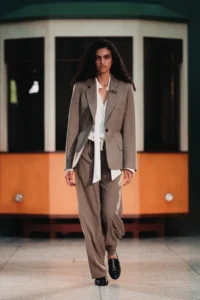
The intersection of archival fashion and modern luxury retail has once again yielded a resurgence of 1990s footwear silhouettes, highlighted by the sustained cultural fixation on the minimalist wardrobe of Carolyn Bessette-Kennedy. Among the most sought-after relics of that decade is a specific footwear hybrid that successfully bridged masculine tailoring with feminine elegance: the heeled loafer. While transient trends constantly cycle through the fashion calendar, the current industry-wide return to the heeled loafer and its derivative iterations—such as mule variants and printed calf-hair designs—signals a broader consumer shift toward structured, enduring footwear that references late-twentieth-century understated glamour.
An Archival Reference: The Bowery Bar Sighting
In October 1995, a frequently referenced yet notoriously grainy photograph captured Carolyn Bessette-Kennedy and John F. Kennedy Jr. leaving the Bowery Bar in New York City. In the image, Bessette-Kennedy wore a crisp white button-down shirt, cropped flared denim, and a pair of Prada heeled Dalmatian-print loafers originating from the Italian luxury house’s Fall 1995 runway collection.
Though preserved in lower-resolution paparazzi archives, the footwear choice cemented a standard for effortless off-duty styling that continues to resonate decades later. The spotted print, initially introduced by Miuccia Prada during a pivotal era for the brand, quickly found favor among notable cultural figures of the period, including model Kate Moss, who was photographed wearing the mule variation of the print in the summer of 1996.
For contemporary fashion historians and archival collectors, specific iterations of these 1990s animal-print heeled loafers have achieved "white whale" status—proving exceedingly difficult to source on the secondary resale market. Despite their scarcity, the silhouette has re-entered contemporary luxury dialogues, driven by both consumer nostalgia and major design houses reissuing heritage shapes.
The Anatomy of the Trend: Masculine-Feminine Balance
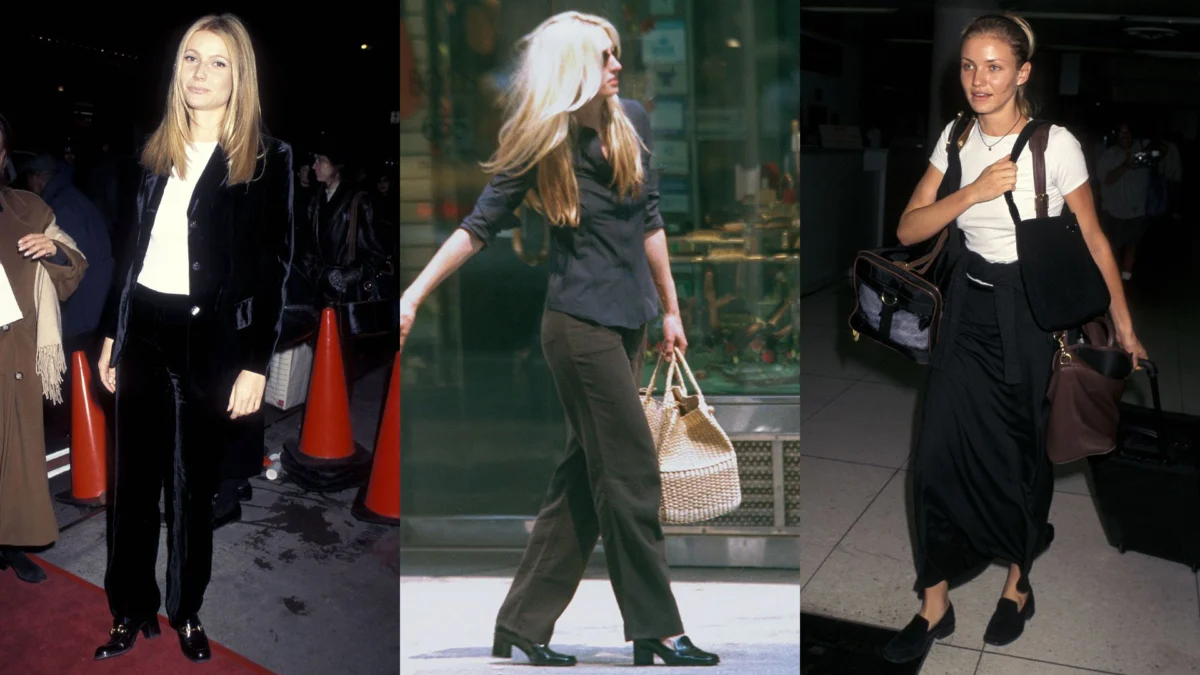
The enduring appeal of the heeled loafer lies in its precise structural duality. By taking the substantial, traditionally masculine upper of a classic penny loafer and elevating it with a heel, footwear designers of the 1990s created a versatile hybrid. During that decade, style icons ranging from Gwyneth Paltrow to Kate Moss integrated heeled loafers into diverse settings, spanning airport transit looks to formal red-carpet appearances.
This inherent adaptability is a primary driver behind its current market revival. Contemporary styling conventions mirror those of the late twentieth century: the shoes are frequently paired with relaxed denim and basic white T-shirts, or contrasted against slouchy knitwear and tailored trousers. The addition of a modest heel provides sufficient elevation to elevate casual daytime attire without sacrificing the grounded comfort associated with flat footwear.
Market Landscape: Reissues and Modern Interpretations

Recognizing the commercial viability of these archival references, major luxury conglomerates and contemporary contemporary labels have introduced modern interpretations of the heeled loafer for recent seasonal rotations.
Prada recently reissued its coveted Dalmatian-print loafers, directly catering to archivists and younger consumers seeking authentic design lineage. Concurrently, other established luxury and contemporary brands have fielded competing models to capture market share:
- Prada: Continues to anchor the trend with its reissued printed leather loafers, retailing around $1,720, maintaining the bold animal-print legacy of the mid-1990s.
- Herbert Levine: Offers the Showtime calf-hair leopard-print loafer at approximately $1,725, targeting the ultra-luxury segment.
- Jimmy Choo: Contributes the Eliot Slipper 45, blending natural leopard-print pony leather with a practical block heel, priced near $1,295.
- Margaux: Presents the Sigrid tan zebra haircalf loafer at $475, offering a distinct animal print within a contemporary price tier.
- Gucci: Explores minimalist executions via the Galleria loafer ($1,180), recalling the Tom Ford-era sleekness of the late ’90s.
- Dries Van Noten and Phoebe Philo: Have each introduced distinct leather penny loafer and pump hybrids (priced around $1,180 and $1,500, respectively), emphasizing architectural heels and premium leather finishes.
- Accessible Contemporaries: Brands like Cos ($199) and Reformation in collaboration with Alexa Chung ($298) provide accessible entry points for consumers seeking the trend without luxury price tags.
Categorization of the Revival
The current market assortment of heeled loafers generally falls into three distinct stylistic categories, allowing consumers to navigate the trend according to personal aesthetic preferences:
- The Printed Loafer: Championed by animal prints and bold textures, this category revives the maximalist footwear moments spearheaded by Miuccia Prada and Tom Ford in the 1990s. Ideal for pairing with understated denim or monochrome trousers to let the pattern serve as the focal point.
- The Loafer Mule: Offering a relaxed, backless construction, the mule variation was ubiquitous in the mid-1990s. Today, houses such as Saint Laurent, JW Anderson, and MM6 Maison Margiela offer updated interpretations that combine the front profile of a traditional loafer with the ease of a slip-on mule.
- The Minimalist Loafer: Representing the quiet luxury movement, brands like The Row, Khaite, and Cos focus on clean lines, supple leather, and subtle heel heights. These silhouettes are designed for maximum versatility, transitioning seamlessly from professional tailoring to evening slip dresses, with sufficient internal volume to accommodate hosiery during cooler months.
Implications for the Footwear Industry
The systematic revival of 1990s footwear trends reflects a broader macroeconomic and consumer preference for longevity and historical authenticity in fashion. As consumers increasingly scrutinize cost-per-wear metrics, luxury houses are looking
inward at their design archives rather than inventing entirely novel silhouettes.
The heeled loafer fulfills a practical market need: it combines the arch support and structural integrity of a closed-toe shoe with the formal elevation traditionally reserved for pumps. Furthermore, the scarcity of authentic vintage pieces from brands like Prada has created a lucrative secondary market, validating the investment value of well-crafted leather goods.
Industry analysts note that as fall and winter collections emphasize rich textures—such as calf hair, embossed leather, and pony skin—the heeled loafer will likely remain a staple fixture in retail inventories. Whether sourced through high-end contemporary labels or secured as a heritage reissue, the silhouette bridges decades of design evolution, proving that true style references are perennial.