In a landmark diplomatic and humanitarian development on December 20, 2024, the Grand Duchy of Luxembourg cemented its role as a premier champion of international health security by signing historic funding agreements with the World Health Organization (WHO). Finalized symbolically on the International Day of Human Solidarity, the dual agreements total €47.5 million, representing the largest financial commitment Luxembourg has ever extended to the United Nations’ health agency.
The comprehensive funding package comprises a €46.5 million Strategic Partnership Framework (SPF) executed alongside the Ministry of Development Cooperation and Humanitarian Affairs, coupled with a groundbreaking €1 million multiyear agreement with the Ministry of Health and Social Safety. This second agreement marks Luxembourg’s very first voluntary contribution directed through the health ministry to the WHO, signaling an expanded, whole-of-government approach to multilateral health diplomacy.
The infusion of capital arrives at a critical juncture for the international community. As the world navigates the midpoint of the timeline toward the 2030 Agenda for Sustainable Development, global health institutions face mounting challenges, including escalating climate-related health risks, persistent post-pandemic vulnerabilities, widening health inequalities, and resurgent infectious diseases. Luxembourg’s substantial financial backing provides the WHO with crucial predictability, flexibility, and technical capacity to address these systemic hurdles over the 2025–2028 programmatic cycle.
Chronology of the Partnership and the Signing Ceremony
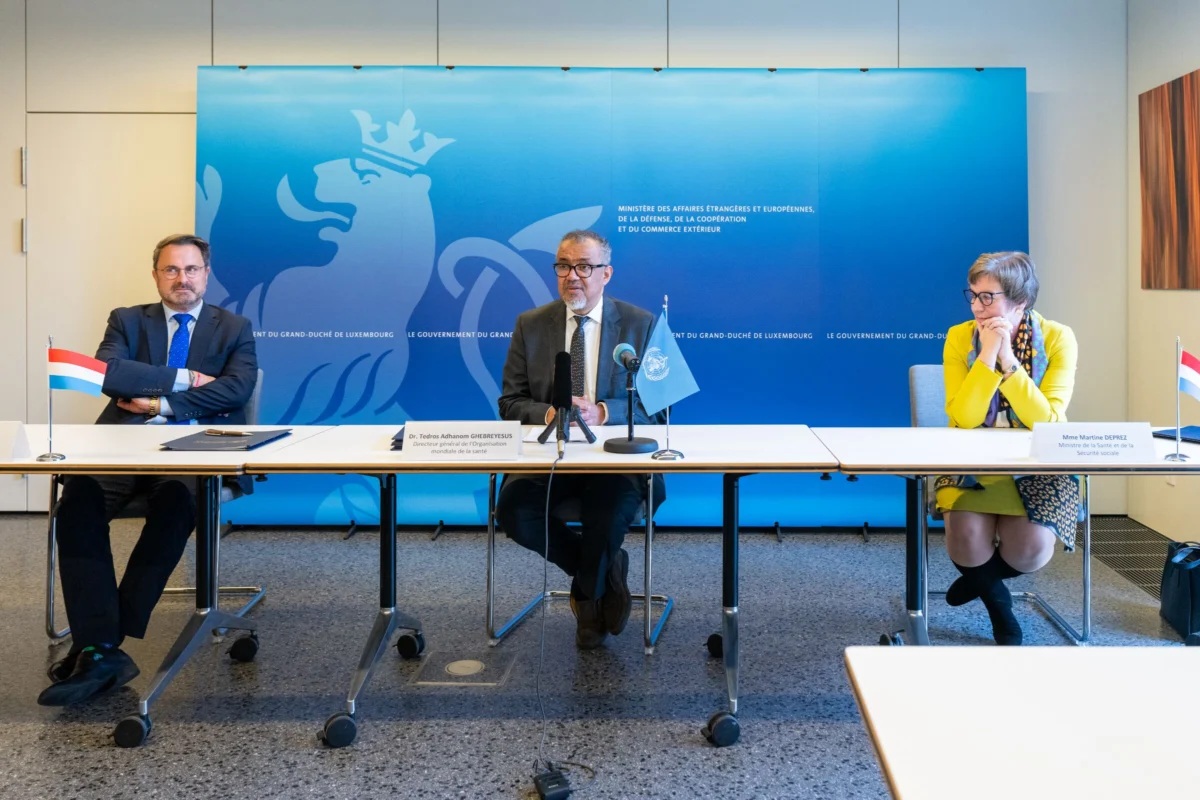
The signing ceremony, held in a high-level bilateral meeting format, brought together key dignitaries from both Luxembourg and the global health sector. Among them were Dr. Tedros Adhanom Ghebreyesus, WHO Director-General; Xavier Bettel, Luxembourg’s Deputy Prime Minister and Minister of Foreign and European Affairs, Cooperation and Foreign Trade; and Martine Deprez, Minister of Health and Social Safety.
The timing of the agreement on December 20 was widely noted by participants as more than a mere coincidence. Dr. Tedros emphasized the profound alignment between the core tenets of the International Day of Solidarity and Luxembourg’s diplomatic actions. By channeling robust financial resources into global health infrastructure, Luxembourg demonstrated a tangible commitment to planetary welfare that transcends national borders.
Discussions leading up to the signing spanned several months, focusing on harmonizing Luxembourg’s national development cooperation priorities with the WHO’s Fourteenth General Programme of Work (GPW 14). The resulting agreements create a seamless pipeline for funding that targets both immediate health emergencies and long-term structural resilience across developing nations and vulnerable populations.
Breakdown of the Financial Allocation and Strategic Priorities
The centerpiece of the agreement—the €46.5 million Strategic Partnership Framework—is meticulously structured to maximize impact across several core operational pillars of the WHO. A significant portion of this funding is designated as fully flexible and thematic. In the architecture of international aid, fully flexible resources are exceptionally valuable. They empower the WHO Director-General and technical teams to deploy capital swiftly to areas experiencing acute, underfunded emergencies, bypassing the administrative bottlenecks often associated with earmarked grants.

In addition to flexible funding, the SPF allocates precise resources to targeted global health initiatives:
- The Universal Health Coverage (UHC) Partnership: A flagship WHO initiative that supports low- and middle-income countries in strengthening their health systems through primary health care, ensuring that communities can access essential services without financial hardship.
- Tropical Disease Research: Dedicated investments aimed at accelerating the discovery, development, and delivery of diagnostics, treatments, and prevention tools for neglected tropical diseases that disproportionately afflict impoverished populations.
- Polio Eradication: Continued financial support to push the final frontiers of the Global Polio Eradication Initiative, ensuring immunization campaigns reach the most remote and conflict-affected regions.
Meanwhile, the historic €1 million agreement spearheaded by the Ministry of Health and Social Safety introduces a dedicated stream for domestic-to-global health security coordination. Minister Martine Deprez underscored the precise focus areas of this contribution during the bilateral talks.
"From now till 2028, this contribution will help finance priority areas in Luxembourg’s collaboration with WHO," stated Minister Deprez, highlighting two critical pillars: sanitary crisis preparedness and response, and the aggressive fight against health inequalities, with a dedicated lens on gender mainstreaming.
Recognizing that health crises frequently exacerbate existing social divides, the integration of a gender-responsive approach ensures that vulnerable women and girls—who often bear the brunt of healthcare disruptions—are prioritized in emergency interventions and long-term health planning.
Core Technical Support and the Prevention Paradigm
Beyond emergency response and disease-specific campaigns, Luxembourg’s multi-million-euro investment fortifies the foundational bedrock of the WHO: its normative work.
In the complex ecosystem of global health, the WHO serves as the ultimate arbiter of scientific consensus. The organization develops, validates, and disseminates high-level technical products, including clinical guidelines, public health norms, and international standards. National health authorities across the globe—from advanced economies to resource-constrained ministries—rely heavily on these evidence-based frameworks to draft domestic legislation, manage clinical care, and regulate pharmaceuticals and medical devices.
By funding the WHO’s core technical operations, Luxembourg ensures that the agency can continue producing independent, rigorous scientific guidance free from commercial or political interference.
This emphasis on prevention and systemic resilience was explicitly championed by Deputy Prime Minister Xavier Bettel. During the proceedings, Bettel articulated the philosophical foundation driving Luxembourg’s foreign policy choices in global health.

"By signing two new partnership agreements, we have reaffirmed Luxembourg’s continued support for the WHO and its mission," said Mr. Bettel. "This reflects our strong commitment to promoting global health and multilateralism. We launch these agreements with WHO because we believe the best way to avoid [crisis] is to prevent."
Bettel’s assertion underscores a growing consensus among donor nations that reactive emergency aid, while necessary, is economically and humanly inferior to robust, proactive investments in primary healthcare infrastructure, epidemiological surveillance, and institutional preparedness.
Broader Impact and Implications for the 2025–2028 Cycle
The timing of these agreements aligns strategically with the WHO’s broader institutional cycles. As the organization transitions into the execution phase of its strategic plans for 2025–2028, predictable multiyear funding from reliable donor partners like Luxembourg mitigates the budgetary volatility that has historically hampered international health organizations.
Historically, the WHO has relied heavily on voluntary contributions, a significant portion of which has been tightly earmarked for specific diseases or regions. While earmarked funding is crucial, it can create operational silos and leave critical, non-glamorous areas of public health chronically underfunded. Luxembourg’s inclusion of fully flexible financing within its €46.5 million package directly addresses this structural vulnerability, allowing the WHO to maintain balanced institutional capacity.
Furthermore, the involvement of Luxembourg’s Ministry of Health and Social Safety signifies a growing trend where domestic health policymakers increasingly recognize their national security and economic stability are inextricably linked to global health security. Pandemics, antimicrobial resistance, and climate-driven vector-borne diseases do not respect national borders; thus, investing in health systems in the Global South is viewed by Luxembourgish authorities as a direct investment in domestic protection.
Reactions from the broader international community have been overwhelmingly positive. Shortly after the formal signing, WHO Director-General Dr. Tedros took to digital platforms, including X (formerly Twitter), to publicly commend the Grand Duchy, writing that the WHO deeply appreciates the signing of these milestone agreements. International health analysts have likewise noted that Luxembourg’s outsized per-capita contributions to multilateral institutions continue to serve as a benchmark for small-state diplomacy, proving that geographical size does not limit a nation’s capacity to drive transformative global change.
As the implementation phase of the Strategic Partnership Framework begins in earnest in early 2025, the international community will be watching closely to measure the tangible outcomes of this collaboration. With €47.5 million now securely integrated into the WHO’s operational architecture, Luxembourg has not only secured its legacy as a steadfast humanitarian partner but has also provided a vital lifeline for millions of individuals worldwide who depend on the global health architecture for survival, dignity, and a resilient future.