The landscape of American transportation underwent a massive evolution in the decades preceding the outbreak of the Second World War. Long before the Interstate Highway System reshaped the geographic contours of the United States, a complex and rapidly growing network of planes, passenger trains, private automobiles, and commercial buses connected cities and towns from coast to coast. Intercity bus travel, spearheaded by industry giants such as Greyhound, experienced unprecedented commercial success. Greyhound’s prominence during this era was so absolute that the corporation even explored futuristic concepts like vertical takeoff and landing aircraft. This booming demand for rubber-tire transit naturally cultivated a competitive market of independent bus coach manufacturers eager to capture a share of the burgeoning industry.
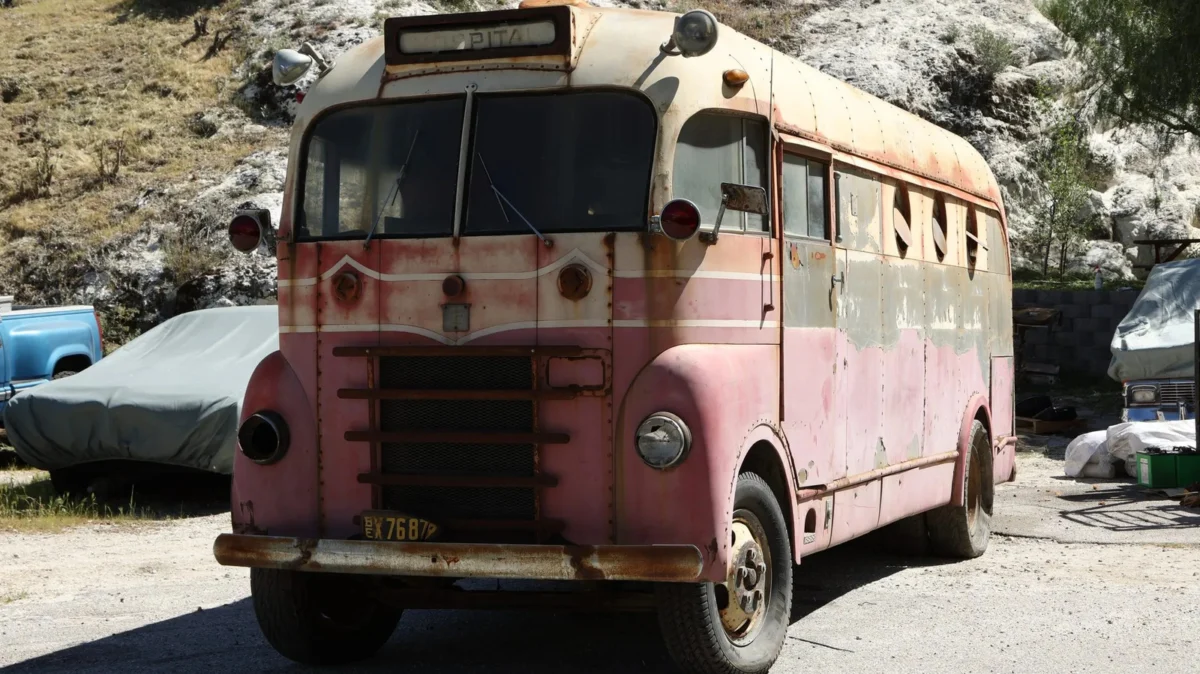
Among these enterprising coachbuilders was Kalamazoo Coaches, a Michigan-based firm that would eventually leave a distinct, albeit obscure, mark on both automotive manufacturing and wartime home-front preparation. Today, the remnants of that era occasionally surface in unexpected places, offering modern enthusiasts a tangible connection to a pivotal period in American history. A prime example of this phenomenon has recently appeared on the automotive auction platform Bring a Trailer: a patina-laden, remarkably preserved 1942 Kalamazoo Coaches Pony Cruiser configured as a Mobile Emergency Room Unit. This historical vehicle, sporting faded red-and-white paint and bearing the scars of decades of service and subsequent storage, presents a unique opportunity for preservationists, collectors, and historians alike.
Origins and Production of the Kalamazoo Pony Cruiser
During the early 1940s, Kalamazoo Coaches operated out of Michigan, specializing in the production of compact, efficient buses designed to shuttle moderate numbers of passengers. Their flagship offering in this category was the Pony Cruiser, a vehicle typically configured to seat between 16 and 18 passengers. These buses were engineered to provide reliable, maneuverable transit for regional operators, small municipalities, and private fleets.
Mechanically, the Pony Cruisers of this vintage were built upon sturdy Ford commercial chassis. Power was supplied by a dependable 239 cubic-inch flathead V8 engine, a powerplant renowned for its torque and straightforward architecture, paired with a traditional three-speed manual transmission. While contemporary accounts suggest these vehicles were capable of reaching speeds approaching 100 miles per hour under optimal conditions, their practical operating envelope was considerably more modest, especially when loaded with passengers or specialized cargo.
Between the inception of the model and the company’s eventual evolution into the Unifab Corporation during the 1950s—an entity that continues to operate out of Portage, Michigan, to this day—Kalamazoo Coaches manufactured approximately 625 Pony Cruisers. While the vast majority of these units entered standard passenger service across the United States, a select few were earmarked for specialized governmental duties that would forever alter their legacy.
Wartime Mobilization and the Office of Civilian Defense
The geopolitical shockwaves of the December 7, 1941, attack on Pearl Harbor fundamentally transformed American society, shifting the nation into a total war footing. The immediate threat of enemy air raids on the U.S. mainland, coupled with the potential for industrial accidents in rapidly expanding wartime manufacturing plants and the logistical challenges of battlefield-adjacent triage, prompted the federal government to hastily organize civil defense infrastructure.
To address these unprecedented vulnerabilities, President Franklin Delano Roosevelt’s administration established the U.S. Office of Civilian Defense (OCD). Tasked with protecting civilian populations and coordinating emergency response measures across municipal borders, the OCD sought practical applications for commercial vehicles that could be rapidly converted into auxiliary emergency assets.
In response to this urgent federal directive, Kalamazoo Coaches diverted three of its standard Pony Cruiser production units to be specially modified into Mobile Emergency Room Units. These vehicles were designed to serve as self-contained, mobile medical triage stations capable of deploying directly to disaster sites, bombed-out urban centers, or industrial facilities following enemy attacks or catastrophic accidents.
Chronology of a Wartime Relic
The operational timeline of the featured Kalamazoo Coaches Pony Cruiser reflects the shifting priorities of twentieth-century America:
- 1942: The chassis is assembled and bodied as a Pony Cruiser by Kalamazoo Coaches in Michigan before being commissioned by the U.S. Office of Civilian Defense as a Mobile Emergency Room Unit.
- 1942–1945: The vehicle remains on standby or active civil defense service throughout World War II, prepared to respond to potential air raids or domestic industrial catastrophes.
- Post-WWII: Following the conclusion of hostilities and the dissolution of active wartime civil defense measures, the specialized bus is decommissioned and sold off to the private sector.
- 1945–1951: The vehicle is acquired by the Snyder Ambulance Company, where it is repurposed and utilized for civilian medical transport and emergency operations until its eventual retirement.
- 1951: The ambulance company parks the aging vehicle, marking the beginning of a multi-decade slumber that transforms the bus into an accidental time capsule.
- Present Day: The vehicle is unearthed and listed on the Bring a Trailer auction platform, sparking renewed interest among automotive historians and preservationists.
An Intact Medical Time Capsule on Wheels
Following its retirement from the Snyder Ambulance Company in 1951, this particular Pony Cruiser was parked and essentially forgotten by the outside world, a circumstance that paradoxically preserved its unique historical integrity. Rather than being subjected to modern modifications, commercial upfitting, or routine scrapping, the vehicle slowly evolved into a time capsule.
Inspection of the vehicle reveals a rear cabin that functions as an authentic, mid-century mobile hospital. The interior space is densely packed with period-correct medical infrastructure, including built-in cabinetry, a 120-volt electrical outlet system, and patient examination tables clad in traditional brown vinyl padding. Crucially, the vehicle is accompanied by four original rolling gurneys and a cache of vintage medical supplies left behind from its operational era. Unused gauze, aging medicine bottles, and authentic plasma cans remain within the vehicle, providing an unvarnished look at emergency medical practices of the 1940s and early 1950s.
Aesthetic and Structural Characteristics
From an exterior standpoint, the Pony Cruiser commands attention through its weathered aesthetic. The faded red-and-white paint scheme still retains faint, legible traces of the original "Snyder Ambulance Service Hospital" lettering along its flanks. The vehicle rides on 18-inch steel wheels and features functional period styling cues, including front and rear spotlights designed to illuminate nighttime emergency scenes, distinctive porthole-style side windows characteristic of the era’s coachbuilding practices, and practical rear barn doors to facilitate the loading and unloading of patients and equipment.
According to documentation provided on Bring a Trailer, the odometer displays approximately 19,000 miles, though the true cumulative mileage of the chassis remains unknown given its decades of multi-phase service. Furthermore, listings note that no factory serial number has been located on the vehicle, meaning the historic transport will be transferred to its next custodian via a bill of sale rather than a standard title—a common hurdle when dealing with long-dormant historical assets.
Broader Impact, Preservation Implications, and Restoration Challenges
The emergence of this 1942 Kalamazoo Coaches Pony Cruiser highlights a broader conversation among automotive historians regarding the preservation of non-Detroit commercial manufacturing history. While the major automakers of the motor city—Ford, General Motors, and Chrysler—receive significant documentation and preservation efforts, the specialized products of independent coachbuilders like Kalamazoo Coaches are disappearing at an alarming rate due to age, attrition, and economic pressures.
Attempting a full restoration of this American relic presents a formidable challenge. A comprehensive overhaul would require not only mechanical restoration of the Ford flathead V8 engine, transmission, and braking systems, but also delicate structural preservation of the wooden and metal framing characteristic of 1940s bus manufacturing. Moreover, conservators would face the philosophical dilemma of balancing mechanical restoration with the preservation of the priceless patina and interior medical artifacts that make the vehicle historically significant in the first place.
For the successful bidder, the acquisition of this Pony Cruiser represents far more than a standard automotive restoration project. It stands as a stewardship opportunity to safeguard a tangible artifact of America’s World War II home front, honoring the collective mobilization of citizens and industry during a period of profound national uncertainty. Whether the vehicle is preserved in its current, evocative state as a museum exhibit or meticulously restored to operating condition, its survival ensures that the physical memory of wartime civil defense engineering endures for future generations.