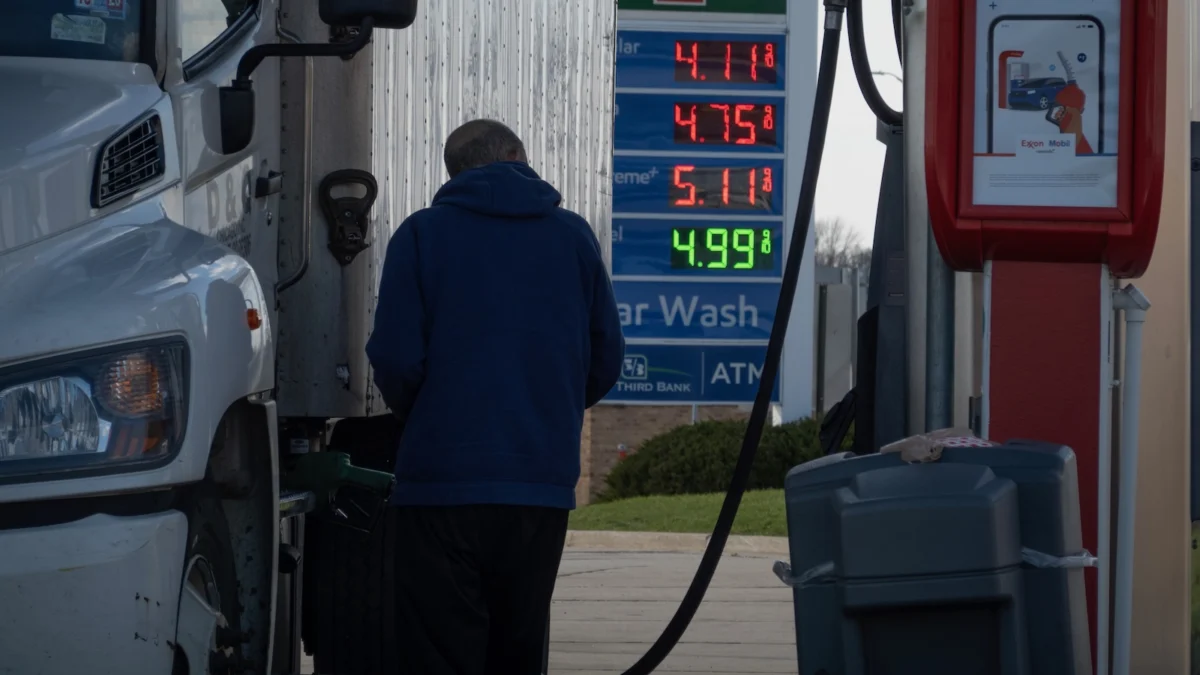
The economic shockwaves of cascading international conflicts reached a historic tipping point on Friday as diesel prices shattered all previous records, climbing to an unprecedented nationwide average of $5.98 per gallon. According to data tracking from the American Automobile Association (AAA), this staggering figure represents a dramatic $2.31 surge since late February, when the United States and Israel initiated military operations against Iran. While regional variations have always existed within the American fuel market, the current crisis has pushed local costs to extraordinary extremes; motorists and commercial operators in states like California are now confronting eye-watering prices reaching up to $7.91 per gallon.
Although the average citizen rarely purchases diesel directly for personal transportation, the economic burden of these soaring costs is universally shared. Diesel fuel serves as the lifeblood of modern commerce, powering the heavy-duty semi-trucks, cargo vessels, and freight trains responsible for moving essential goods—ranging from fresh dairy to building lumber—across the country. Consequently, these transportation premiums are rapidly embedding themselves into the final retail prices consumers encounter at grocery stores, hardware outlets, and shopping malls. The last time American consumers experienced a comparable inflationary shock regarding diesel was in 2022, when the outbreak of the Russia-Ukraine war drove prices to a then-record high of $5.82 per gallon. However, market analysts emphasize that the current convergence of geopolitical disruptions has created an even more volatile and constrained economic landscape.
A Chronology of Disruption: From Late Winter Flashpoints to Autumn Shortages
The roots of the current energy crisis trace back to the sudden escalation of military hostilities in the Middle East during the closing weeks of February. The outbreak of war between the U.S.-Israel coalition and Iran severely destabilized the Strait of Hormuz, a critical maritime chokepoint through which approximately 10 percent of the world’s seaborne diesel supply historically flowed. As commercial shipping lanes through the Persian Gulf faced mounting security threats, global supply chains experienced an immediate bottleneck, triggering the initial upward trajectory of wholesale fuel costs.
Compounding this Middle Eastern flashpoint, the prolonged conflict in Eastern Europe has continued to exert relentless pressure on international energy markets. Ukrainian military forces have intensified and refined strategic drone and missile strikes targeting critical Russian oil refineries and processing infrastructure. These successful operations have effectively crippled Russia’s capacity to export refined petroleum products to the global market. Patrick De Haan, head of petroleum analysis for the fuel-tracking platform GasBuddy, noted the compounding severity of these dual conflicts. "Russia is no longer supplying the global market," De Haan explained, highlighting that American refineries are currently operating at maximum processing capacity, leaving domestic producers virtually incapable of absorbing the shortfall or increasing output to stabilize prices.
Data from the Energy Information Administration (EIA) underscores the precarious nature of the domestic inventory. U.S. crude and distillate inventories have plummeted to their lowest levels since 1982, leaving the nation exceptionally vulnerable as it transitions into the demanding autumn months. David Russell, global head of market strategy at brokerage service TradeStation, warned of the impending seasonal spike. "We’re entering a key period for diesel consumption with the lowest inventories on record for early September," Russell stated. "Farmers and truckers typically use more diesel in the autumn, which raises the stakes for the current crisis and increases the risk of sharper price increases."
Economic Toll and Macroeconomic Implications
The rapid escalation of fuel costs has translated into a massive financial drain on American households. Data compiled by a specialized research tracker at Brown University reveals that surging diesel prices have cost U.S. consumers an additional $46 billion, translating to an average burden of roughly $350 per household. While this figure is slightly lower than the estimated $55 billion extracted by rising gasoline prices, the velocity of the crisis is starkly apparent in the percentages: diesel prices have leaped by an astonishing 61 percent, easily outpacing the 41 percent increase recorded for standard gasoline over the same timeframe.
Experts emphasize that the lag effect of supply chain pricing means the worst may still be ahead for everyday consumers. David Ortega, a professor of food economics and policy at Michigan State University, explained the mechanics of this delayed economic transmission to the Associated Press. "Early on, much of the cost increase gets absorbed along the supply chain through existing freight contracts and retailer margins," Ortega observed. "But as contracts reprice and fuel surcharges take hold, more of that cost makes its way to the grocery store."
This sentiment is echoed by industry analysts who point out that diesel is uniquely exposed to structural supply deficits. "Diesel right now is caught up in more of a geopolitical turmoil than gasoline," De Haan reiterated. The lack of domestic buffer stock means that any localized disruption—whether related to weather events, refinery maintenance, or transportation bottlenecks—carries the potential to trigger disproportionate price spikes at the pump.
The Impending Home Heating Crisis and Winter Vulnerabilities
As the northern hemisphere looks toward the colder winter months, the diesel crisis threatens to morph into a severe humanitarian and domestic heating emergency. Because heating oil is chemically and functionally nearly identical to diesel fuel, millions of American households—particularly in the Northeast—that rely on oil-heat systems face the prospect of unprecedented utility bills.
This financial squeeze arrives at a politically sensitive juncture, coinciding with ongoing policy proposals from the administration of President Donald J. Trump targeting federal safety nets. The administration’s proposed federal budget includes measures that threaten to eliminate or severely curtail the Low Income Home Energy Assistance Program (LIHEAP), a vital federal initiative designed to help vulnerable, low-income families afford their home heating fuel bills during extreme weather.
Mark Wolfe, executive director of the National Energy Assistance Directors Association, highlighted the disproportionate regional threat in an interview with Axios. "If you’re in the Northeast, then this is much more burdensome than anywhere else in the country," Wolfe warned. "Families are getting hit by both gasoline and heating oil." Without robust federal assistance, low- and fixed-income households face impossible choices between adequate home heating and other basic necessities as temperatures drop.
Political Fallout Ahead of the Midterm Elections
The timing of this energy price shock could not be worse for the political establishment, occurring just weeks before crucial midterm elections where economic anxiety and the cost of living consistently rank as top priorities for the American electorate. Historically, fuel prices have operated as a secondary or downstream consideration in voter decision-making, secondary to broader inflation or employment rates. However, energy analysts suggest this election cycle may break historical molds.
Kevin Book, head of research at the energy consulting firm ClearView Energy Partners, pointed out the acute political vulnerability tied to home heating and regional energy dependency. In cold-weather states, particularly those reliant on heating oil rather than natural gas, Book noted that the surge in fuel costs "could be a very big deal" in shaping voter sentiment at the ballot box. Lawmakers from both sides of the aisle are facing intense constituent pressure to deliver immediate relief, though legislative remedies remain severely constrained by global market realities.
Path to Recovery: A Long Road Ahead
For consumers hoping for quick relief at the pump or the grocery store, market fundamentals offer little immediate comfort. Energy experts emphasize that even under the most optimistic geopolitical scenarios—such as an immediate, negotiated end to the wars in Iran and Ukraine—the normalization of global energy markets will be a protracted, multi-week or multi-month process.
De Haan outlined the strict sequence required for any meaningful price correction. "After both of those are solved, then once the flow normalizes, that will start to help global inventories recover," he explained. "Only after inventories have recovered do diesel prices really see a full decline." Until international shipping lanes reopen, Russian refining capacity is restored, and domestic inventory buffers are replenished, American consumers and businesses must brace themselves for an extended period of high energy costs and economic friction.