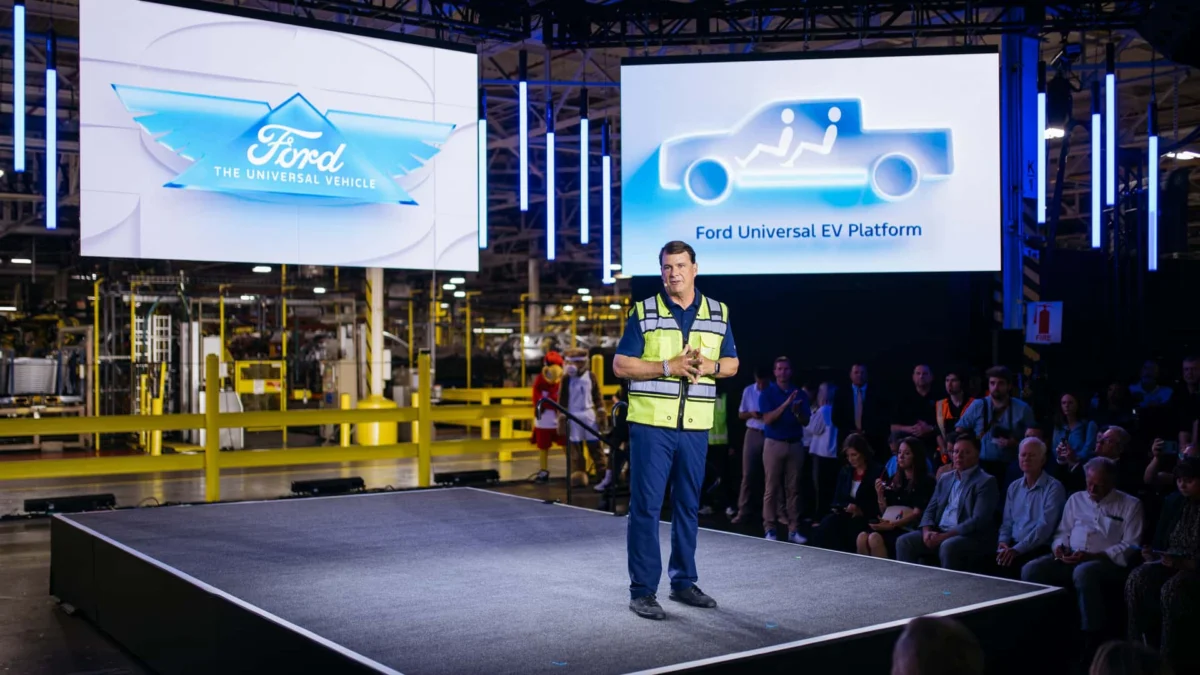
The political battle over the future of the American automotive industry has reached a fever pitch, with Ford Motor Company emerging as the central flashpoint in a growing dispute over the role of Chinese technology in domestic manufacturing. This week, U.S. Transportation Secretary Sean Duffy delivered a sharp rebuke to Ford CEO Jim Farley, issuing a formal letter that questioned the automaker’s strategic reliance on Chinese entities, specifically targeting a high-profile licensing agreement with Contemporary Amperex Technology Co. Limited (CATL).
The letter, sent Tuesday, serves as a significant escalation in the federal government’s efforts to decouple the U.S. automotive supply chain from China. Secretary Duffy articulated "profound concern" regarding Ford’s operational trajectory, specifically citing the company’s plan to utilize CATL’s lithium iron phosphate (LFP) battery technology at a planned manufacturing facility in Marshall, Michigan. Duffy’s correspondence characterized the move as a failure to act as a "reliable partner" to the American public, suggesting that deepening dependencies on strategic competitors undermines national security and domestic industrial autonomy.
A Chronology of the Ford-CATL Controversy
The tension surrounding Ford’s battery strategy did not emerge in a vacuum; it is the culmination of years of legislative maneuvering and shifting industrial policy.
- February 2023: Ford announced plans for a $3.5 billion battery plant in Michigan, utilizing technology licensed from CATL. The deal was structured as a licensing agreement rather than a joint venture, a move designed to comply with Inflation Reduction Act (IRA) requirements by keeping the facility entirely under Ford’s ownership and control.
- Late 2023: Republican lawmakers began scrutinizing the deal, arguing that the licensing structure was a "loophole" that would allow Chinese firms to benefit from U.S. tax subsidies.
- 2024: The federal government tightened rules regarding Foreign Entities of Concern (FEOC), effectively barring vehicles containing battery components from Chinese-linked firms from receiving federal tax credits.
- December 2024: Secretary Duffy’s letter reignited the debate, explicitly calling out Ford for its "strategic choice" to integrate CATL technology into its domestic EV roadmap.
The Complexity of the Automotive Supply Chain
The focus on Ford has surprised industry analysts, largely because the company is not an outlier in its utilization of Chinese technology. The global automotive supply chain is deeply intertwined, and untangling it has proven to be a logistical and economic challenge that goes far beyond a single licensing agreement.
General Motors, for instance, has long utilized batteries and components with Chinese heritage in its Chevrolet Bolt and other platforms. Stellantis, the parent company of brands including Chrysler and Jeep, has invested in Leapmotor, a Chinese automaker, to distribute vehicles in international markets. Furthermore, smaller players and even some larger suppliers rely on U.S.-based facilities owned or heavily supported by Chinese battery giant Gotion.
The lack of a uniform regulatory standard has created a fragmented landscape where companies are often uncertain about which partnerships are permissible. This inconsistency was highlighted by the White House’s own messaging. While Secretary Duffy criticized Ford’s reliance on CATL, the White House rapid-response team issued a statement shortly thereafter praising Ford as a "great American company" that has made significant strides in domestic investment and manufacturing. This contradiction highlights the tension between the administration’s desire to promote domestic manufacturing and its simultaneous commitment to restricting Chinese influence in the EV supply chain.
Regulatory and Legislative Context
Washington’s approach to the Chinese auto industry has evolved from a focus on trade imbalances to an existential security concern. The U.S. currently imposes a 100% tariff on Chinese-manufactured vehicles, a policy inherited from the previous administration and expanded under the Biden administration.
Beyond trade, the legislative branch is considering even more aggressive measures. A proposal currently gaining traction in a Senate committee would prohibit any automaker from selling vehicles in the U.S. if more than 15% of the company is owned by Chinese entities. Another proposed policy aims to prevent the entry of Chinese vehicles into the U.S. market via secondary channels, such as through Mexico or Canada, by closing loopholes in the United States-Mexico-Canada Agreement (USMCA).

These efforts reflect a broad bipartisan consensus in Washington: the U.S. must reduce its reliance on Chinese technology to ensure that the domestic automotive sector remains competitive and secure. However, the lack of clarity on how to execute this shift—without crippling the domestic transition to electric vehicles—remains a significant hurdle.
Ford’s Rebuttal and the Innovation Gap
Ford has pushed back forcefully against the criticism, arguing that the federal government’s focus is misplaced. In a formal response and a subsequent interview with The Wall Street Journal, Jim Farley emphasized that the company’s deal with CATL is designed to bring critical, cost-effective battery technology to U.S. soil, thereby creating jobs and lowering the barrier to entry for American consumers.
Ford’s leadership contends that the government’s approach ignores the reality of the current global market. For over a decade, Chinese manufacturers have benefited from extensive government support, enabling them to leapfrog international competitors in battery chemistry, software integration, and manufacturing scalability. By forcing companies to abandon these partnerships, critics argue that the U.S. risks falling further behind.
The core of the argument against the current regulatory path is that the U.S. automotive industry cannot simply "out-innovate" a decade of Chinese advancement through isolationism. If American automakers are denied access to the world’s most efficient battery technology, the resulting increase in vehicle prices could stifle consumer demand, ultimately slowing the transition to electric mobility and harming the very companies the government intends to protect.
The Broader Economic Implications
The implications of this dispute extend beyond Ford and CATL. The case of Polestar, a brand under the Geely umbrella, serves as a cautionary tale. While Polestar faced significant challenges in the U.S. market due to its Chinese technology ties, its sister brand, Volvo—also owned by Geely—has maintained a stable presence, even as the two companies share platforms and production facilities. This inconsistency creates market uncertainty, discouraging long-term capital investment.
Furthermore, reports of potential shifts in policy—such as rumors of a future easing of restrictions on Chinese vehicles—have added another layer of volatility to the industry. For legacy automakers like Ford, the goal is stability. They are currently managing a massive, multi-billion-dollar transition to electrification while simultaneously navigating a shifting regulatory landscape that changes with every political cycle.
As the industry moves toward 2025, the central question for policymakers is whether the goal is to fully sever ties with China—a process that would take years and billions in capital—or to create a sustainable framework that allows for competition while maintaining security. For now, companies like Ford remain in the middle, attempting to satisfy both market demands for affordable, high-tech EVs and federal demands for technological independence.
The outcome of this standoff will likely define the structure of the American automotive industry for the next decade. Whether through increased domestic subsidies, stricter trade barriers, or a change in diplomatic strategy, the path forward remains highly contested, leaving automakers to balance on a thin line between geopolitical compliance and economic survival.