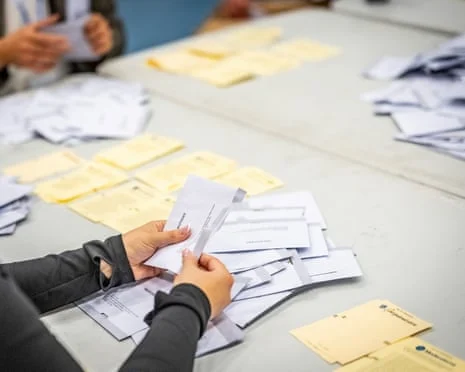
Sweden’s general election has descended into a historic nail-biter, with models from the Swedish public broadcaster SVT and provisional figures from the Swedish Election Authority showing the left-leaning opposition bloc leading the incumbent government by the slimmest possible margin of a single seat. Following a fiercely contested and polarizing campaign dominated by discussions on the economy, crime, and immigration, initial projections and early vote counts point to a parliament split 175 to 174.
With 71% of the total vote now counted, the provisional results highlight an extraordinary national stalemate. The center-left opposition bloc—led by Magdalena Andersson’s Social Democrats, alongside the Centre Party, the Left Party, and the Green Party—holds a razor-thin advantage over the incumbent right-wing government coalition, comprising the Moderates, the Christian Democrats, and the Liberals, backed by the populist, anti-immigration Sweden Democrats (SD).
The stakes of the election stretch far beyond domestic policy. For the past four years, Sweden has been governed by a three-party minority administration under Prime Minister Ulf Kristersson of the Moderates. Crucially, Kristersson’s government has relied on the parliamentary backing of the Sweden Democrats, a party with roots in the country’s neo-Nazi movement. This arrangement broke a longstanding cordon sanitaire in Swedish politics, shifting the national discourse significantly toward tighter border controls and harsher anti-crime measures. Ahead of the vote, the ruling coalition went a step further, indicating that the Sweden Democrats would be offered formal ministerial posts if the right retained power—a prospect that has drawn intense international scrutiny amid a broader European trend of far-right mainstreaming.

A Campaign Defined by Polarization and Economic Squeeze
The road to the 2026 election was marked by heightened rhetoric, unprecedented attacks between political rivals, and tactical voting anxieties. While polls earlier in the electoral cycle consistently favored the center-left opposition—with the Social Democrats polling comfortably in the mid-30s—the gap narrowed drastically in the final weeks of the campaign.
Voters cited healthcare, law and order, immigration, and the cost of living as their primary concerns. However, economists and political commentators noted that the campaign frequently devolved into a financial bidding war, with parties attempting to outbid one another with promises of economic relief. Households across Sweden have faced growth figures trailing far behind national potential, leading to squeezed paychecks and a growing sense of economic unease.
The polarizing nature of the debate was further underscored by the campaigns of the fringe and populist parties. Jimmie Åkesson, leader of the Sweden Democrats, utilized high-profile campaign stops in immigrant-heavy suburbs like Rinkeby to emphasize an anti-immigration message, prompting criticism from opponents who accused the party of stoking division. Meanwhile, Andersson framed the election as a fundamental choice for the soul of the nation, warning against a society steered by extremist forces while simultaneously navigating internal policy disputes within her own diverse bloc.
Chronology of the Election Day Drama
The voting process on Sunday, September 13, 2026, was characterized by high turnout and logistical bottlenecks. Over 3.5 million citizens cast their ballots early in an extended voting window that began on August 26, yet polling stations across major urban centers—including Stockholm and Umeå—experienced unusually long queues, with some citizens waiting up to three hours to cast their votes. The Swedish Election Authority acknowledged the delays, describing them as highly unusual and hinting at future simplifications to the complex multi-ballot voting system.
Polls officially closed at 8:00 PM local time, immediately followed by the release of major exit polls from public broadcaster SVT and private broadcaster TV4. The initial exit polls suggested a comfortable five-percentage-point lead for the opposition, triggering premature celebrations among left-leaning supporters.
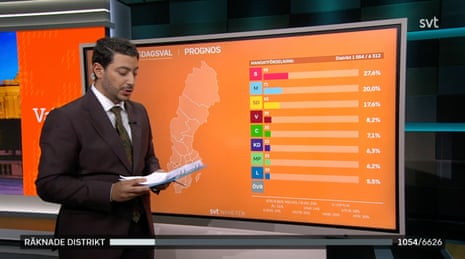
However, as actual district results began flowing in, the landscape shifted dramatically. By 9:45 PM local time, SVT released its revised model incorporating actual returns from 10% of districts. The projection revealed a statistical dead heat, showing the two blocs separated by a mere 0.1 percentage points in vote share (49.3% to 49.2%) and a single parliamentary seat: 175 for the opposition and 174 for the incumbent government.

As the night progressed and vote counting surpassed 70%, the provisional numbers stubbornly held their ground, confirming the historical tightness of the race.
Echoes of Past Stalements and the Road Ahead
The prospect of a one-seat majority brings a sense of historical déjà vu to Swedish politics. In the 1973 general election, the two main political blocs tied at 175 seats each, a legislative stalemate that ultimately forced parliament to reform the Riksdag to an odd number of 349 seats to prevent future deadlocks. That structural change proved vital six years later in 1979, when the center-right bloc secured a victory by the exact same margin of 175 to 174.
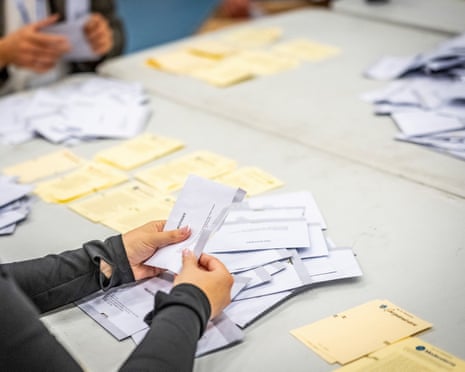
Political analysts have warned that final confirmation of the results may be delayed until Wednesday, as outstanding late ballots—particularly those cast by overseas voters—are processed. These late votes could easily outnumber the current margin of approximately 20,000 votes separating the two blocs.
Should the center-left opposition successfully cross the finish line with a 175-seat majority, Magdalena Andersson is poised to return to the office of prime minister, shifting the Moderates into the role of opposition leader and dealing a severe blow to the Sweden Democrats’ aspirations of entering government.
Conversely, if late counts swing in favor of the incumbent government, Prime Minister Kristersson will likely move forward with unprecedented coalition negotiations to formalize the inclusion of the far right. Regardless of the final outcome, political scientist Nicholas Aylott notes that the profound transformation of Sweden’s political conversation over the past decade ensures that the country’s approach to migration, security, and governance has been permanently altered.