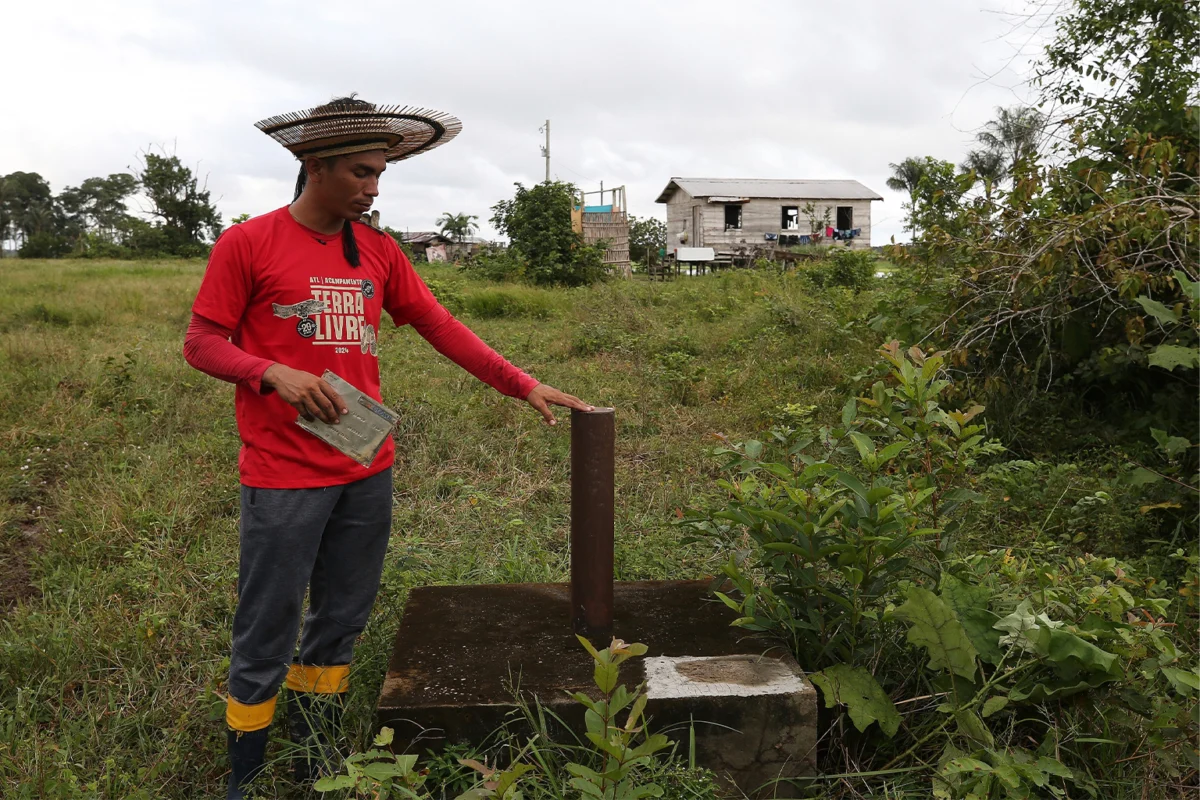
The Autazes municipality in Brazil’s Amazonas state has become the epicenter of a fierce, decade-long struggle between international mining interests and the Mura Indigenous people. Recent reports from community leaders in the Lago do Soares village indicate that the construction of an industrial access road for the Potássio Autazes project has resulted in the desiccation of at least two sacred springs. For the Mura, this environmental degradation is not merely a localized infrastructure issue; it represents an existential threat to their cultural heritage, their primary food sources, and the spiritual equilibrium of their ancestral territory.
The project, managed by Potássio do Brasil—a subsidiary of the Canada-based Brazil Potash Corp.—has long been framed by supporters as a strategic imperative for Brazilian food security. Proponents argue the mine could fulfill nearly 20% of the nation’s domestic potash requirements, effectively insulating the country’s massive agribusiness sector from the volatility of global fertilizer imports. However, the advancement of the project has been marred by legal challenges, allegations of procedural irregularities, and intense friction with local Indigenous populations.

A Chronology of Conflict
The controversy surrounding the Potássio Autazes project spans over ten years, marked by shifting judicial rulings and intense advocacy efforts.
- 2014-2016: Initial exploration and planning phases encounter pushback from the Federal Public Prosecutor’s Office (MPF) over the lack of proper Indigenous consultation.
- 2022: The project gains renewed momentum under a push from federal authorities to secure domestic fertilizer production, citing the need to reduce dependence on foreign suppliers like Russia, which accounted for approximately 45% of Brazil’s potash imports in 2025.
- February 2024: The Federal Regional Court of the 1st Region (TRF1) issues a pivotal ruling allowing state-level environmental licensing to proceed, overturning previous suspensions.
- April 2024: The Amazonas Environmental Protection Institute (IPAAM) grants the formal installation licenses, authorizing the construction of the mine, processing facilities, and a dedicated port.
- May 2024: The MPF files a formal lawsuit challenging the validity of the IPAAM licenses, citing insufficient prior consultation and failure to address the cumulative environmental risks.
- October 2026: Indigenous leaders report the drying of sacred springs following the completion of a 13.7-kilometer access road and subsequent land clearing.
The Spiritual and Ecological Toll
For the Mura people, the physical landscape is inseparable from their cosmological framework. Residents describe the springs as being protected by guardians or "owners." According to traditional knowledge shared by Willian Rodrigues Filgueira, a professor from the Mura Baixo Madeira territory, the disappearance of a spring is interpreted as the departure of these spiritual guardians. When these entities leave, they are said to take the fertility of the soil and the local fauna with them.
Milena Mura, coordinator of the Mura Indigenous Women’s Organization (OMIM), emphasizes that the environmental impact is immediate and practical. The springs are critical for maintaining the hydrological health of the region, specifically for the fish populations that serve as the community’s primary protein source. The filling of these springs with earth for road construction has disrupted the natural flow, leading to a documented decline in fish stocks.

"The water is linked to our food, the animals, and our daily activities," says Chief Filipe of the Lago do Soares village. "When the spring changes, we are not just losing water; we are seeing a part of our relationship with that place being affected. We feel as though we are dying as a people."
Corporate Stance and Regulatory Oversight
Potássio do Brasil has denied the allegations regarding the springs. In an official communication to investigators, the company stated that a technical inspection conducted on October 8, 2026, yielded no evidence of spring desiccation or causal links to the construction of the access road. The firm maintains that it operates in full compliance with the permits granted by IPAAM and has committed to ongoing monitoring and further verification of the site’s hydrological status.
However, the Federal Public Prosecutor’s Office (MPF) paints a different picture. Prosecutors involved in the case have labeled the environmental studies provided during the licensing process as "incomplete and flawed." In a joint response, the MPF highlighted that these studies failed to adequately account for several high-stakes risks, including the potential salinization of groundwater and surface water, the encroachment of personnel into protected territories, and the social ills often associated with rapid industrialization in remote regions, such as increased crime rates.

Furthermore, the MPF and the National Indigenous People Foundation (Funai) have argued that the project violates the International Labour Organization (ILO) Convention 169, which requires free, prior, and informed consent (FPIC) for any development impacting Indigenous lands. The Soares community, which is situated directly within the project’s footprint, asserts they were never engaged in a meaningful or good-faith consultation process.
Broader Implications for the Amazon
The situation in Autazes reflects a broader tension in Brazil between the drive for economic development and the protection of Indigenous rights and biodiversity. As Brazil seeks to expand its agricultural capacity, the demand for raw materials like potash—a key component of NPK fertilizer—has placed immense pressure on the Amazon basin.
The legal complexity of the case is compounded by the fact that the mine overlaps with territories currently undergoing the formal demarcation process. Funai has formally requested a suspension of the project, noting that as these territories are officially recognized, the restrictions on mining and resource extraction will become significantly more stringent. The MPF warns that if the current licensing trajectory continues, it could set a dangerous legal precedent, effectively bypassing federal oversight in favor of state-level approvals that may lack the rigor necessary to protect the constitutional rights of Indigenous peoples.

The potential for groundwater salinization remains a primary scientific concern. Potash mining involves the extraction of potassium salts, and the management of waste tailings is a notoriously delicate process. In an ecosystem as sensitive as the Amazon, where water tables are shallow and interconnected with vast river networks, any leakage or structural failure in tailings management could have irreversible consequences for local biodiversity and the health of the downstream communities.
Conclusion
The conflict at Autazes is far from settled. With legal appeals pending in federal courts and the physical landscape of the region rapidly changing due to industrial clearing, the Mura people find themselves at a critical juncture. For the international community, the case serves as a poignant reminder that resource extraction projects are rarely purely economic endeavors. They are embedded in social and spiritual landscapes that, once disrupted, may never fully recover.
As the company proceeds with its clearing operations and the community continues its resistance, the eyes of human rights observers and environmentalists remain fixed on the Autazes project. The outcome will likely influence how future industrial developments are reconciled with the rights of traditional communities in the Amazon, serving as a litmus test for the effectiveness of Brazil’s environmental and indigenous protection institutions in the face of intense economic pressure. The loss of the sacred springs in Lago do Soares is more than an isolated environmental grievance; it is a signal of the profound, often invisible, costs of modern industrial expansion.