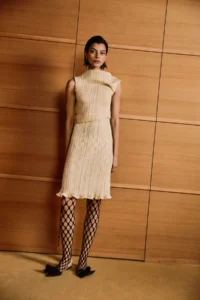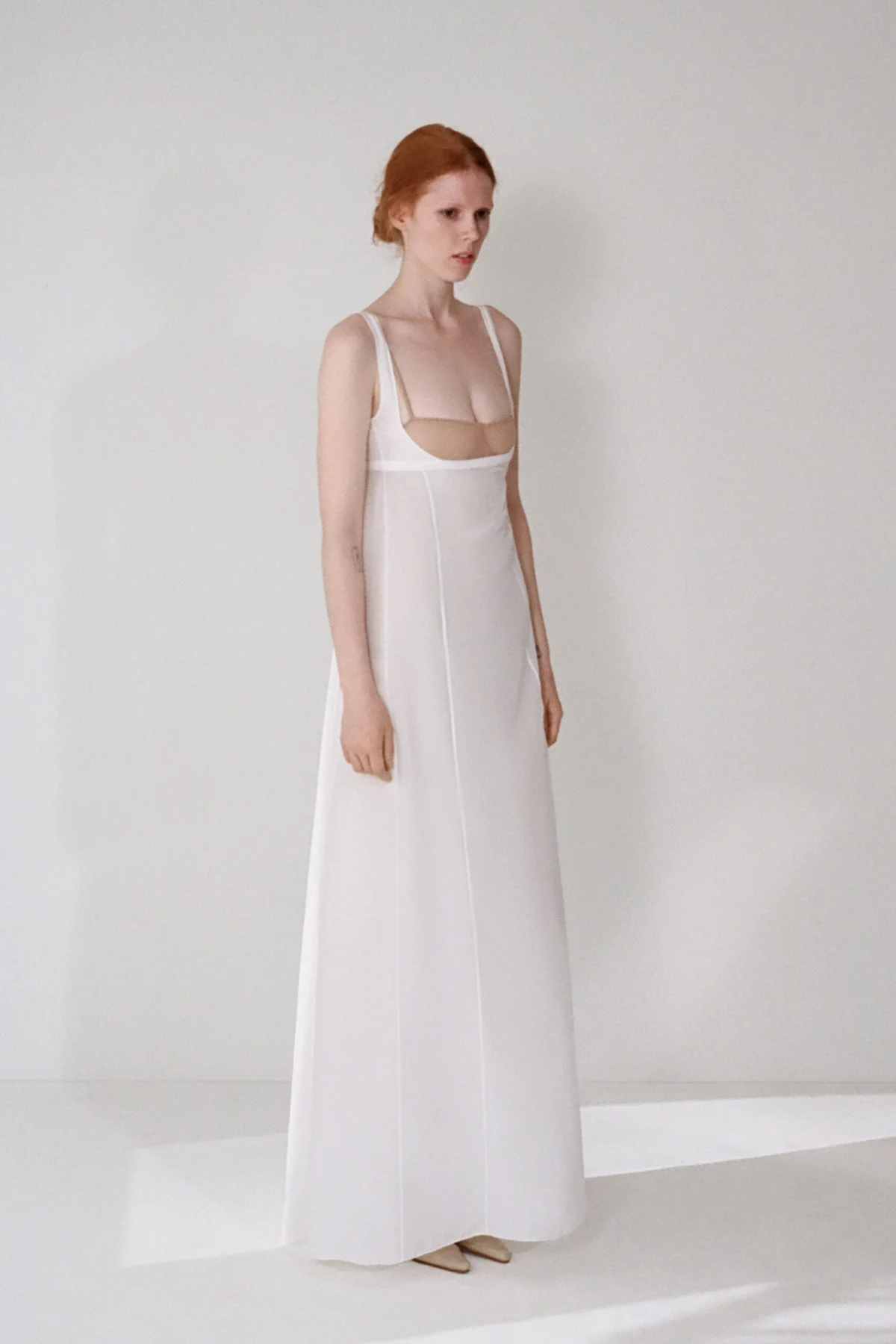
The intersection of spiritual devotion, physical rigor, and contemporary high fashion took center stage as designer Colleen Allen presented her latest collection to the international fashion community. Standing as one of only three women among the ten finalists for the prestigious 2025 LVMH Prize, Allen used her platform in Paris and New York to redefine the boundaries of women’s ready-to-wear. Her collection, which artfully bridges the gap between austere discipline and uninhibited desire, offers a profound exploration of how historical silhouettes and religious iconography can be reinterpreted for the modern wardrobe.
The presentation cycle marked a critical milestone in Allen’s burgeoning career, placing her alongside some of the most promising emerging design talents in the global luxury market. By showcasing her work first to the rigorous LVMH Prize expert panel in Paris and subsequently to buyers and press in a New York showroom, Allen cemented her reputation as a designer capable of intellectual depth paired with immaculate technical execution.
Main Facts and Conceptual Foundation of the Collection
At the heart of Allen’s collection is an unconventional muse: the fashion nun. However, this figure is far removed from cliché tropes of perpetual black garments or monastic isolation. Instead, Allen’s collection is an exercise in reconciliation, examining how the human body can serve as a vessel for both profound spiritual belief and vibrant sensuality.
The designer’s research and development process was rooted in a diverse array of visual references. Her mood board featured archival photographs of historical nuns alongside Regency-era fashions reminiscent of Jane Austen’s literary heroines. Alongside these historical markers were striking images of modern dance pioneers Martha Graham and Pina Bausch.
"I was thinking about dance as this sort of access to an ecstatic spiritual religious state," Allen explained during her presentation. This conceptual framework allowed the designer to draw a direct line between the rigorous discipline required by classical and modern dance and the exacting precision demanded by high-level patternmaking.
This technical mastery was immediately evident in the construction of the garments. A standout piece from the collection—a cropped, historically inspired tailored jacket—featured a sparrow-like precision across the back that was achieved entirely through a single seam. Similarly, Allen utilized sophisticated C-shaped cuts to create lavish, languorous drapes, allowing the cloth to pull diagonally across the body with a calculated, tantalizing tension.
Chronology and Presentation Timeline
The journey to the LVMH Prize finals represents a grueling, highly competitive multi-stage process designed to unearth the industry’s most transformative creative leaders.
The evaluation timeline typically begins with hundreds of global applicants vetted by a committee of international fashion experts, editors, and buyers. By spring, the field is narrowed down to twenty semifinalists, who then present their work during Paris Fashion Week. Following this rigorous vetting phase, the panel selects the ultimate finalists.
Colleen Allen’s presentation schedule for this phase required split-continent agility. First, she presented her complete collection to the LVMH Prize jury in Paris, enduring the scrutiny of industry titans such as Jonathan Anderson, Maria Grazia Chiuri, and Nicolas Ghesquière, alongside other luminaries and executives from the LVMH conglomerate. Immediately following the Parisian evaluation, Allen transported the collection across the Atlantic to mount a dedicated showroom presentation in New York City, catering to American media, private clients, and retail buyers. This dual-city rollout not only tested the operational capacity of her independent label but also maximized her international exposure during a critical commercial window.
Deconstructing the Silhouettes: Beyond Balletcore
In an era dominated by viral digital aesthetics—most notably the ubiquitous "balletcore" trend popularized on platforms like TikTok—Allen’s work deliberately diverges from internet-driven superficiality. While the influence of dance is undeniably present, her interpretation is structural and philosophical rather than literal.
"I love the idea of looking at the proportions of the way that dancers dress," Allen noted. This fascination prompted the designer to pivot away from traditional waist-centric silhouettes, choosing instead to focus on an elongated, vertical human form.
This verticality was heavily influenced by Regency-era Empire-waisted styles, which inherently carry a historical resonance. However, Allen modernized these historical references through inventive layering and proportion play. One of the collection’s most successful iterations was an exaggeratedly short Spencer jacket paired with a sleek strapless gown. By engineering deliberate slits of skin between the hem of the jacket and the top of the dress—as well as through the sharp cut of the lapels—Allen created an abstract visual resembling a clerical collar, seamlessly merging the sacred with the contemporary.
Allen’s structural experimentation extended to how she blocked out the human body. By dividing silhouettes into distinct horizontal thirds—such as pairing a rich persimmon capelet over a foundational black top and a crisp white skirt—she created an architectural rhythm across the garments. Perhaps the most striking example of this methodology was the pairing of a cropped Spencer jacket and low-waisted trousers worn over a sheer body stocking. Developed in a strategic collaboration with Swedish Stockings, this specialized undergarment served to maximize a long, lean, and uninterrupted visual line.
The Muses of History and Myth
The narrative thread of the collection deepened through evocative textures and historical allusions. Moody, hooded ensembles introduced a distinct medieval atmosphere, heightened by an all-over coin-embroidered dress that caught the light with every movement. A lighter counterpart—a sleek black slip dress adorned with orange coin-covered fabric patches over a single breast and shoulder—produced a subtle, musical chime when in motion.
These auditory and visual elements served as a direct invocation of Joan of Arc, a historical figure whose themes of martyrdom, strength, and ultimate sacrifice continue to exert a powerful pull over fashion and broader pop culture. Joan of Arc, alongside Martha Graham and Pina Bausch, form the definitive triad of Allen muses: women defined by extraordinary strength of both mind and physical fortitude.
Background Context of the LVMH Prize
Established in 2013 by the LVMH group, the LVMH Prize for Young Fashion Designers has grown to become one of the most lucrative and influential accolades in the global fashion industry. Offering a grand prize of €400,000 alongside a year-long mentorship program overseen by veterans of the luxury conglomerate, the prize aims to support and nurture the next generation of creative directors and independent brand owners.
In recent years, the competition has placed an increasing emphasis on technical innovation, sustainability, and unique brand identity over sheer commercial output. Being named one of the top ten finalists places a designer in an elite echelon, significantly boosting their visibility with international stockists, venture investors, and fashion editors. For independent designers operating outside the financial safety net of major luxury houses, the validation of the LVMH Prize jury can radically alter the trajectory of their business.
Broader Industry Impact and Commercial Implications
Colleen Allen’s inclusion in the final cohort of the LVMH Prize—and the critical acclaim garnered by her latest collection—signals a broader shift in contemporary fashion toward intellectual rigor and narrative-driven design. As consumer fatigue grows regarding fast-fashion micro-trends and algorithmically generated aesthetics, collections that demand deeper contemplation and showcase superior craftsmanship are finding an increasingly receptive audience.
The commercial implications of Allen’s work point toward a strengthening market for elevated, tailored sportswear that prioritizes comfort without sacrificing architectural integrity. Her collaborations with specialized manufacturers, such as her work with Swedish Stockings for the sheer body stocking, demonstrate a modern approach to collection-building that leverages technical partnerships to achieve seamless functional and aesthetic goals.
Furthermore, Allen’s ability to successfully balance historical references—from Regency-era tailoring to medieval armor and monastic vestments—with modern feminist archetypes positions her label as a cerebral alternative in the contemporary luxury landscape. As the luxury market continues to reward brands that offer a distinct point of view and uncompromising quality, Colleen Allen’s artistic and commercial trajectory suggests that the union of discipline, history, and modern sensuality will remain a potent force in high fashion for years to come.