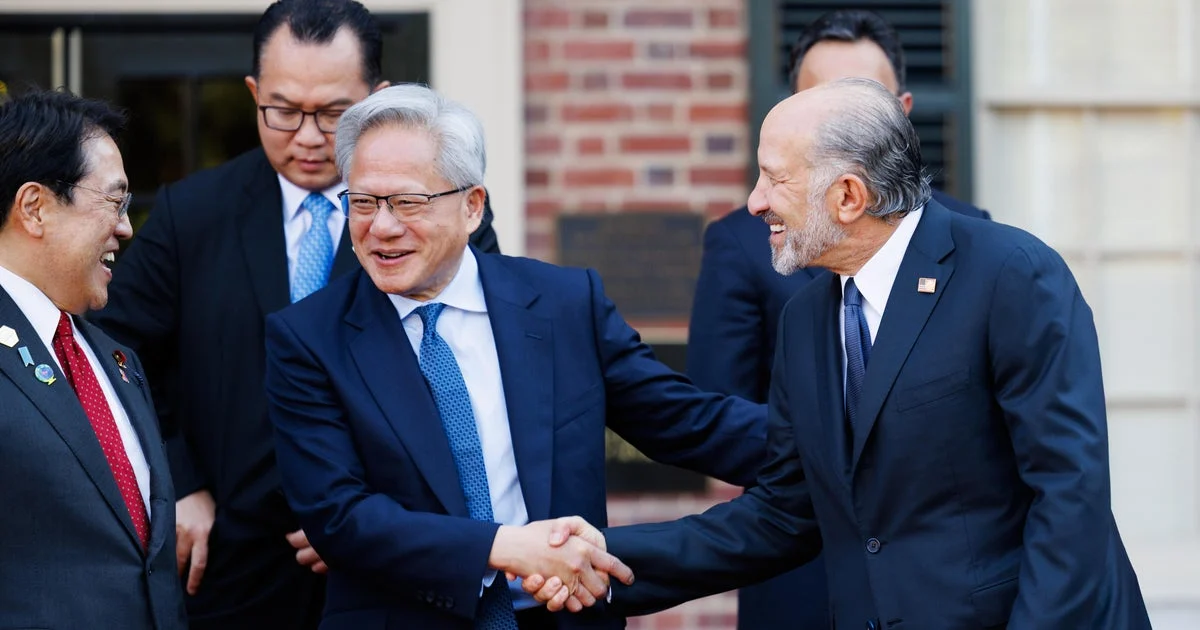
Commerce Secretary Howard Lutnick is facing an escalating political and regulatory firestorm as lawmakers, administration officials, and ethics experts question his department’s oversight of billions of dollars in advanced artificial intelligence chip sales to China. The controversy centers on allegations that Lutnick’s historical financial entanglements in Chinese markets, combined with a close personal relationship with ousted Nvidia CEO Jensen Huang, created a severe conflict of interest that compromised U.S. export enforcement protocols.
The scrutiny intensifies following the sudden resignation of Jensen Huang from the world’s dominant AI chipmaker amid a cascading corporate scandal. Reports revealed that Huang was engaged in multiple affairs, including a relationship with Alice Huang—no relation—who is identified by U.S. intelligence as a suspected Chinese intelligence asset. Alice Huang directed Megaspeed International, a Singapore-based enterprise that rapidly transformed into one of Nvidia’s premier buyers. U.S. authorities suspect Megaspeed acted as a crucial conduit, systematically funneling cutting-edge Nvidia processors to Chinese entities in direct violation of federal technology embargoes.
As the head of the Department of Commerce, Lutnick oversees the Bureau of Industry and Security (BIS), the agency legally mandated to police cross-border technology transfers and prevent strategic assets from falling into the hands of geopolitical adversaries. Critics argue that despite mounting intelligence pointing to illicit diversion networks, the Commerce Department maintained a posture of passive oversight, failing to leverage key enforcement tools to halt the flow of sensitive hardware.
A Legacy of Financial Entanglements in China
Before stepping into public service following President Donald Trump’s inauguration in February 2025, Lutnick spent decades as a prominent Wall Street titan, most notably serving as the chairman and chief executive officer of Cantor Fitzgerald, a major New York-based investment bank. During his tenure, Cantor Fitzgerald amassed approximately $1.2 billion in Nvidia stock holdings. Furthermore, Lutnick’s broader financial ecosystem included significant investments and operational joint ventures within mainland China.
Financial disclosures and corporate records indicate that BGC Group, another financial services firm previously managed by Lutnick, maintained a 33-percent equity stake in a joint venture alongside China Credit Trust. The latter is a prominent state-owned enterprise whose principal shareholder is the People’s Insurance Company of China, another massive state-backed entity. Meanwhile, Cantor Fitzgerald—currently overseen by Lutnick’s two eldest sons—actively facilitated initial public offerings for multiple Chinese corporations seeking listings on U.S. exchanges. Cantor Fitzgerald also maintained a notable investment in Satellogic, a satellite imaging company bound by active contractual agreements with Zhong Ke Guang Qi Space, a Chinese data science enterprise, through the year 2033.
These deep-seated connections were a focal point during Lutnick’s Senate confirmation hearings in late 2024 and early 2025. Lawmakers from both sides of the aisle pressed the nominee on whether his extensive commercial history in Asia would impair his ability to maintain an objective posture regarding national security and technology protection.
During the hearings, Sen. Maria Cantwell of Washington questioned Lutnick extensively regarding potential conflicts of interest tied to Chinese investments and Cantor Fitzgerald’s financial exposure to Tether, a major cryptocurrency issuer with a vast operational footprint in China. Similarly, Sen. Deb Fischer of Nebraska pressed Lutnick on how he intended to counteract escalating threats from the Chinese Communist Party within critical technology markets.
In response, Lutnick offered robust assurances, stating flatly, "I take a very jaundiced view of China. I think they only care about themselves and seek harm to us, and so we need to protect ourselves." Upon assuming office, Lutnick formally resigned from his corporate leadership positions and transferred management of his business holdings to his children to comply with ethics requirements. However, his financial fortunes have continued to grow; reports from financial publications indicate that his family’s net worth doubled to approximately $7.3 billion, largely propelled by an indirect, surging stake in Tether valued in the billions.
The Megaspeed Investigation and Export Control Lapses
At the heart of the current political crisis is the handling of the federal investigation into Megaspeed International. In 2024, under the Biden administration, the Commerce Department’s BIS initiated a formal probe into Nvidia’s supply chain to determine whether advanced processors shipped to Megaspeed were being transshipped to restricted Chinese entities.
However, according to reports by The New York Times, the investigation was abruptly transferred to the Department of Justice, which has declined to comment on the matter. More critically, critics point out that the Commerce Department has entirely refrained from adding any new foreign enterprises to its restrictive Entity List since October 2025. Inclusion on the Entity List restricts target organizations from accessing U.S.-origin technology based on substantiated risks to national security or foreign policy.
The policy inertia within the Commerce Department drew sharp rebukes from within the administration itself. Treasury Secretary Scott Bessent reportedly confronted Lutnick directly regarding the agency’s refusal to designate Megaspeed on the Entity List, a failure that allowed high-performance computing components to continually reach Chinese end-users.
China and emerging technology experts have added authoritative condemnation to the mounting criticism. Chris McGuire, an expert at the Council on Foreign Relations, characterized the situation as a systemic failure of governance. "The real scandal here is the lack of enforcement of export controls," McGuire stated, noting that federal agencies had possessed intelligence for roughly a year indicating that Megaspeed was operated by an individual suspected of espionage on behalf of Beijing, yet the Commerce Department took no administrative countermeasures. "Either Lutnick doesn’t know how to do his job or he is protecting Huang," McGuire asserted.
The intelligence dimensions were further underscored by reports that President Trump was personally briefed roughly a year prior regarding intelligence assessments identifying Alice Huang as a Chinese intelligence asset who had cultivated a close personal and professional rapport with Jensen Huang.
Political Fallout and Congressional Inquiries
The convergence of corporate malfeasance, executive resignations, and alleged regulatory capture has triggered aggressive legislative oversight. Following the public disclosure of Jensen Huang’s resignation, Sen. Elizabeth Warren, the ranking Democrat on the Senate Banking Committee, directed a formal inquiry to Lutnick and his deputy, Jeffrey Kessler—the undersecretary who directly supervised the Megaspeed inquiry—demanding comprehensive explanations for the persistent loopholes in U.S. export controls.
"Act today to ensure our advanced technology is not fueling China’s military," Warren urged in communications directed at the Commerce leadership. These demands echo earlier legislative actions, including a March letter in which Warren called for an immediate, total moratorium on all export licenses authorizing shipments of Nvidia chips to the Chinese market.
Legal and government ethics scholars have similarly highlighted the structural vulnerabilities introduced by Lutnick’s personal association with the ousted tech executive. Kathleen Clark, a professor of law and government ethics at Washington University in St. Louis, noted that the informal and exceptionally warm dynamic between the cabinet secretary and the regulated corporate leader represents a significant departure from standard arm’s-length regulatory conduct.
In an interview on a widely distributed podcast last year, Jensen Huang recounted how Lutnick initiated their professional relationship shortly after the commerce secretary took office. According to Huang, Lutnick greeted him by declaring, "Jensen, this is Secretary Lutnick. I just want to let you know that you’re a national treasure. Nvidia is a national treasure. And whenever you need access to the president, the administration, you call us." Huang added that whenever he required direct communication with the commerce secretary’s office to air grievances or discuss industry concerns, executive staff were immediately accessible.
This privileged access reportedly translated into tangible policy shifts. In April 2025, Jensen Huang attended an exclusive, high-profile donor dinner at Mar-a-Lago, where he directly lobbied President Trump to ease export restrictions on Nvidia’s less advanced H20 chips destined for China. Less than three months later, in July 2025, the administration lifted those specific limitations, though strict bans on Nvidia’s flagship Blackwell architecture remained intact.
The culmination of this relationship was prominently displayed in July 2025, when Lutnick published an image on social media depicting Jensen Huang—wearing his signature black leather jacket—standing in the Oval Office alongside President Trump, with Lutnick positioned nearby. The accompanying caption celebrated the milestone of Nvidia surpassing a $4 trillion market valuation.
Implications for U.S. Technology Policy and National Security
The mounting controversy surrounding Secretary Lutnick and the enforcement of export controls highlights the profound systemic challenges at the intersection of American industrial policy, national security, and global corporate influence. As artificial intelligence continues to serve as a foundational pillar of geopolitical and military competition, the integrity of federal oversight mechanisms remains paramount.
With congressional committees preparing hearings to investigate the handling of the Megaspeed probe, and with bipartisan demands for rigorous reviews of technology transfer policies, the Department of Commerce faces mounting pressure to restore public and institutional confidence. Whether through tightened administrative enforcement, expanded utilization of the Entity List, or stricter ethical firewalls between regulators and industry leaders, the resolution of this crisis will likely redefine the framework governing U.S. technological primacy for years to come.