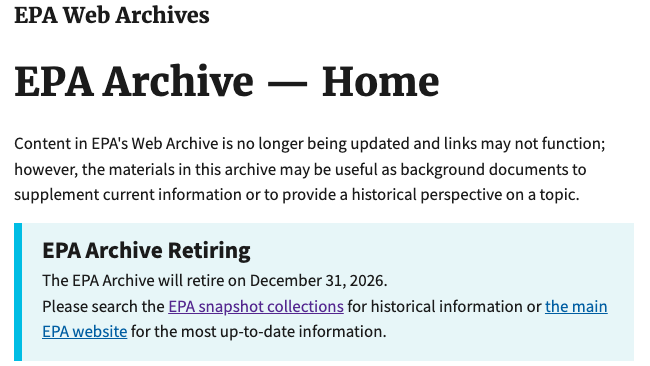
The United States Environmental Protection Agency (EPA) has quietly confirmed plans to permanently shutter its online web archive by December 31, 2026. This administrative decision, revealed via a subtle banner update on the agency’s digital repository, will effectively erase tens of thousands of publicly accessible environmental reports, policy guidelines, and historical regulatory records spanning at least two decades. The move arrives during a period of sweeping regulatory rollbacks led by EPA Administrator Lee Zeldin, whose tenure has already been marked by the systematic dismantling of major federal climate frameworks, including power plant emissions limits and methane monitoring programs.
While the agency’s top leadership has maintained an aggressive public posture regarding active policy changes, the decision to dismantle the online repository has largely bypassed public debate. Information scientists, environmental historians, and open-government advocates warn that deleting the archive will inflict permanent damage on democratic transparency, stripping researchers, lawmakers, and communities of critical tools required for environmental oversight and historical accountability.
An Irreplaceable Digital Repository for Public Oversight
Operating for more than twenty years, the EPA’s online web archive has served as an essential clearinghouse for environmental governance data. The repository preserves documents that trace the evolution of federal environmental policy, including agency fact sheets, technical reports, enforcement records, and major regulatory amendments.
Gretchen Gehrke, co-founder of the Environmental Data and Governance Initiative (EDGI), emphasized the irreversible nature of the planned closure. For a decade, Gehrke has monitored federal data preservation practices and tracked federal website modifications. She noted that the online archive makes historical policies and technical findings accessible in a manner that cannot be easily replicated once the servers are taken offline.
The loss of this platform threatens to blindside independent researchers and journalists who rely on continuous, direct access to past agency data to evaluate current environmental policies. Without the archive, tracing the lineage of federal standards—from water quality criteria to hazardous waste management protocols—becomes exponentially more difficult, shifting the burden of record-keeping onto already strained public information channels.
A Repeated Threat: The Chronology of the Archive’s Demise
The impending closure of the EPA digital repository is the culmination of a multi-year effort by federal officials to reduce data management expenditures and alter the scope of public-facing federal disclosures.
The controversy surrounding the archive first surfaced in January 2022, during the Biden administration, when the EPA initially announced plans to discontinue the digital repository. At the time, agency officials cited high maintenance costs as the primary justification, with Freedom of Information Act (FOIA) disclosures later revealing that the platform cost approximately $2 million annually to maintain.
The initial announcement triggered immediate pushback from a broad coalition of historians, librarians, and environmental groups. Organizations such as EDGI and the American Society for Environmental History formally condemned the plan, warning that shuttering the archive would create a massive blind spot in the national historical record.
Facing intense public scrutiny and pressure from Capitol Hill, the EPA relented in mid-2022, postponing the retirement date to July 2023. By March 2023, the agency adjusted its messaging once more, removing the definitive expiration date and replacing it with a vague notice that the archive was simply "retiring."
For the next three and a half years, the repository remained operational in a static state—retaining past documents without receiving new updates. That status quo shifted abruptly weeks ago when the agency updated the site banner to reflect a hard stop date of December 31, 2026.
Preserving Critical Environmental History and Landmark Regulations
Despite occasional technical hurdles, including broken hyperlinks and limited search functionalities, the EPA web archive has preserved vital touchstones of American environmental history.
Major regulatory shifts over the past twenty-five years are permanently documented within its pages. The repository houses extensive records from the George W. Bush administration’s 2003 Clear Skies Initiative, as well as documentation surrounding the Obama administration’s 2015 Clean Power Plan, which sought to curb carbon emissions from existing power plants.
Furthermore, the archive proved indispensable during the first Trump administration, when numerous climate change webpages and scientific data portals were removed from active EPA domains. During that period, the web archive functioned as a vital bridge, preserving defunct pages and ensuring that public access to foundational climate science remained intact.
The repository has also played a crucial role in localized environmental justice and public health investigations. For example, records concerning the contamination of Marine Corps Base Camp Lejeune and the Marine Corps Air Station in North Carolina—designated as Superfund sites by the EPA in 1989 following widespread chemical pollution of soil and groundwater—were meticulously preserved through the agency’s archiving systems. These historical documents allowed exposed service members, families, and independent researchers to verify findings regarding toxic water exposures and evaluate federal cleanup efforts over decades. This historical visibility remains critical, particularly as ongoing political debates center on compensation packages and accountability for victims of military base contamination.
Broader Implications for Government Transparency and Public Trust
The decision to decommission the web repository aligns with broader federal trends under the second Trump administration, which has seen a series of concerted efforts to purge, alter, or restrict public access to federal datasets across multiple agencies.
Critics argue that dismantling the archive directly exacerbates the steady erosion of public trust in government institutions, which currently hovers near historic lows according to recent polling data from the Pew Research Center.
Lauren Harper, the inaugural Daniel Ellsberg chair on government secrecy for the Freedom of the Press Foundation, stressed that eliminating easy digital access to public records forces civil society to rely on alternative, less efficient mechanisms to secure government accountability. Harper noted that shuttering the platform will inevitably flood already overburdened FOIA offices with requests for documents that were previously available with a simple internet search, effectively bottlenecking the dissemination of public information.
Official Guidance and the Limits of "Snapshot Collections"
In its updated webpage notices, the EPA has directed users seeking historical data toward its official "snapshot collections," suggesting that these periodic static backups will adequately replace the dynamic web archive.
However, independent data watchdogs remain skeptical. Given recent budget reductions, workforce reorganizations, and shifting federal priorities under Administrator Zeldin, researchers question whether these snapshot collections will capture the full scope of historical data previously housed in the comprehensive repository.
Gehrke and other data advocates argue that the agency should instead modernize, expand, and systematize its digital archiving practices rather than discard decades of public records in favor of limited, piecemeal snapshots.
As the December 31 deadline approaches, independent organizations and university libraries are scrambling to harvest and mirror as much EPA data as possible to prevent its permanent disappearance from the public domain. The EPA declined to comment on inquiries regarding the specific data preservation protocols being used to ensure that unique historical records are not lost forever when the servers are finally disconnected.