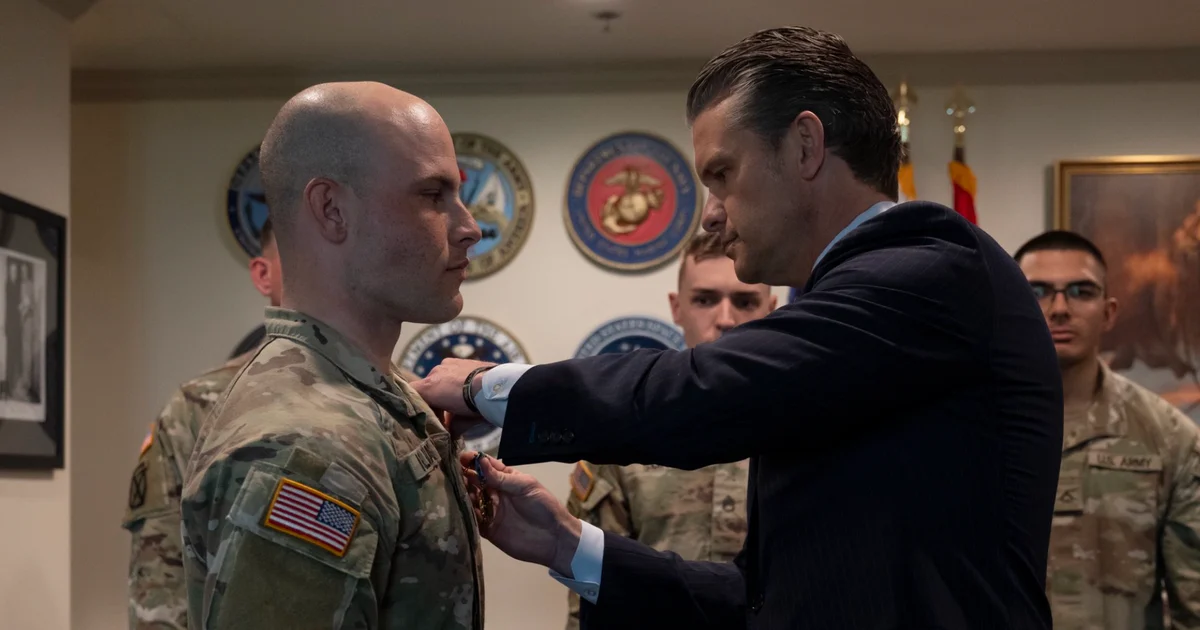
WASHINGTON — In a public display of contrition and respect for military tradition, Defense Secretary Pete Hegseth presented a military decoration on Thursday to the sentry who sharply corrected his delegation for making noise near the Tomb of the Unknown Soldier at Arlington National Cemetery.
The service member, Spc. Thomas Iglesias of the elite 3rd U.S. Infantry Regiment, known as "The Old Guard," was awarded the Joint Service Commendation Medal during a formal ceremony at the Pentagon. The gesture followed a widely circulated incident on Veterans Day, November 11, 2026, when Iglesias publicly reprimanded members of Hegseth’s inner circle for failing to observe the solemn decorum mandated at the sacred national monument.
The encounter, captured on video and broadcast across national news outlets, underscored the strict adherence to protocol required of the sentries who watch over the resting place of America’s unidentified war dead 24 hours a day, 365 days a year, regardless of weather conditions or the prominence of visitors.
Chronology of the Veterans Day Incident
The sequence of events began on the morning of November 11, 2026, as the nation observed Veterans Day. A high-level government delegation, including President Trump, Defense Secretary Hegseth, and various administration officials, attended a commemorative wreath-laying ceremony at Arlington National Cemetery.
Following the official program, Hegseth, accompanied by his wife, his chief of staff, and several senior aides, lingered near the plaza surrounding the Tomb of the Unknown Soldier for photographs. As the group posed, laughter and elevated voices broke the required silence of the hallowed grounds.
Spc. Iglesias, who was executing his precisely choreographed walking watch to protect the tomb, immediately stepped forward to address the breach in etiquette. In a firm, authoritative voice that echoed across the plaza, Iglesias called out: "All visitors will maintain an atmosphere of silence and respect at all times."
The intervention brought an immediate halt to the chatter. Rather than using his executive authority to challenge the reprimand or deflect criticism, Hegseth and his staff complied with the sentinel’s directive, recognizing the absolute authority of the guard to enforce the rules of the plaza.
The Pentagon Response and Medal Presentation
By the following day, the video of the incident had gained traction online, prompting discussions regarding civilian leadership, military decorum, and the reverence due to America’s fallen soldiers. Rather than attempting to downplay the incident, the Department of Defense embraced it as a testament to the unyielding standards of the United States Armed Forces.
Pentagon spokesman Sean Parnell issued an official statement on behalf of the agency following the event. "The Secretary and the entire Department have always honored—and will always honor—the sacrifices our military men and women have made to keep America safe," Parnell told CBS News. "While commemorating this solemn day, a soldier correctly and respectfully reminded everyone to maintain decorum."
On Thursday, Hegseth invited Spc. Iglesias and other members of the Old Guard’s ceremonial unit to the Pentagon. In photographs posted to social media by the Defense Secretary, Hegseth is seen pinning the Joint Service Commendation Medal to Iglesias’ service uniform, flanked by fellow sentries.
"We love soldiers. We love standards. Well done, Specialist," Hegseth wrote in a post on the platform X. "Carry on Patriots."
A Pentagon official elaborated on the meeting, noting that Hegseth welcomed the regiment to the headquarters to formally recognize Iglesias for the exemplary execution of his duties during a high-pressure national event.
The Sacred Duty of the Old Guard
The Tomb of the Unknown Soldier is one of the most hallowed sites in the United States, serving as the symbolic grave for unidentified American service members from World War I, World War II, and the Korean War. Guarding the monument is considered one of the highest and most rigorous honors in the U.S. Army.
The sentries, drawn exclusively from the 1st Battalion of the 3rd U.S. Infantry Regiment, undergo grueling training regimes that test their physical endurance, mental toughness, and precise knowledge of military history and cemetery regulations. The guards maintain a constant, unbroken vigil over the tomb, pacing a black mat measuring exactly 21 steps before pausing for 21 seconds—a symbolic reference to the 21-gun salute, the highest military honor.
Enforcing the rules of the plaza is a routine, albeit serious, part of a sentinel’s daily responsibilities. According to historical and operational data from the U.S. Army, sentries frequently find themselves having to address unruly crowds, tourists speaking too loudly, or individuals attempting to cross security barriers. Army interviews with former and current Tomb guards indicate that sentries are forced to issue verbal warnings to visitors multiple times per day.
These warnings are typically delivered in a loud, commanding tone designed to re-establish the somber atmosphere without breaking the rigid discipline of the watch. While most tourists who receive a reprimand are ordinary citizens or foreign visitors unfamiliar with American military traditions, incidents involving high-ranking political figures or government officials are exceptionally rare.
Broader Implications and Public Reception
The public reaction to the incident and Hegseth’s subsequent honoring of Spc. Iglesias has been largely favorable across political and military spectrums. Veterans’ advocacy groups, active-duty service members, and political commentators praised the Defense Secretary for accepting the correction gracefully and highlighting the apolitical, unwavering nature of military standards.
Military analysts note that the episode serves as an important reminder of the boundary between civilian political leadership and military tradition. In a democratic society, the military answers to civilian leadership, yet within specific ceremonial and tactical domains—such as the defense of the Tomb of the Unknown Soldier—military regulations and traditions reign supreme. By publicly rewarding the soldier who corrected him, Hegseth reinforced the principle that military protocols apply to all individuals equally, regardless of their rank in the civilian government.
Furthermore, the recognition brought renewed public attention to the grueling daily realities faced by the Old Guard. For decades, the sentries have operated largely behind the scenes of official state ceremonies, performing their duties through rain, snow, hurricanes, and sweltering summer heat.
As the Department of Defense moves forward from the Veterans Day events of 2026, the image of a cabinet secretary being corrected by an enlisted specialist—and subsequently rewarding him for doing his job—stands as a unique moment in modern military-civilian relations. It highlights an institutional culture that values discipline, accountability, and the preservation of national reverence above personal rank or political convenience.