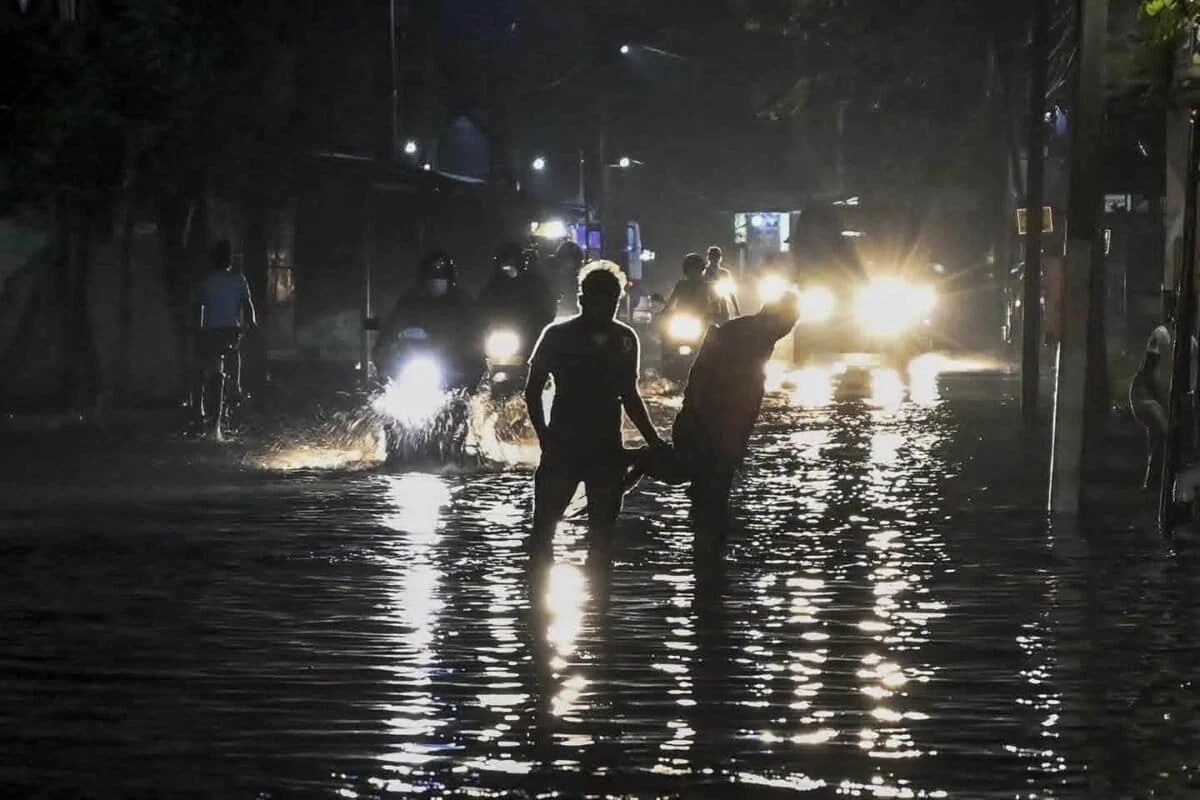
On November 6, the commercial capital of Colombo faced a staggering climatic event when 129 millimeters (5.1 inches) of rain descended upon the city in a matter of minutes. This intense meteorological burst overwhelmed the metropolitan infrastructure, paralyzing transit, submerging vehicles, and leaving residents in a state of alarm. While Colombo is no stranger to monsoon-driven precipitation, the velocity of this particular event—clocking in at over 120 millimeters per hour in some districts and peaking at 135 millimeters in others—has ignited a critical national debate regarding urban planning, the preservation of natural flood-mitigation zones, and the urgent need for climate-resilient infrastructure.
A Chronology of Climate Stress
The November 6 deluge serves as a grim reminder of the city’s susceptibility to flash flooding. Although the Department of Meteorology has documented historical events where rainfall exceeded 400 millimeters within a 24-hour cycle—such as the 493.7 millimeters recorded in June 1992 and the 440.2 millimeters in November 2010—the recent event was defined by its extreme intensity rather than total volume.
According to Ajith Wijemanna, director of the Department of Meteorology, the "gushing" nature of the rainfall caught the city off guard. "The main cause of flooding was the high intensity during a short period of time, such as an hour," Wijemanna noted. The city’s inability to process such a high volume of water in such a compressed timeframe highlights a significant gap in current disaster preparedness. Officials acknowledge that the absence of advanced technology, specifically a Doppler radar system, has hampered the agency’s ability to provide high-resolution, short-lead-time forecasts. Without this capability, the city remains reactive to atmospheric volatility rather than proactive.

The Failure of Century-Old Infrastructure
The flooding also underscored the obsolescence of Colombo’s drainage architecture. Deepika Wijethilake, deputy director of engineering for drainage design at the Colombo Municipal Council (CMC), explained that the city’s storm water and sewer networks are effectively a century old. These systems were engineered for a bygone era of lower population density and different climate patterns.
"The current storm water system is designed to handle approximately 30 millimeters of rainfall per hour," Wijethilake stated. "When you receive over 100 millimeters in that same window, the system is fundamentally incapable of keeping pace."
This structural limitation is exacerbated by the modern trend of urban densification. The replacement of absorbent soil and vegetation with concrete pavements and high-rise foundations has drastically reduced the ground’s natural permeability. Consequently, the city is left with no choice but to rely on its artificial drainage, which is currently obstructed by debris, silt, and a lack of systematic maintenance. In response to the crisis, the government has identified 60 high-priority locations where blockages are most severe, with specialized crews currently working to clear canals and waterways to restore flow.
The Intersection of Real Estate and Ecology
Beyond the failure of concrete systems, the rapid degradation of Colombo’s wetlands has emerged as a primary concern. Wetlands act as the city’s "natural kidneys," absorbing, holding, and slowly releasing floodwaters while simultaneously recharging groundwater tables.

A 2025 study by the Centre for a Smart Future (CSF) sheds light on the economic paradox of Colombo’s development. The study, titled "Shifting Grounds," highlights how developers have exploited the aesthetic appeal of wetlands in suburbs like Kaduwela, Malabe, and Thalawathugoda. By branding these areas as "green living" enclaves, developers have seen property values spike by 30-40% annually. However, this development often comes at the cost of the very ecosystem services—such as flood control—that make these areas habitable.
"Developers are leveraging the wetland to create demand and price premia, but they are failing to ensure their projects are nature-positive," says Anushka Wijesinha, co-founder of the CSF. He argues that the economic valuation of wetlands is currently missing from the ledger of urban planners. "Over 45% of the country’s GDP is generated by the Western Province. When the city floods, it is not just a localized inconvenience; it is a systemic risk to the national economy, logistics, and international supply chains."
The Economic Value of Natural Infrastructure
The environmental significance of these areas cannot be overstated. Chethika Gunasiri, an environmental scientist specializing in urban sustainability, points out that the Colombo Wetland Complex (CWC) is responsible for retaining approximately 37% of the city’s rainwater. Yet, this capacity is being compromised by the invasion of non-native, terrestrial-shifting vegetation like the pond apple (Annona glabra), which gradually converts wetlands into dry land, further reducing their water-absorption potential.
"Colonial cities like Colombo were founded in flood plains for a reason," Gunasiri explains. "We have spent decades trying to fight against the natural behavior of these landscapes rather than working with them. If we continue to fill these wetlands, we will eventually face costs that exceed our capacity to pay."

Historical data supports this, with the 2003 Muthurajawela wetland study serving as a benchmark for the economic value of ecosystem services. Without the natural flood control provided by such wetlands, the government would be forced to invest billions in artificial, energy-intensive flood-mitigation projects.
Towards a Resilient Future
The path forward requires a fundamental shift in how the city finances and manages its resilience. Experts are now calling for a "blended finance mechanism"—an adaptation and resilience fund that combines government allocations, bilateral grants, and contributions from private developers who profit from wetland-adjacent land.
Such a fund could prioritize the transition from "grey" to "green" infrastructure, similar to the strategies employed in cities like Copenhagen. This would involve the implementation of "rain gardens," bioswales along roadways, and the conversion of public spaces into temporary detention basins. These nature-based solutions allow for the management of high-intensity rainfall without placing total reliance on the aging, century-old subterranean pipes.
The Colombo Municipal Council has signaled a willingness to adapt, with plans currently being drafted for new drainage systems capable of handling 100 millimeters of rainfall per hour—a significant upgrade from the current 30-millimeter threshold. However, engineers caution that even the best systems will fail if the city continues to ignore the essential role of its wetlands.

Conclusion: A City at the Crossroads
The events of November 6 represent more than just a seasonal weather anomaly; they are a structural warning. The intersection of rapid, poorly regulated real estate development and the lack of investment in climate-resilient infrastructure has created a "perfect storm" scenario for Colombo.
As the city continues to grow, the pressure to maintain its status as a commercial hub will only increase. If the government fails to reconcile its urban expansion with the preservation of the surrounding ecosystem, the economic cost of future flooding could become a permanent drag on national progress. Ensuring that the city’s "green" areas are protected, restored, and integrated into a modern, data-driven disaster management framework is no longer an environmental ideal—it is a prerequisite for the economic survival of the capital.
For the residents of Colombo, the sight of dark clouds on the horizon has evolved from a simple meteorological observation into a source of genuine concern. The transition from a city that fights the water to a city that manages it will require a level of political and financial commitment that has yet to be fully realized. Until then, the cleaning of clogged drains remains a temporary salve on a systemic wound, leaving the city in a perpetual state of waiting for the next, inevitable, and potentially more destructive rainfall.