The dark, temperate waters of the Salish Sea have long been a focal point for marine biologists, yet the seafloor remains a frontier of profound mystery. A recent study published in the peer-reviewed journal Organisms Diversity & Evolution has cast light on this hidden world, announcing the identification of two previously unknown species of sea spider. This discovery, led by researchers at the University of British Columbia (UBC), marks the first formal description of new pycnogonid—or sea spider—species in the region in nearly a century, providing a critical diagnostic baseline for an ecosystem currently grappling with the pressures of climate change and anthropogenic disturbance.
A Century-Long Gap in Taxonomical Record
The last time a new sea spider species was formally documented in the Salish Sea was in the early 20th century. For nearly 100 years, the biodiversity of these marine arthropods remained largely uncatalogued, hindered by their cryptic nature and the technical difficulty of conducting surveys in sub-tidal zones. Lead author Cormac Toler-Scott, who spearheaded the research as part of his master’s degree in zoology at UBC, noted that the lack of baseline data creates a significant obstacle for conservationists.
"I was interested in how sea spiders are impacted by climate change and human disturbance, because marine invertebrates in the Salish Sea are particularly at-risk, and I couldn’t find anything," Toler-Scott explained. "That’s largely because people don’t know much about what species exist here and what their lifestyle is."
Without a clear taxonomy, assessing the health of the Salish Sea ecosystem becomes an exercise in guesswork. By establishing these two new species, the research team has provided a framework for future environmental impact studies. Identifying these animals is not merely an exercise in cataloging; it is a fundamental requirement for understanding how shifts in water temperature and ocean acidity will affect the broader benthic food web.
Evolutionary Origins and Biological Bizarreness
Sea spiders, or Pycnogonida, are an ancient lineage that emerged approximately 500 million years ago. While they are distant relatives of modern land-dwelling spiders, scorpions, and horseshoe crabs, they diverged early in evolutionary history to occupy a strictly marine existence. Their anatomy is a marvel of evolutionary adaptation, characterized by a body plan that is often described as "bizarre."
These creatures possess a range of specialized, sometimes grotesque features. Some species boast as many as 12 legs, while others rely on a sucking proboscis—a tube-like mouthpart used to extract nutrients from soft-bodied hosts like sponges, anemones, or jellyfish. Their scale is equally variable; while many shallow-water species measure less than a centimeter in length, polar species in Antarctica can grow to over 70 centimeters, a phenomenon known as "polar gigantism."
Their physiological processes are distinct even among arthropods. Lacking a complex circulatory system, they breathe directly through their skin. Perhaps most notable is their reproductive strategy, which reverses common gender roles found in many other species. In the world of the sea spider, it is the male who takes on the role of primary caregiver. Females carry ovaries that extend into their limbs, and when the eggs are ready, they are released through specialized pores. The male then gathers these eggs using modified limbs near his head, known as ovigers, and carries the developing clusters on his own body until they hatch.
Meet the New Species: Callipallene pilosuspedes and Tanystylum kiixin
The research team collected specimens between September 2023 and August 2024, employing diving techniques to survey depths of up to 18 meters. The findings were concentrated around Quadra Island, Vancouver, Bamfield, and Victoria, highlighting the high biodiversity of these coastal regions.
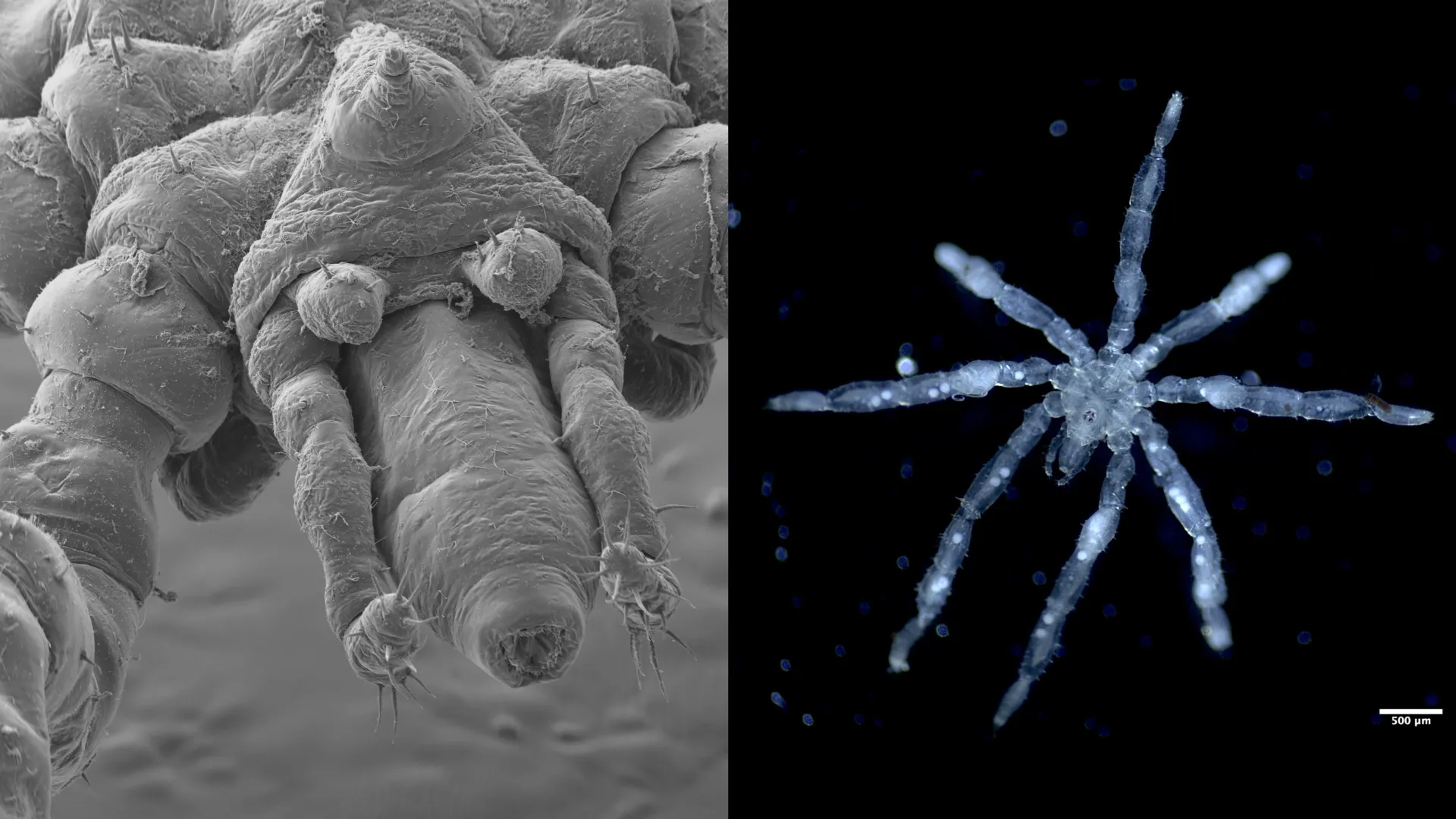
The first of the two, Callipallene pilosuspedes, derives its name from the Latin for "hairy feet." This designation describes the long, curved spines lining the lower segments of its legs. Beyond its hairy appearance, the specimen is defined by striking red eyes and a sophisticated, albeit unsettling, mouth apparatus. Its triangular mouth is composed of three distinct lips surrounded by sensory tendrils, which help the creature manipulate prey. Microscopic analysis revealed that this species possesses highly agile ovigers, which it uses not only to carry its young but also to groom its own body—a necessary act to prevent the buildup of debris and parasites.
The second species, Tanystylum kiixin, was named in honor of an ancient Indigenous village site located near the collection point. The name ‘kiixin’ (pronounced ‘kee-hin’) evokes the rhythmic sound of waves crashing against the shoreline. Unlike its hairy-legged counterpart, Tanystylum kiixin lacks the flexible, grooming-capable appendages of Callipallene pilosuspedes. Consequently, these individuals were frequently found covered in environmental debris and small, external parasites. This observation led the researchers to describe the animal’s existence as "an ecosystem within an ecosystem," where the spider serves as a host to an entire micro-community of organisms.
Methodology: Bridging Imaging and Genetics
The UBC study stands out for its rigorous methodology, which combined high-resolution physical observation with modern genetic sequencing. By generating DNA sequences for species that had previously lacked such data, the researchers have created a permanent digital record that will facilitate future identification efforts.
The production of an identification guide for Salish Sea sea spiders is expected to be a vital tool for local marine researchers. Currently, the identification of these creatures is often relegated to specialists; however, this guide aims to democratize the process, allowing for more widespread data collection.
Despite the success of the project, the researchers emphasize that their work has only scratched the surface. "I only had one field season, but there’s definitely more diversity out there that we haven’t documented," Toler-Scott noted. The vast, complex topography of the Salish Sea suggests that numerous other species remain hidden in plain sight, waiting for the right conditions—and the right investigators—to reveal them.
Implications for Ecosystem Conservation
The broader implications of this research extend to the management of Canada’s coastal resources. As climate change continues to increase sea surface temperatures and alter salinity levels in the Salish Sea, marine invertebrates serve as early warning signals. Because sea spiders occupy specific ecological niches—often acting as parasites or predators on other invertebrates—their population shifts can indicate wider systemic distress.
The financial support for this project, provided by the Natural Sciences and Engineering Research Council of Canada (NSERC), reflects a growing recognition of the need for foundational biological research. In a time of rapid environmental transition, the ability to monitor biodiversity is essential for effective policy-making.
The discovery of Callipallene pilosuspedes and Tanystylum kiixin serves as a poignant reminder that the Salish Sea is not merely a backdrop for human activity, but a complex, living laboratory. As scientists continue to unravel the biology of these "hairy-legged" residents, they are not only filling gaps in the taxonomic record but also gaining a deeper understanding of the resilience—and the fragility—of the marine environments we share.
The data gathered during this study has now been registered in global databases, ensuring that these new species are recognized by the international scientific community. While the researchers prepare for future field seasons, the public is left with a clearer, if slightly more "bizarre," image of what lies beneath the surface of the Salish Sea: a world of red-eyed, hairy-legged, and surprisingly complex creatures that have been there all along, silently enduring for millions of years.