On October 25, 1671, Italian-born astronomer Giovanni Domenico Cassini peered through his long, cumbersome telescope and recorded a sighting that would permanently alter our understanding of the Saturnian system. Operating at the Paris Observatory—where he served as the institution’s first director under the patronage of King Louis XIV—Cassini identified a faint, moving point of light orbiting the distant, ringed gas giant. This celestial body, later named Iapetus, marked only the second moon ever discovered around Saturn and the inaugural lunar find in a prolific career that would eventually yield three more major discoveries in the same system.
Cassini’s groundbreaking observation did not occur in a vacuum; it represented a golden era of telescopic astronomy. Just six years prior, in 1655, Dutch polymath Christiaan Huygens had discovered Titan, Saturn’s largest moon and the first natural satellite identified orbiting the planet. While Huygens utilized an innovative, highly polished air telescope to find Titan, Cassini relied on increasingly refined instruments to expand the known boundaries of Saturn’s immediate celestial neighborhood. Following his identification of Iapetus, Cassini went on to discover Rhea in 1672 and both Tethys and Dione in 1684. Together with Huygens’ single discovery, these four additions formed the bedrock of humanity’s knowledge of Saturn’s extensive family of moons for more than a century.
However, the initial excitement surrounding the discovery of Iapetus quickly gave way to a persistent astronomical mystery. Upon first spotting the moon as a tiny speck positioned to the west of Saturn, Cassini calculated its orbital period and anticipated observing it again on the eastern side of the planet roughly 39 days later. To his profound confusion, when the designated time arrived, Iapetus had completely vanished from view. It was only after the moon reappeared on the western side in its predictable orbital rhythm that Cassini deduced a brilliant, counterintuitive conclusion: Iapetus possessed a starkly bifurcated surface, featuring one hemisphere significantly darker than the other. When the dark hemisphere rotated toward Earth, the moon’s optical reflectivity, or albedo, dropped precipitously, rendering it virtually invisible to 17th-century optics.
The Chronology of Exploration: From 17th-Century Telescopes to NASA’s Cassini Orbiter
The peculiar optical properties of Iapetus remained an enduring enigma throughout the Enlightenment and well into the space age. Astronomers could measure its orbital mechanics with increasing precision, but the physical mechanisms behind its dramatic two-tone coloration eluded definitive explanation. Generations of scientists debated whether the dark material originated from internal volcanic outgassing or external accumulation.
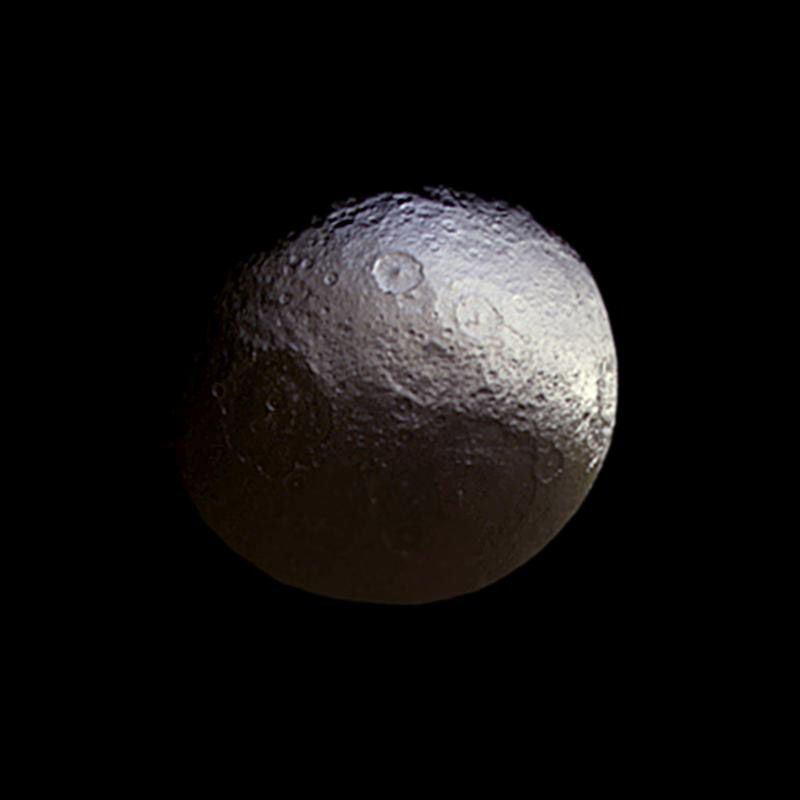
The definitive breakthrough arrived more than three centuries later, during the late 20th and early 21st centuries. In 1981, NASA’s Voyager 1 and Voyager 2 spacecraft swept past the Saturnian system, providing humanity with its first close-up imagery of Iapetus. The Voyager flybys confirmed that the moon’s leading hemisphere—the side facing forward in its orbit—was coated in a pitch-black material as dark as charcoal, while its trailing hemisphere was as bright as clean snow.
The true validation of Cassini’s 17th-century deductions, however, came with the arrival of the NASA/ESA/ASI Cassini-Huygens spacecraft in 2004. Named in honor of the astronomer who first mapped the Saturnian moons, the Cassini orbiter spent 13 years studying Saturn, its rings, and its satellites in unprecedented detail. During multiple targeted flybys of Iapetus, the spacecraft captured high-resolution, natural-color images that vividly displayed the moon’s striking resemblance to the traditional Chinese philosophical symbol, cementing its modern moniker: the "yin-yang moon." Furthermore, the Cassini mission solved the mystery of the dark material, determining that it is composed of dark dust swept up from Phoebe—a distant, retrograde outer moon of Saturn—and thermally driven ice migration across the surface of Iapetus itself.
Supporting Data and Orbital Mechanics
Analyzing the physical and dynamical characteristics of Iapetus reveals a world starkly different from any other in the solar system. Orbiting at a mean distance of approximately 3.56 million kilometers (2.21 million miles) from Saturn, Iapetus is classified as the planet’s third-largest moon and its outermost major satellite. Its distant orbit places it well outside the dense complex of inner moons and prominent ring systems, allowing it to preserve conditions and histories distinct from its closer neighbors.
| Parameter | Measurement / Detail |
|---|---|
| Discovery Date | October 25, 1671 |
| Discoverer | Giovanni Domenico Cassini |
| Mean Orbital Radius | ~3,560,820 kilometers |
| Orbital Period | ~79.33 Earth days |
| Mean Radius | ~734.5 kilometers |
| Surface Albedo Characteristics | Highly asymmetrical (leading hemisphere albedo ~0.03–0.05; trailing hemisphere albedo ~0.5–0.6) |
In addition to its contrasting coloration, Iapetus features a colossal equatorial ridge—a massive mountain range up to 20 kilometers (12 miles) high and 1,300 kilometers (800 miles) long that encircles nearly the entire equator of the moon. This geological feature gives Iapetus a distinct walnut-like appearance when viewed from certain angles, presenting planetary geologists with ongoing questions regarding the moon’s early thermal history, rotational deceleration, and past ring-formation events.
Broader Impact and Implications for Planetary Formation
The study of Iapetus, initiated by Giovanni Cassini’s meticulous observations in 1671 and expanded by modern robotic exploration, holds profound implications for our understanding of how planetary systems evolve. For decades, standard planetary formation theories assumed that major moons formed alongside their host planets in a uniform, synchronized accretion disk. However, modern computer simulations and data gathered by the Cassini spacecraft have challenged this paradigm.

Astrophysical researchers analyzing the dynamics of the Saturnian system have concluded that Saturn’s inner moons and its iconic ring system are remarkably young—potentially far younger than the dinosaur-free epochs of Earth’s history, having formed within the last 10 to 100 million years. According to leading evolutionary models, distant outer moons such as Titan and Iapetus possess ancient origins that predate this recent inner-system upheaval.
Scientific consensus suggests that Saturn likely hosted an earlier, different collection of mid-sized and inner moons. Over vast stretches of time, gravitational perturbations—specifically orbital resonances involving Saturn’s gravitational interaction with the sun—destabilized the orbits of these ancestral satellites. Eventually, neighboring orbital paths intersected, resulting in catastrophic high-speed collisions. The debris field generated by these ancient impacts ultimately re-accreted to form the modern ring system and the younger generation of inner moons, while ancient survivors like Iapetus and Titan weathered the dynamical storm in distant orbits.
As contemporary astronomers continue to analyze the archival data transmitted by the Cassini spacecraft prior to its intentional de-orbiting in September 2017, the legacy of Giovanni Cassini’s 1671 discovery endures. What began as a shifting speck of light in a primitive 17th-century eyepiece has evolved into a vital laboratory for understanding the violent, dynamic processes that shape worlds across our solar system.