The contemporary fashion landscape is frequently dominated by loud logos and exaggerated proportions, yet Koki Enomoto, the creative director of the Japanese label Attachment, has opted for a radically different trajectory with his latest collection. Titled "Lightly," the collection serves as a profound meditation on the relationship between the human form, the textiles it inhabits, and the invisible forces of the natural world. Presented in a stark, concrete warehouse in Tokyo, the show signaled a definitive shift away from the heavy, oversized silhouettes that have defined streetwear for the past decade, moving instead toward a refined, ethereal minimalism that prioritizes the kinetic movement of fabric.
The Genesis of Lightly: From Urban Observation to Sartorial Concept
The conceptual foundation of the "Lightly" collection was born from a moment of quiet observation in an urban environment. During a routine morning run earlier this year, Enomoto stopped near a highway overpass to rest. His attention was caught by a piece of discarded gray industrial netting caught on the structure, fluttering in the breeze. This mundane sight provided a spark of inspiration regarding the visualization of the unseen. Enomoto noted that while wind is inherently invisible, its presence and character are revealed through its interaction with physical matter.
In his subsequent showroom walkthrough, Enomoto explained that he felt he was witnessing something "invisible" made manifest. This observation led to a creative inquiry: could clothing serve as a medium to reveal the nuances of the environment and the wearer’s movement rather than simply acting as a static shell? This question became the guiding principle for the collection, influencing everything from the selection of ultra-lightweight textiles to the engineering of "shirt-blouson" hybrids that respond to the slightest air current.
Chronology and Development of the Attachment Brand Under Enomoto
To understand the significance of the "Lightly" collection, it is essential to view it within the broader timeline of the Attachment brand. Founded in 1999 by Kazuyuki Kumagai, Attachment quickly gained a reputation for its "discreet" approach to menswear, focusing on high-quality materials and sharp, slim tailoring. For over two decades, the brand remained a cornerstone of the Japanese "Ura-Harajuku" movement, bridging the gap between avant-garde design and everyday wearability.
Koki Enomoto’s tenure represents a new chapter for the label. Since taking the creative helm, Enomoto has maintained the brand’s DNA of functional minimalism while introducing a more fluid, experimental approach to fabrication. The "Lightly" collection, following the previous seasons’ focus on technical utility, marks a pivot toward a more poetic interpretation of masculinity. The development of this collection began in late 2023, with Enomoto spending months collaborating with Japanese textile mills to develop fabrics that possessed the necessary structural integrity despite their near-weightless properties.
Material Innovation and Technical Specifications
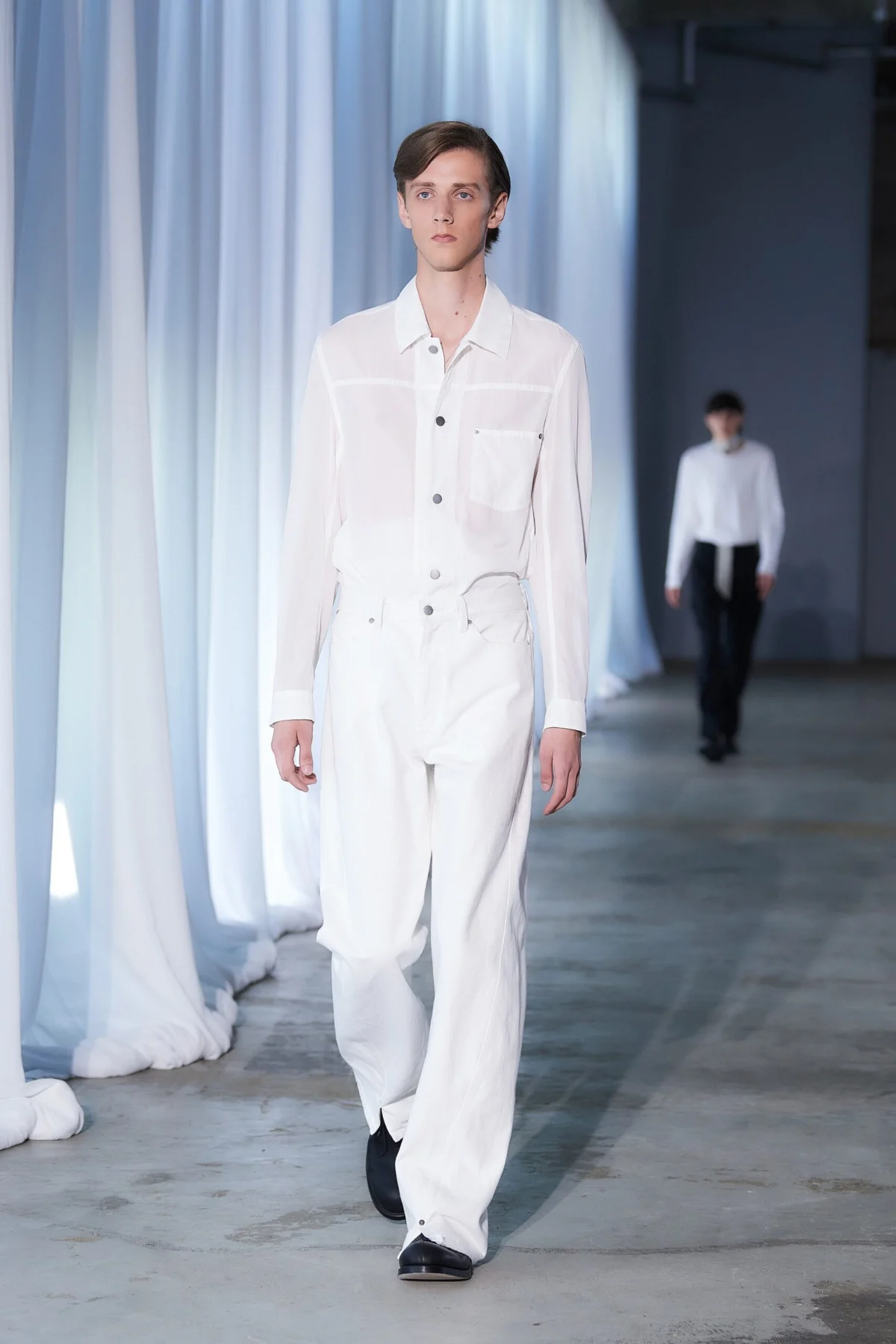
The hallmark of the "Lightly" collection is its sophisticated use of materials, specifically chosen for their ability to hold a "memory" of movement. Enomoto’s design process began not with sketches, but with the fabrics themselves. A key material featured throughout the collection is translucent cupra cotton. Cupra, a regenerated cellulose fiber derived from cotton linter, is known for its silk-like hand and breathability. By blending it with cotton in a translucent weave, Enomoto created trucker jackets and workwear staples that defy their traditional rugged associations.
The technical execution of the garments involved several innovative approaches:
- The Shirt-Blouson Hybrid: By merging the structural elements of a blouson (waistbands, cuffs, and zippers) with the lightweight drape of a high-count poplin shirt, Enomoto excised extraneous weight. These pieces are designed to function as outerwear in temperate climates while remaining thin enough to be layered under heavier coats.
- Slimmer Tailoring and "The Space Between": Enomoto addressed the industry-wide trend of oversized garments by intentionally slimming down his silhouettes. However, this was not a return to the restrictive "skinny" fits of the mid-2000s. Instead, the designer focused on the "Ma"—a Japanese concept referring to the negative space or the gap between the body and the fabric. By using drawstrings at the waist of easy cotton shirts, he allowed the wearer to define the garment’s structure dynamically.
- Ultra-Thin Leather Engineering: One of the most technically impressive feats in the collection was the introduction of leather blazers so thin they could be rolled up at the sleeves like a standard cotton shirt. This was achieved through a rigorous thinning process that maintained the leather’s tensile strength while removing the bulk typically associated with hide-based outerwear.
The Runway Presentation: A Study in Controlled Atmosphere
The presentation of "Lightly" was as minimalist as the clothes themselves. Held in a cavernous concrete warehouse, the setting emphasized the industrial roots of the brand while providing a neutral backdrop for the ethereal garments. The primary set piece was a single, sheer white curtain, illuminated from behind to create a soft, diffused glow. This choice of staging mirrored Enomoto’s original inspiration—the netting on the overpass—as the curtain swayed gently, visualising the airflow within the room.
Models moved through the space with a deliberate pace, allowing the audience to observe how the yellow silk hooded shirts billowed and how the translucent layers interacted with the light. The color palette remained largely monochromatic, with pops of pale yellow and muted earth tones, ensuring that the focus remained on the texture and the silhouette. This atmospheric consistency reinforced the collection’s theme of "barely-there" fashion, where the sensation of wearing the garment is as important as its visual impact.
Market Context and Industry Implications
The "Lightly" collection arrives at a pivotal moment in the global fashion industry. Market data from 2023 and early 2024 suggests a growing consumer fatigue with "heavy" fashion—both in terms of physical weight and visual complexity. The rise of "Quiet Luxury" and the "Clean Girl/Boy" aesthetic has paved the way for brands like Attachment to find a broader international audience.
According to recent retail reports, there is an increasing demand for "trans-seasonal" clothing—garments that can be worn across different climates and environments due to the unpredictability of global weather patterns. Enomoto’s use of cupra and ultra-thin leather directly addresses this market need. By reimagining the trucker jacket—a staple typically reserved for spring or autumn—in a translucent, breathable fabric, Attachment is catering to a demographic that values versatility and climate-adaptability.
Furthermore, the collection reflects a broader shift in Japanese menswear. While the previous decade was defined by a rugged, "workwear-meets-military" aesthetic, the new wave of Japanese designers is leaning into a softer, more fluid interpretation of the male form. Enomoto is at the forefront of this movement, proving that minimalism does not have to be cold or clinical; it can be emotive and responsive.
Reactions and Critical Analysis
Industry analysts and fashion critics have noted that Enomoto’s approach to "Lightly" successfully balances the commercial with the conceptual. While the idea of "invisible wind" might seem abstract, the resulting garments are eminently wearable. The decision to move away from oversized fits is also seen as a strategic move to differentiate Attachment from competitors who are still leaning heavily into the Balenciaga-inspired proportions of recent years.
"What Enomoto has achieved is a sense of sartorial liberation," noted one retail consultant present at the showroom. "He is offering the modern man a way to look fully dressed and sophisticated without the physical burden of traditional tailoring. It is a psychological lightness as much as a physical one."
The inferred reaction from the brand’s loyal customer base suggests a positive reception to the refined fit. Long-time followers of Attachment have often looked to the brand for its "stealth wealth" appeal—clothing that looks simple to the uninitiated but reveals its complexity through the quality of its construction and the uniqueness of its drape.
Future Outlook: The Evolution of "Lightly"
As Attachment prepares to ship the "Lightly" collection to international boutiques, the implications for the brand’s future are clear. Koki Enomoto has established himself as a designer who is not afraid to challenge the prevailing trends of the moment in favor of a more thoughtful, observation-based design process.
The success of "Lightly" likely signals a continued exploration of technical fabrics and human-centric design for Attachment. As the fashion industry continues to grapple with sustainability and the necessity of "less but better," Enomoto’s philosophy of removing the extraneous and focusing on the essential provides a viable roadmap for the future. By making the invisible visible—whether it be the wind, the space around the body, or the craftsmanship inherent in a simple seam—Attachment is carving out a unique space in the contemporary fashion narrative.
In conclusion, the "Lightly" collection is more than just a seasonal offering; it is a statement of intent. It asserts that fashion should not just be seen, but felt, and that the most powerful designs are often those that allow the wearer to feel as though they are "barely wearing anything at all," while remaining undeniably, elegantly dressed.